
Translated material
Is there any hope for the future?
On January 25, 2024, Doxa was recognized as an “unwanted organization”.
If you are in Russia or plan to return to it, you can not replace our materials on social networks, refer to them and publish quotes.
Read more about what is possible and impossible, read in the cards .
The political situation in Russia seems completely hopeless. Uncultural elections, tough censorship and propaganda of the war in the media, attempts to kill opposition and prison deadlines for an anti -war position. Against this background, even the smallest victories that allow you to save life or freedom (for example, the freedom of Ukrainian refugees that are in Russia) is a big event. But it’s not enough just to respond to increasing repressions, to laws that are increasingly limiting the freedom of Russians_ok. The Russian opposition lacks its vision of the future, its utopia.
Editor
Editor
Peter tIllustrator
Illustrator
Stasya BububuPublication
October 2, 2023
In one of the most famous texts about utopia - the “city of the Sun” Tommaso Campanella - a society without private property is described, in which all life is regulated by astrology. In the “utopia” of Thomas Mora , which gave the name of the very idea of an ideal society, a society without private property is also described. We can say that these are just bizarre fantasies of people divorced from reality. But the authors of both texts were not idle dreamers: Sir Thomas Mor, the author of “Utopia”, was the Lord Chancellor (actually the head of government) of England under Henry VIII and ended his life on a block after a conflict with the eager king. And Tommaso Campanella wrote his most famous work in prison, where he spent 27 years to try to raise an armed uprising against the Spanish government in his native Calabria and establish a regime similar to the Sun City. Both author turned to utopian ideas as a continuation of their political activity.
The tradition of using utopias in politics is also characteristic of more modern liberation movements. For example, the American suffrarinist Annie Denton Crege , who is considered the first author of feminist utopia, wrote a book with the ironic name “Rights of Men” in 1870. In the book, she describes nine dreams about alternative forms of gender order in society. In the first seven parts, we are talking about society on Mars, in which men are engaged in household work, and women have complete freedom in choosing a profession and life path. But the eighth dream is especially interesting, in which the author represents the nearby future, where a woman has been chosen by the president, half of both chambers of the Congress consists of women, and the burden of punishment for prostitution was transferred to a man who prostitutes her.
Today, the gender equality that the suffrazhist of the 19th century imagined is already difficult to call utopia - these are quite realized and not even very radical political requirements. Nevertheless, in 1870 they could find a place only on the pages of the utopian text.
Another example is the socialist movements of the XIX century, which largely grew out of the utopian ideas of Saint-Simon , Fourier and Robert Owen . Having passed the long political path, these ideas partly found their embodiment in the socialist revolutions of the 20th century. The utopian charge, which inspired socialist movements, allowed politicians from different countries to conduct radical political changes. Regardless of our assessment of the Soviet Union and the October Revolution, it must be admitted that the utopian image of the future allowed millions of people to represent a different world for the first time - without world wars and the oppressed position of the proletariat.
Utopic ideas have a particularly great potential for political mobilization in situations where conventional methods of political action are impossible: for example, participation in elections or peaceful demonstrations. Even before the start of a full -scale invasion of Ukraine, Russian society was subject to apathy and depolitization . With the beginning of hostilities, the possibilities of conducting public political activities were finally destroyed. If the system is not amenable to improvement, then the question arises of its complete breakdown and reconstruction.
The appeal to utopia looms in the political field for several years: the most characteristic example is the “beautiful Russia of the future” by Alexei Navalny . This cliche gained great popularity and quickly became part of the political language of Russian society. But what exactly does the beautiful Russia of the future look like, or at least what it is fighting with, remains unclear. This concept could serve as a foundation for building a full utopian project, however, unfortunately, this has not yet happened. The political platform of most Russian liberal opposition_k is reduced to bringing the Russian regime to “normality”, that is, to forms corresponding to Western liberal democracy: honest elections, an honest court, eradication of corruption. So, in his letter about the nineties, Navalny writes that one of the main political problems is the absence of an independent judiciary. This is a fair claim, but it is not enough.
There are fundamental problems that accompany Russia from the nineties. A huge income gap between the richest and most poor: according to Global Wealth Report , 1% of the richest Russians owed 58.6% of national wealth - in this indicator, Russia is in the first place in the world. Problems of relations of regions and metropolis. The gap in the standard of living between Moscow and other regions of the Russian Federation over time becomes only more obvious . Colonial policy in relation to both the republics within Russia and the former Soviet republics . The imperial war against Ukraine is a continuation of the war in Chechnya, Russia's intervention, including the military, into the domestic policy of the countries of the former USSR (support for the Lukashenko regime, the commissioning of troops into Kazakhstan in 2022, etc.), and cultural suppression of the national republics as part of the Federation.
The utopian policy, that is, the use of policies of the images of a utopian future as a political instrument, can answer the fundamental problems of Russian society. While the politicians ignore the issues of property gap, national oppression and superconditional of resources in the capital, it will be impossible to achieve radical political changes. The conversation about what a policy should be after Putin should start with a reaction to these problems, and not with the search for “more honest” politicians, which will replace the dictator and his team. It is obvious to me that it is not enough to remove Putin and United Russia, as Maxim Katz proposes , for example,. It is not enough to even stop the war with Ukraine and withdraw troops from the occupied territories (this, of course, is the first thing that should be done). It is necessary to change the system factors that have done all this possible.
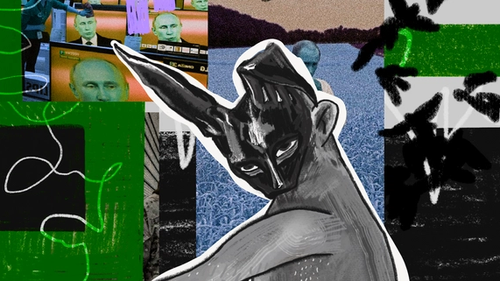
I believe that the utopian model for Russia should imply a transition to a much more egalitarian economy (for example, to democratic socialism), redistribution of income from the center to the periphery, honest federalism with a high level of autonomy of regions and republics and the right to exit them from the Federation. Large monopolies in the resource, banking and technological areas, which have served all these years a support for the oligarchic regime, should be nationalized. It is necessary to significantly expand the rights of trade unions, stimulate the creation of a cooperative economy and working self -government. To create an institution of political power of the working class - tips in which only people who have income below a certain level can be elected. This branch of power will work in parallel with the State Duma, have a legislative initiative and the right of a veto Such political mechanisms are promoted, for example, John McCormik, a professor of political sciences of Chicago University. .
It is not necessary to expect that the opposition politicians will sharply change their strategies and begin to put forward the more brave images of Russia of the future. You should be bolder. Utopia has always been a political weapon of oppressed social groups, which have nothing to lose. Therefore, let's try to imagine what we would like to see Russia. Ask the question: what systemic problems are there and how to change it so that they disappear? Think for yourself, ask friends and relatives - I am sure that many answers will be unexpected and courageous. Moreover, it may turn out that the usual oppositions - young people and people aged, “remaining” and “left” - will be irrelevant. The utopias that you offer can be unexpectedly similar, or, conversely, the difference in views may not be found where we expected to find her. Do not be afraid of your own political imagination, because in the surrounding reality there was nothing left that would be worthy of preservation. Do not hold on to what has failed, and then Russia of the future will really be beautiful.