
Translated material
Sid Meier's Postcolonial Theory
On January 25, 2024, Doxa was recognized as an “unwanted organization”.
If you are in Russia or plan to return to it, you can not replace our materials on social networks, refer to them and publish quotes.
Read more about what is possible and impossible, read in the cards .
The Russian authorities regularly try to take control of the video game industry in order to popularize “patriotic” ideas with its help. DOXA tells how games are manipulated by officials much more successful than officials - games.

Editor
Editor
Peter tIllustrator
Illustrator
Your soulPublication
July 19, 2022
“The State Duma was offered to create a computer game about the Russian Guard,” - this title could be seen in many media at the end of June. A month earlier, the state allocated 260 million rubles to create a game in the RPG genre about troubled times. And at the PMEF of ANO “Institute for the Development of the Internet” he presented a game on Slavic mythology “Tartaria”.
The Kremlin believes that through computer games you can (and should) broadcast important political narratives. So, on July 1, the head of one of the administrations of the President of the Russian Federation Tatyana Matveeva said that “due to the possibility of various semantic interpretation of certain historical, cultural, socio-economic events at the level of intra-game scenarios and mechanics, computer games are used as an tool for influencing users-the so-called soft power tool.”
Loyalist commentators have long adhered to this view of computer games. Already in 2013, due to the hype, raised by people like Evgeny Bazhenov or Dmitry Puchkov, the sales of the game Sompany of Heroes 2 were stopped, the story campaign of which allegedly broadcasts the unwanted image of the Red Army soldiers during the Second World War. And political scientists close to the presidential administration even publish academic articles about the Overton window, in which “methods of changing public consciousness are shown on the examples of computer games and Internet resources.”
A 2020 survey showed that video games are the most popular hobby of Russians who are fond of 40% of respondents. This means that games are important media with a huge and constantly growing audience. And if the idea that with their help it is really manipulated by public consciousness can be considered to be speculative with a great degree of confidence, it is difficult to deny the fact that the gaming design is largely socially determined.
The video games, as well as any other media, are affected by the control systems prevailing in society: capitalism and patriarchy. They largely determine how the games depict social institutions, gender roles, ethical representations of actors, and so on.
Nicholas Pallen from McGill University, working on the establishment of more fair and equal relations between settlers and indigenous peoples, calls computer games one of the few in the West spheres of exclusivity of white men. This can explain why any attempts to change the “canon”, often based on sexist, racist or xenophobic prerequisites, cause powerful resistance and accusations of following the “agenda”.
The desire to save computer games in their original form is quite characteristic of the right. For example, one of the first articles released in the Libertarian Mikhail Svetov Media was devoted to explaining that "how politics came to video games." In fact, as in any other media, the policy has always been in games - and this is best seen in the analysis of strategies like the Civilization series The cult strategy created by the Gamda Designer Sid Meier, the first part of which was released in 1991. , Total War Total War - a series of games developed by the Creative Assembly studio. Since the release of the first part of the series (Shogun: Total War) in 2000 it has become the main example of “global” strategies that combine the mode of step -by -step strategy and tactical battles in real time. or games from the studio Paradox Interactive A series of games of the Swedish company Paradox Interactive became cult thanks to a complex and detailed gameplay, due to which these strategies are often called the “state simulator”. The first game, Europa Universalis, was released in 2000. .
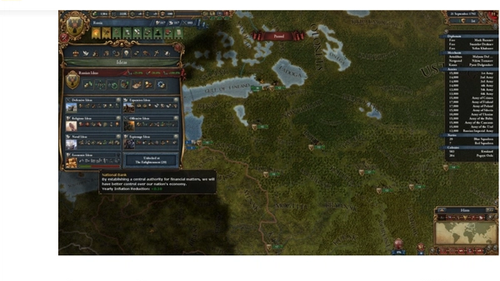
Screenshot of the article on the nationalist resource "Sputnik and Pogrom".
The representation of social institutions in games is often perceived as something granted and not requiring explanation-a sure sign that in reality we are talking about “sewn up” into the game of dominant ideas about the state, man and history. We will analyze some of them.

We talk about Russia's military invasion of Ukraine, protests and repression. We believe that now, when dozens of media have closed or ceased to cover the war, access to independent information is more important than ever.
Territory
“Study, expand, exploit, destroy”-you might think that this is the gloomy motto of the colonialists of the Victorian era, carried away by the ideas of the Social Darwinism, but in fact the most popular strategies genre is called. The formulation of 4x ( Explore, Expand, Exploit, Exterminate ) was proposed by the game designer Alan Emrich back in 1993 and most briefly characterizes the essence of the gameplay in such strategies.
As a rule, a player is invited to take some political community under their management and spend it through centuries or millennia. The key in this case is the intra -game space: it is proposed to study it in order to then establish control over the territory with important resources that can be pumped out. These resources are needed for the last component of the games of this type - the destruction of opponents.
In computer strategies, politics is closely related to space and control over it. For example, the usual condition for the victory in the Total War series - control over a certain number of provinces, in SimCity, we are constantly conquering more and more spaces for the city, and in the Civilization IV, the development of culture is necessary in order to conquer control over the territory already occupied by a neighbor, without spending resources for warfare. Control over the territory is the basis of gameplay in strategies, and such a view of the political process refers us to the optics of classical geopolitics.

In the social sciences of the concept of Ratzel or Hausherofer, in which the category of “Lebensraum” (“living space”) plays a key role, they have long been obsolete, and after the Second World War - discredited Nazis (Haushofer even gave lectures to Hitler). However, the gameplay of modern computer strategies, as Rolf Nor from the Braunschweig Arts University writes , is literally built on the ideas of geopolitics of the 1920-50s. He gives the following examples:
- Strategies, as a rule, greatly simplify the variety of forms of territorial measurement of policy. Victory in the game does not imply strategic submission of the enemy, but literally the liberation of the territory from him, which joins the player’s faction. In the Medieval 2 Total War there are relations of vassalite, but they are always a prologue to the final inclusion of a vassal in their fraction. The relations of the vassalite that appeared in the Civilization 4 Warlords also do not differ in diversity;
- An important factor in space is the resources that control over the victory: in Civilization, players seek to expand their territories as much as possible at the time of “modernity” in order to increase their chances of access to strategically important oil and uranium, which is necessary to create nuclear weapons;
- The concept of “living space” that is determining for gameplay becomes, according to which the expansion of the territory becomes selfless. In addition, the capture of the entire gaming card is the most common goal that players choose as “victorious”, in addition to the developers set. Fan groups and forums dedicated to the games of the Total WAR series and Paradox strategies are full of screenshots of game cards, fully occupied by the player’s faction. It is not surprising that on the right-wing twitter, supporting the foreign policy of Russia, you can stumble upon screenshots showing total expansion in Europa Universalis or Hearts of Iron.
In the dry remnant of the strategy, we are taught to believe that the seizure of new territories is one of the main tasks of the state and an indicator of its greatness.
The state and the empire
Territory control is provided by the national state - and this is another problematic component of strategies. For 6,000 years of the standard game cycle, the player has controlled an unchanged political community. The fractions presented in the games also ignore the dominant heterogeneity of communities. For example, the Greece faction for such games simply never existed: in Greece there were many ethnic and language groups with different political devices.
In fact, the player is always proposed to manage the National-STATE exclusively striving for world domination-and this is also a problem. Moreover, the state itself in strategies is almost always similar to a simplified model of the Hobbs Leviathan. The player is always the same sovereign, who was once transferred by the contract, and now it is impossible to revise the deal. Change of regime or “revolution” is a completely controlled process. Civil society as such does not exist, and the player only has to periodically specify the rebellious population with the construction of new theaters, hospitals and other social infrastructure.
A look at human communities as National States, which strive for world domination, is an attempt to universalize the experience of European colonial empires.
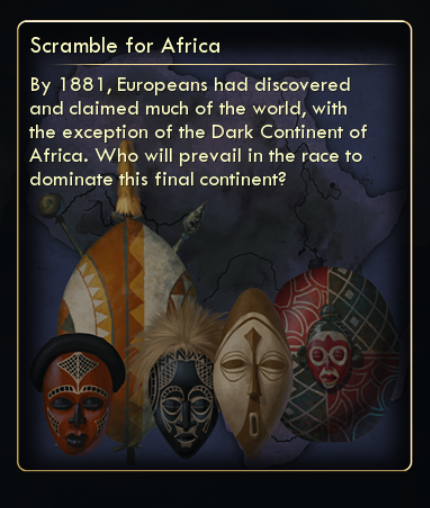
Description of the African campaign in the game Civilization v
The second part of Crusader Kings has a script in which the player is invited to capture and colonize Europe, playing the Aztec empire. You can try to find a decolonizing potential in this-the game makes it possible to "take revenge" by European colonialists over the centuries of colonialism.
However, in reality, this is not as good as it might seem. Despite the representation of various cultures in video games, the European desire for world domination remains universal for everyone. Such an optics fixes the idea that everyone is striving for world domination - just Europeans have succeeded in this struggle. “If we were not a colonial empire, we would be a colony,” - a favorite argument of the apologists of European colonialism.
Ultimately, as Nick Dayer-Viseford and Greg de Peouter notes, video games are a “paradigmatic means of spreading the empire” in the sense in which it is understood by hardt and blacks-like planetary, militarized hypercapitalism. Almost any strategy offers us an exclusively European view of the state, society and history, and in one of the most brutal versions that glorify the attitude to politics as a “big game”. And no matter how many developers add playable fractions of non -European peoples, all of them in one way or another will strive to repeat the path of France, Great Britain or Spain.
Civilization and barbarism
An important component of 4x strategies is the opposition of “civilization” and “barbarism”. From school history textbooks, we know that “barbarism” preceded “civilizations”, the concept of which coincides with the concept of “state”.
At the same time, modern researchers convincingly prove the opposite. So, for example, according to the point of view of James Scott, the author of the book “against grain”, “Many barbarians were not primitive peoples who, by their own or other people's will, turned out to be backward, but political and economic refugees who escaped to the periphery to get rid of the poverty, taxes, slavery and wars imposed by the state”.
In the strategies, barbarians are an aggressive, hostile and striving for destruction by default, which the player is always trying to suppress. It is quite terrible to ask yourself the question: what happens to the barbaric village when your troops go there in Civilization? After all, she forever disappears from the card.
The possibility of studying new technologies is also closed for barbarians. The development of fractions in strategies is depicted as a linear passage of the same stages for all stages: everyone should study the wheel in order to start livestock, and after several hundred moves to make a nuclear bomb. This consolidates the idea of “developed” and “backward” states, where the former “naturally” dominate the second, less successful. This is another contribution of strategies to consolidate the most brutal forms of colonialism.
In general, strategies teach us that all countries go the same way, just some have already succeeded in this, while others are not - and then this can be explained by the “national characteristics” that need to be level. Approximately in this logic, the IMF imposes a neoliberal model to developing states, which are proposed to implement the “best practices” of Western countries, which leads to prosperity. And if something does not work out on this path, then the problem is in the ineffectiveness of the government or the “backward” culture, but not in the unfair system of global neoliberalism-such a victimbleming on an interstate scale.
How not to build an empire
As a rule, strategies do not offer any picture of the future-one way or another, they should have the end point to which the player can “develop”. As a result, most often we see a slurred picture of the “best future”, to which the player faction hypothetically comes once after his victory. From Civilization, we will not recognize, for example, how humanity overcome the environmental crisis caused by the rapid development of our faction, because there is simply no such problem there.
What are the alternatives of the imperialist perspective of popular strategies? Firstly, even in the context of the existing gameplay, players find the possibilities of “hack” a sewn look in the game. For example, at the Medieval 2 Total War game forums, you can find the threads of players who, by making changes to the program code, make the players fraction of the gaming and describe how they destroyed all states on the map.
In addition, not only players, but also studios are looking for new ways of representing power relations. For example, in the Civilization created by the designers, Old World, a significant part of the gameplay is built around numerous family and family ties in the Middle Ages.
The fact that games are reproduced by the most brutal models of colonialism and imperialism does not mean that we need to stop playing them. But we can be more attentive to alternative projects that the game industry offers, usually small indie teams of developers.
An example is a series of games The Banner Saga from the Studio Stoic. This is an amazingly beautiful game, a significant part of the gameplay of which is due to the fact that you are caravan and should constantly make decisions about his life (for example, take random fellow travelers or not, because it may be robbers), while following the mood and number of food. When I read the “Anabasis” by Xenophon, I found that the experience of the ancient military leader was almost accurately played in Banner Saga, because the ancient army moved much more and was looking for a forage, which fought.
Returning to the beginning of this text, it is worth noting that the capabilities of the Russian state to impose any ideas through video games are very limited. Officials often perceive the games instrumentally: it is enough to give money and build a plot around the Time of Troubles, and not the Crusades, and the task of “patriotic education” will be completed. However, in modern computer games, much deeper ideas about society, the state and history are sewn, regardless of their setting. And playing different games, getting acquainted with indie projects, we can not only enjoy a variety of game experience, but also comprehend the social reality surrounding us.