
Translated material
How abortion was prohibited and allowed

On January 25, 2024, Doxa was recognized as an “unwanted organization”.
If you are in Russia or plan to return to it, you can not replace our materials on social networks, refer to them and publish quotes.
Read more about what is possible and impossible, read in the cards .
In July of this year, the Ministry of Health proposed limiting the sale of drugs for drug abortion and prohibit private clinics on an abortion. The history of Russia is rich in laws that limit the reproductive rights of women. If in the middle of the 17th century the death penalty threatened for abortion, then under Stalin for illegal termination of pregnancy, a woman had to pay a serious fine. One prohibitive measures unites one thing: they did not work.
We tell how Russian policy has changed about abortion and why each time it turned out to be ineffective.

Editor
Editor
Ivan RazgulovIllustrator
Illustrator
SandyPublication
October 24, 2023
Tsarist Russia
17th century - mid -19th century: death penalty
In tsarist Russia, abortions were prohibited. If until the middle of the 17th century the woman was threatened only by condemnation by the church, then after the adoption of the Council Code in 1649, the death penalty was provided for abortion.
1845–1903: from four to ten years of hard labor or links - a doctor: for, from four to six years old - a woman who had an abortion
The Code of Punishments of 1845 softened the punishment. The 1462nd article was guilty of abortion both on the pregnant women themselves and on conducting surgery. The latter was threatened by four to ten years of hard labor or a link to Siberia, and a woman who had an abortion was sent to prison or a link for a period of four to six years. The gestational age did not matter, there were no legal grounds for its interruption.
At the end of the 19th century, the Russian Empire was modernized: mobility of the population grew, cities developed, along with this, a request for individualism and autonomy of personality from the family grew. On the other hand, the country remained primarily agrarian, a patriarchal idea of the "natural" purpose and duty of a woman to become a mother remained. In his memoirs, publicist Alexander Goldenweiser leads the phrase of Leo Tolstoy, addressed to his wife Sofya after she complained about the hardships of motherhood:
A woman who is burdened and not wishing children, not a wife, but a bitch
Even at the beginning of the 20th century, the average woman in Russia gave birth to about seven children during her life. Against this background, for the first time in society, a large public discussion about abortion unfolded. Equally The movement of Russian feminists originated in the middle of the 19th century. The first equalities sought women's rights to education and work. , the first Russian feminists connected the subordinate position of a woman with motherhood: giving birth to seven to ten times per life, a woman simply could not fully join society. The right to free pregnancy planning, according to equalities, would give a woman this opportunity.
1903–1917: up to three years of imprisonment for abortion
In 1903, the punishment for abortion softened These are 465 and 466 articles of a new criminal Code, highly approved in 1903. But the authorities showed indecision: the Code did not enter into legal force entirely, but gradually, special decrees of individual chapters. Articles about abortion were never introduced. In fact, until the revolution itself, the norm of 1845 continued to operate. : The woman could be concluded for no more than three years, and the doctor: Yin - by six.
At the same time, many member: Ki of the Professional Community advocated the decriminalization of abortion. At the 12th Pirogovsky Congress Meetings doctor: Yin in the Russian Empire of the late XIX - early XX centuries. , which was held in 1913, the majority of the doctor: Yin admitted that the woman should have the right to legally terminate the pregnancy in the clinics intended for this.
Opini remained in the country: the decriminalization, who claimed that "the conceived woman concludes an agreement with the state, by virtue of which, even risking her life, to give the state a new citizen." This approach was criticized for not taking into account difficult life and economic conditions that brought women to abortion. So, the feminist and doctor Maria Pokrovskaya was indignant : “Our lawmakers think about the protection of the embryo, about the protection of life in the womb, but when the child was born, they are no longer interested in them.”
The criminal punishment for abortion did not eradicate them, but only pushed women to dangerous underground operations. So, in 1914, about 400 thousand abortions were carried out in Russia, while only 20 cases reached the trial. As noted by progressive doctors: neither at Pirogov congresses, the legislation did not work. Public changes were brewing.
Soviet Russia
1917–1930: from complete legalization to abortion "with reservations"
Back in 1913, at the 12th Pirogov Congress, the doctor P. Chukhnin noted : “ Now a rare woman is only a wife, mother and mistress, she is often a teacher, a midwife, a paramedic, a doctor, a seamstress, a cashier ...”
The ideals of the 1917 revolution confirmed this vision of a woman.
The new woman, according to the concept of revolutionary and feminist theoreticism Alexandra Kollontai, should not have been concluded within the walls of the house by the norms of “bourgeois morality” and had the right to show their career aspirations and sexuality along with a man.
In 1920, the RSFSR became the world's first country to fully legalize abortion. At the same time, the text of the relevant resolution of the People’s Commissariats of Health and Justice still contained a condemnation of artificial termination of pregnancy as evil, to which women were forced to resort due to economic difficulties.
It is necessary to demand the unconditional abolition of all the laws pursuing abortion or for the distribution of medical works on safety measures, Vladimir Lenin
The demand for abortion, which became legal and free, turned out to be huge. In 1924, special commissions were established to regulate the growing flow of those wishing to terminate the pregnancy for free. By 1926, 54 abortions were per 100 clans. The state, concerned about the increase in the number of abortion and a decrease in the birth rate, began to introduce restrictions. In 1926, abortions were ceased to be available for the first time as a pregnant and those who have already undergone the operation less than six months ago. In 1930, abortion became paid.
1936–1950: Criminalization of abortion and boom of underground operations
In 1936, abortions in the country were again criminalized. Opposi: Tws of artificial termination of pregnancy claimed: the socialist state under construction needs more new people. So, the prominent member of the Communist Party Aron Solz said : “Abortion is an evil heritage of the order when a person lived with narrow -minded interests, and not the life of the team. The Soviet woman is equalized in rights with a man. But <...> is not exempted from the great and honorary duty that her nature endowed with - she is a mother, she will give birth . And this, undoubtedly, is not only her personal business. ”
Resolution CEC Central Executive Committee and SNK The Council of People's Commissars of the USSR of June 27, 1936 banned abortion for non -medical reasons, and the list of medical indications limited the risk of hereditary diseases and the threat of a woman’s life. Pregnant women who had stopped the law at the first violation were “condemned”, and in the second they were supposed to pay a fine of up to 300 rubles. Doctors: no one could get a term of one year to two years.
The ban contributed only to the short -term growth of the birth rate in 1937. The number of abortions also decreased only in the first two years. Then it began to grow inexorably: in 1940, 807 thousand abortions were recorded in the country-239 thousand more than in 1937.
Unable to legally terminate the pregnancy, women resorted to illegal methods - there were 90% of the total number of procedures of such non -navigable abortions. These operations were carried out unprofessional For example, instruments for the study and expansion of tubular organs (ureters, esophagus and others), as well as using poisons and seeds of plants. And they were life -threatening: by 1940 more than 2000 deaths from criminal abortions were registered - this is 51% of all cases of maternal mortality recorded then.
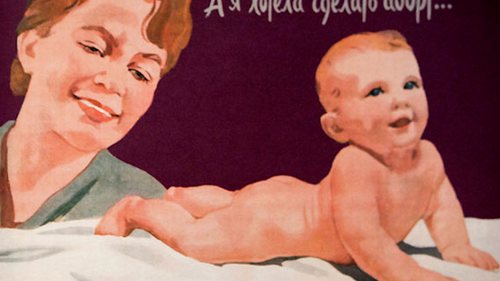
Soviet agitlakat, 1961
In the war years, the ban on termination of pregnancy continued to operate and was still ineffective: in 1944, more than 30 abortions were per 100 pregnancies. July 8, 1944 Presidium The Supreme Soviet of the USSR issued a decree "On an increase in state assistance to pregnant women, many children and single mothers." He introduced into the law the category of “single mothers” (they should have been provided with state support) and at the same time freed men from responsibility for children born out of marriage. But this attempt to increase the birth rate in the conditions of a lack of men failed: the number of births in the country did not reach pre -war indicators. The new law worsened the situation of women: not afraid of responsibility, men threw pregnant companions, and the benefits for single mothers were low.
Therefore, women continued to interrupt unwanted pregnancies: in 1950 they registered more than a million abortions, most of which were all -offs. Abortion in the USSR has become the main means of family planning. Doctors: neither associate this with the poor quality of contraceptive and lack of sex education in the country. Soviet condoms were often torn and uncomfortable, one and a half times thicker than modern ones, and oral contraceptives came to the USSR only in the early 1970s. As a result, women resorted to unreliable, dangerous and emergency methods of protection: they agreed to interrupted sexual intercourse, douching with a solution of citric acid or urine, lifted severity and lay for hours in hot baths.
It is impossible to turn a woman into a creature that should give birth and give birth - Maria Kovrigina, the Ministry of Health of the USSR
1950–1990: legal, but condemnedly
In 1951, the USSR expanded the list of medical indications, according to which the pregnancy could be terminated, and on November 23, 1955, abortion was completely legalized again. The criminalization of termination of pregnancy did not lead to the desired goals: the birth rate did not increase, and underground abortions continued to prosper. An important role in legalization was played by the minister of healthcare of the USSR Maria Kovrigina. She consistently advocated the lifting of the ban on abortion in numerous commissions. In her memoirs, she wrote : "The ban on the production of abortion, as it were, humiliated the personality of the woman herself, put under control the intimate side of her life, not to mention the fact that a great many women paid for health and even life itself."
At the same time, the decree that legalized abortion contained the intention to continue to reduce the number of abortions through “encouraging motherhood” and “explanatory measures”, and legalization was accompanied by anti -red propaganda.
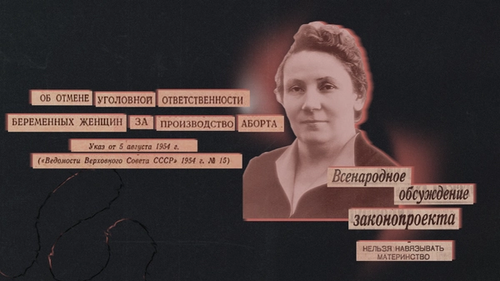
The commission of abortion, although it became legal, was not simple for women. Firstly, until the 1990s, abortions in the USSR were carried out almost without anesthesia. Secondly, the data on the operation was entered into the employee’s medical card, and in the case of a working day pass, an abortion certificate had to be attributed to the authorities, who often looked at this with condemnation. The lack of anonymity and fear of public censure pushed Soviet women to search for bypass ways: someone agreed with the doctor for money: in vinosy operations, someone continued to resort to all-in-law procedures. In one of the numbers of a popular magazine for women, the “employee” for 1977 complained about the inability to terminate the pregnancy without the knowledge of third parties: “We protect the secret of the most trifling correspondence ... and immediately openly, close -up and large circulation, we record the personal secrets of the woman.” In the 1980s, the share of criminal abortion among all operations was 37%. At the same time, 67% of women underground the first pregnancy underground-due to the fear of condemnation and ignorance of contraceptive means.
So far, in the West in the 1980s, oral contraceptives were gaining popularity, which allowed a woman to plan a pregnancy on her own, they were treated in wary-not least due to state propaganda. So, back in 1974, the Ministry of Health warned Soviet citizens about supposedly terrible, up to death, consequences of COC receiving Combined oral contraceptives . As a result, the drugs were in pharmacies, but the women did not use them, and the doctors almost did not prescribe them. The couples continued to plan the family with unreliable ways: in the 1980s, Muscovites called the most effective method of contraception interrupted sexual intercourse.
Post -Soviet Russia
1991–2023: legal abortion amid a return to traditional values
If, before the late Soviet period, gender relations and sexuality in the USSR were almost completely regulated by the state, then in the 1990s they are able to influence the media, religious organizations and international programs. The reproductive services market arises, private clinics and a variety of contraceptive means appear. On the one hand, as Gender researcher Anna Temkina notes in the book “ The Sexy Life of a Woman ”, liberalization gave women more choice. On the other hand, after privatization, it was women who became the main victims of unemployment. Their ousting from the career sphere and the collapse of the Soviet ideal of a “working woman”, working for the benefit of socialism along with a man, opened the way to alternative definitions of “female destiny”, in particular conservative and traditional gender roles. In this phenomenon, gender researchers, such as Anastasia Posadskaya and Olga Voronina, saw the “Renaissance Patriarchate”: women are forced to abandon career heights not only because of the “glass ceiling”, but also because of fear not to correspond to the traditional ideal of the woman realized in motherhood.
In 2009, Dmitry Medvedev signed a law on restriction of abortion advertising, and in 2012 the Law on Silence Week entered into force in Russia. According to it, if a woman contacted the clinic to terminate pregnancy for up to 11 weeks, she can be aborted no earlier than seven days after contacting. In a term of 11 to 12 weeks, a woman is given "48 hours of silence." At this time, the “pre -analysis counseling” is taking place: the pregnant woman is sent to the psychologist: it, who forms in her “the consciousness of the need to bear pregnancy”. Women are discouraged from abortion and doctors: nor - by a special memo of the Ministry of Health. It says that
Pregnant women need to make it clear that the embryo is a person, not a clot of blood
The Ministry of Health considers the practice of “dissuading” effective: according to it, thanks to it, 140 thousand women managed to dissuade it from abortion in three years. These data, as “important stories” found out , can be falsified. If you believe the statistics of the Ministry of Health, it turns out that 17 thousand more women refused abortion than they initially turned to medical facilities. To falsifications, the doctor: Yin can be encouraged by the “successful” pre -analysis counseling of cash prizes: in 2020, Vladimir Putin instructed “to strengthen the financial interest of medical organizations in the results of the work on the prevention of abortion”.

We talk about Russia's military invasion of Ukraine, protests and repression. We believe that now, when dozens of media have closed or ceased to cover the war, access to independent information is more important than ever.
A decrease in the number of abortion is one of the main demographic goals of the Russian state. In 2021, the government ordered the increase in the number of abortions to 50% by 2025. At the same time, the case is not limited to “complementary counseling”. In July of this year, the Ministry of Health proposed limiting the sale of drugs for drug abortion and prohibit private clinics on an abortion. In August, Mordovia became the first Russian region, where they introduced a penalty for “declining” to terminate pregnancy: from five to ten thousand rubles for citizens: OK (including relatives: Pregnant CC) and from 100 to 200 thousand for organizations. A similar bill prohibiting “persuasion [on abortion], proposals, bribery, deceit and other requirements” regarding a pregnant woman, the governor of the Tambov region recently submitted to consideration.
Expert: Ki evaluate the possibility of a complete ban on abortion in Russia as unlikely. At the same time, in some regions, for example, in Tatarstan, private clinics are already ceasing to provide this service.
The ban on abortion in private can lead to the fact that women either do not have time to have an abortion at all, or they will be forced to agree to a surgical operation instead of a less invasive drug method. Also, the inability to make an abortion in a non -state clinic will increase the load on budgetary institutions, which they may not be ready for. Plus, an appeal to the state clinics involves a mandatory consultation of a psychologist and a long bureaucracy, which is critical at certain periods of pregnancy.

Organizer: “We understand that now we have problems with demography, but this difficulty not to overcome the ban on abortion. Those women who will not be able to cripple themselves or kill with the help of an underground abortion will find a way to get rid of an undesirable child. ”
The action of the Chelyabinsk feminists on August 5, 2023
Finally, the restriction of the right to abortion will not lead to the results desired for the authorities. The history of state control over the birth rate shows: criminalization does not lead to an improvement in demographic indicators, but to an increase in the number of underground abortions, and with them - maternal mortality.