
Translated material
Two years, nine days
What happened to us in February
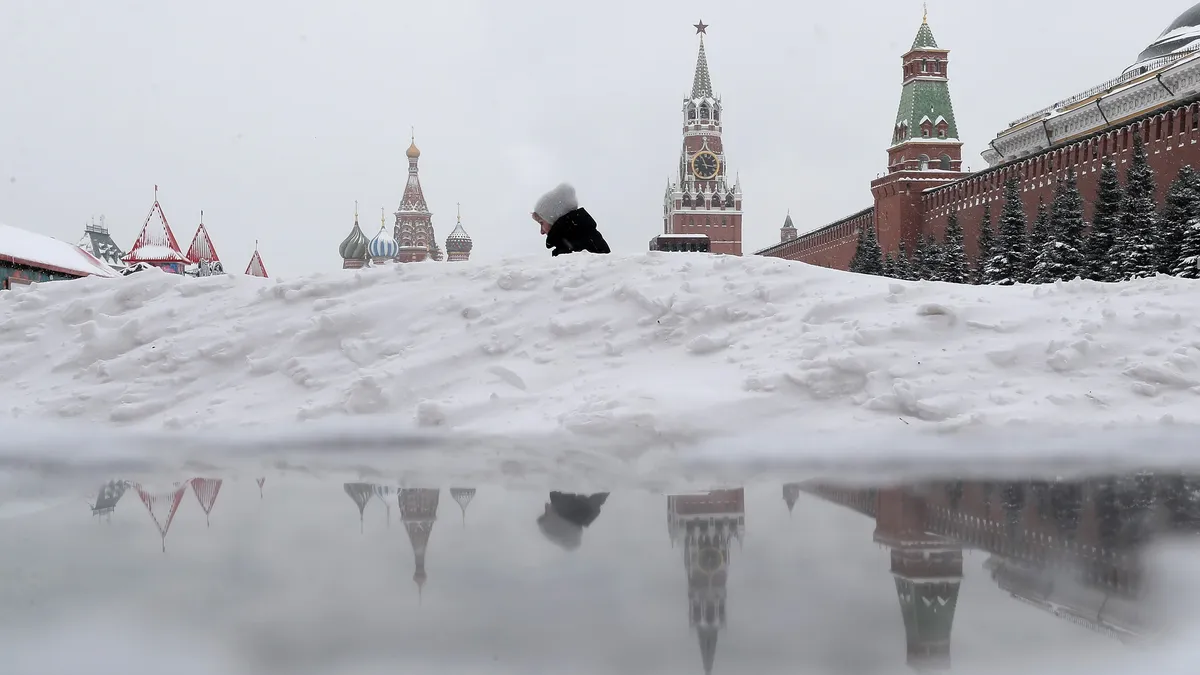
Moscow, Russia, February 2024. Photo: EPA-EFE/Maxim Shipenkov
Two years ago, the Russian Federation attacked Ukraine. We gathered in the editorial office to make a newspaper’s cover - as I thought, the last number of “New” - where three words were printed on a black background: “Russia bombing Ukraine”. The text that opened this number ended with the words: "The war is unleashed in a few hours by one person, the path to the world will become a test for each of us." At that moment on the morning of February 24, the Russian authorities have not yet come up with their own, and it was possible to speak in Moscow as it is.
The war brought innocent people to innocent people - primarily Ukrainians, but also residents of border Russian regions. I write this text, returning to the editorial office from Saraev, where on the facades of high -rise buildings facing the Serbian part of the city, still thirty years later, traces of bullets are visible, and people never forget about the worried misfortune. After the high -precision war of Putin, high -rise buildings do not remain at all, only scorched land, grief and hatred of many generations forward. As a scenery - architects of the fashionable Moscow bureau who are engaged in the construction of pedestrian zones and bicycle paths at the massacres of people.
The war irreversibly changed each of us, regardless of what personal choice a particular person made.
Here the professor-philosopher discusses the ethics of unmanned weapons, refers to his pre-war academic publications and boasts: unlike Western theorists, his students have no ethical doubts about using drones against Ukrainians, only you need to collect more money on drones and hit it properly. Such a philosophical ethics of war, says the professor. Here is the correspondent of Novy-Europe in Ukraine travels from Kyiv to the hospital to his seriously wounded son, the defender of the country, and the soldier of the Armed Forces. The editors should always protect its employees and their family. What should we do with the fact that the families of my colleagues kill the army of the country whose citizen I am?
Here are hundreds of new political prisoners whose guilt consists in the fact that from childhood they knew that war was an impossible crime, and did not change their childhood. Here are investigators and jailers who threaten Alexei Navalny’s mother to bury her son in an unknown grave, hollowed out of a polar circle, so that their lord and owner would be calmer. And the publication of Olesya Gerasimenko in the “layout”, in which the Russian military talk about the punishments they practice at the front: naked men are sent to the pit and forced to copulate.
The war made all this possible, and a new bloody moral has risen over Russia, reminiscent of the main temple of the Armed Forces of the Russian Federation. If something is useful for the war, then this is justified; If something interferes with the war, an obstacle should be eliminated. Human dignity is the first in the list of liquidation; My acquaintance professor of philosophy, perhaps, would personally shoot dignity in the head.
Two weeks ago, the main feeling of my colleagues and those with whom we spoke for our materials was fatigue. Then, nine days ago, they killed Navalny. The murder opens the way to terror against our loved ones that remained in Russia, and indeed against everyone.
This is Putin’s plan: to destroy people as cities on the path of their historical jokes, to prepare a new section of Europe and accompanying torture.
It turns out that those who could not keep silent two years ago cannot be tired now. The philosopher Marta Nyssbaum has a study on political emotions: about how feelings unite or, on the contrary, split people and society. A high wave of rage and despair has risen against the dictatorship and war-the ultimate human emotions, which are not too decent to demonstrate in a society built on polite defaults and a horses. Rage will lead to a radicalization of a political underground. Despair will indicate that many people have nothing more to lose - their family is not safe, their relatives have no future.
Those who will fight against the Supreme Combator, who grows up the grave for people in Ukraine and in the Russian Arctic, should be prudent and protect yourself. Remember that this struggle will be long.
In Harry Potter, the New Testament and in the history of the Second World War, the hero’s death ultimately leads to the crushing of evil. Nobody guaranteed us such an outcome. This opinion is unpopular - I tested several interlocutors. But, in my opinion, even if we are reliably known that at the end of our life, Putin is daces Kankan on the nameless graves of all who wanted peace and freedom for Russia, this does not change anything. Kant, who was called by the villain, the little -known governor of Kaliningrad Alikhanov, would approve this contributive rule: to speak out against evil should not be calculated on the award, but because you will cease to be free otherwise.
So we must do what depends on us so that the evil is stopped. The minimum task: not to participate in war crimes and the promotion of war, and then-who can.
Thanks to everyone who opposed the war, risking losing life, freedom, house or homeland.
And special thanks to my colleagues in the New Evrop: over these two years they managed to protect what they believe in and not give up.
We will still shake, as the classic said.