
Translated material
Shame Movement
On January 25, 2024, Doxa was recognized as an “unwanted organization”.
If you are in Russia or plan to return to it, you can not replace our materials on social networks, refer to them and publish quotes.
Read more about what is possible and impossible, read in the cards .
On March 10, two hours after at the plenary meeting of the Georgian Parliament, deputies voted against foreign agents in the second reading, I went to the Shame Movement office - a large Georgian non -profit organization, which extends for the European path of Georgia. It was they who called on people to take to the streets, and largely the victory of the people in a fight with the ruling party "Georgian Dream" on March 7–8 - their merit.
The spacious room is flooded with the sun, a view of Tbilisi opens from the office terrace. I am greeted by the Dachi Ideadze - in Shame he is engaged in campaigns, and although in recent days he combined a tremendous amount of work with the participation of rallies, looks cheerful and infects with his smile.
Editor
Editor
Ivan GeorgievIllustrator
Illustrator
SandyPublication
March 24, 2023
How it all began
Among the founders of Shame were Shota Digmelashvili, editor -in -chief of the Governance Monitoring Center Anti -Corruption Monitoring Organization and the Forbes Georgia editor, a journalist for Mtavari TV channel Nodar Rukhadze and the former head of the Ministry of Justice of Georgia, Georgy Mzhavadze. Most of the team met each other through Facebook, and on the eve of the elections they made the first campaign aimed at achieving pluralism in parliament and supporting parties that were not previously represented in it. To launch the first campaigns in July 2019, they released a merchant with a woman who was closed with her mouth, and another woman with a bandage in the eye (a reference to the use of rubber bullets by the police).
In subsequent years, the organization conducted campaigns calling for economic, anti -corruption and electoral reforms, attracting more and more attention and supporters. In 2020, the movement united with other opposition forces to support the parliamentary elections of a single national movement - the largest opposition party, the former leader of which - Mikhail Saakashvili - has been in prison since returning to the country in October 2021.
“This gas affects the respiratory system so that in the first two minutes you think you will die.” Protests against the bill on "foreign agents"
Rallies against the bill began long before they became massive. And although a week before voting in the first reading this topic was already central to the media, the cottage says that the parliament had about a hundred people with it.
According to the document published on the website of the Georgian Parliament, the bill on “foreign influence agents” was involved in the creation of a register of non -governmental organizations and the media, the share of foreign financing of which is more than 20%. Evasion of registration in the register would threaten an administrative fine of up to 25 thousand Lari (about $ 9.6 thousand). The foreigner would also be supposed to report on income and fill out annual declarations, however, the NGOs and the media should submit such documents.
The criteria for the appropriation of the legal entity of the status of a foreign agent are the following:
- if it directly or indirectly received funds from “foreign force”;
- If it directly or indirectly received funds from the subject, which, in turn, received funds from “foreign power”;
- If the source of financing is not identified.
In this case, the foreign sender may be not only an organization or fund, but also an individual.

We talk about Russia's military invasion of Ukraine, protests and repression. We believe that now, when dozens of media have closed or ceased to cover the war, access to independent information is more important than ever.
The bill was put forward by the small party “The Power of the People”, founded in 2022 and consisting of immigrants from the “Georgian Dream”. According to the opposition , the party has no political independence and is designed to voice the most radical anti -Western ideas. At the same time, the head of the Georgian Dream, Irakli Kobahidze, stated that his political power and faction “Power of the people” does not have significant disagreements in matters of values, but there are only “tactical disagreements”.
The leaders of the “Forces of the people” believe that the bill “will help put the end of polarization in society and ensure the protection of state interests”, and also insist that it adopts European and American initiatives.
The US State Department said that this bill was actually “based on similar to Russian and Hungarian, and not on Fara Foreign Agents Registration Act, the US Law of 1938, requiring individuals and legal entities representing the interests of foreign states in “political or quasi -political quality”, disclose information about their actions, relations and foreign government and finance. According to the amendment of 1966, in order to introduce the alleged “ino -agent” to the Fara base, it should be proved that he was engaged in political activities “by order, request, under the leadership or control of a foreign leader”. Or any other American law. ” Critics of the bill emphasized that in Russia a similar law became an instrument of repressions against NGOs and the media and this initiative - a new round in the ongoing pressure of the “Georgian Dream” for independent journalism.
So, in 2019, due to personnel permutations on the country's main television channels, almost all of them became controlled by the state. The departed employees created two new television channels: Mtavari and Formula. Two years later, against almost all founders, directors and producers of opposition television channels , criminal cases were either opened, or they began to constantly call them to the prosecutor's office for many hours of interrogations as witnesses.
“[Law] will be used to discredit civilian organizations and activists, as well as to create a legal framework for monitoring civil society organizations,” said Professor of Georgian State University, Elijah, David Afrasidze.
On February 28, 63 Georgian media said that if the law on foreign agents adopted, his requirements will not comply with his requirements, since registration as a “agent of foreign influence” “insults professional dignity”.
Many Georgian media and non -governmental organizations exist on grants of European and American funds, and Shame among them. For example, in 2021, the movement received a grant of $ 64,123 from the National Fund of Democracy (an organization financed by the US Congress) for the Get Out The Vote campaign and the involvement of young people in the vote in the municipal elections. Among the other SHAME trustees, according to Impadaz, there were a European Fund for Democracy , George Soros Foundation Open Society Georgia Foundation and the Helsinki Human Rights Fund .
In case of adoption, the bill could be used not only against the pro -European opposition, but also against the media and NGOs funded from Russia. Then the “agent of foreign influence”, probably, could have been recognized by the ultra-right channel of Alt-Info, whose leaders were accused of financing by Russian special services, as well as Sputnik Georgia and other Russian media broadcasting in Georgia.
March 7, voting day under the bill in the first reading, began calmly. The parliament building had neither a microphone nor a scene. People gathered in anticipation of the results.
The US Embassy in Georgia called this "a black day for Georgian democracy." Also, tens of thousands of Georgians, who went to parliament, also perceived it. The police massively used tear gas, wateringles and rubber bullets. Moments of Rustaveli Avenue, over which puffs of smoke rose, looked like the apocalypse; The protesters did not have time to rinse their eyes, as tear gas was launched again.
According to the “present time”, on March 8, at the anti -government rally gathered up to forty thousand demonstrators. The next day, the bill was failed by the parliamentary majority. During the meeting, the chairman of the Georgian Dream, Irakli Kobahidze, thanked those who voted for the adoption of the “Law on Transparency of Foreign Infant” in the first reading, and called the “foreign agents” of the organization that “demanded the resignation of the government from the stage” do not respect the church, engage in “LGBT propaganda” and “provocations on the borders”.
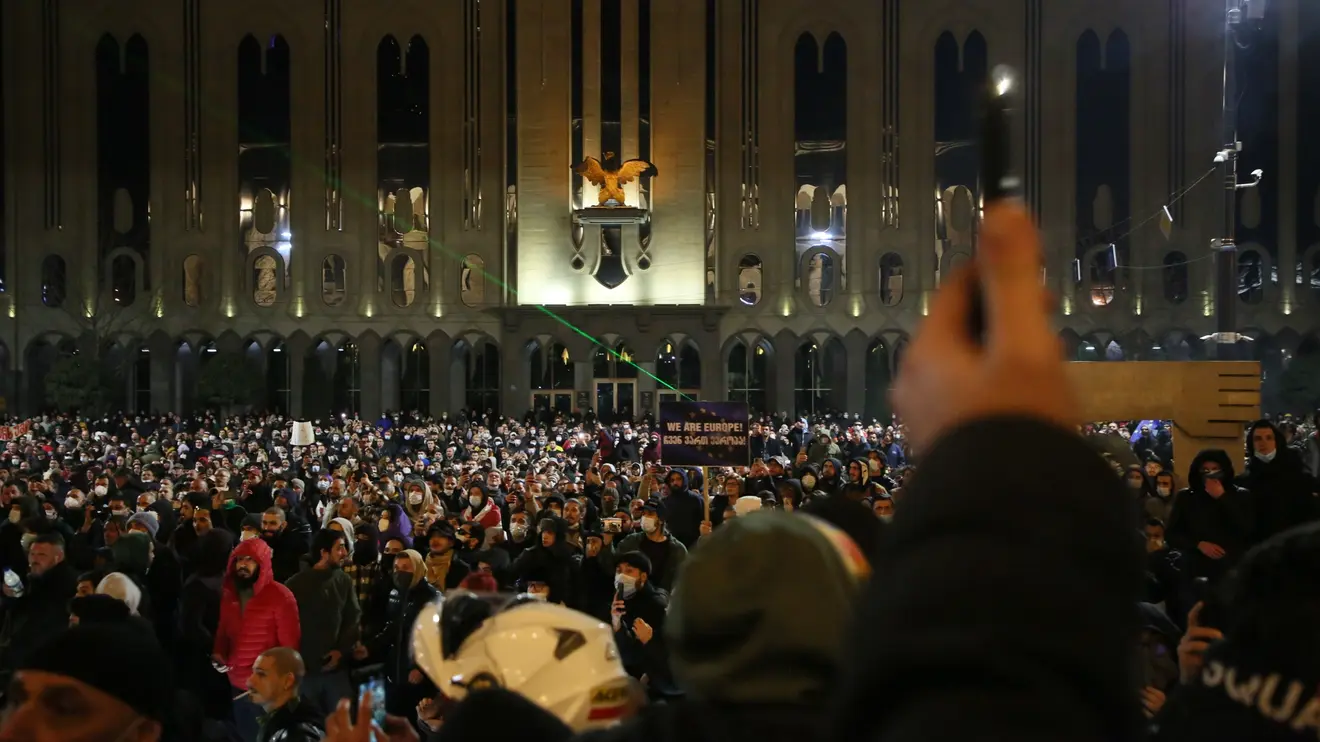
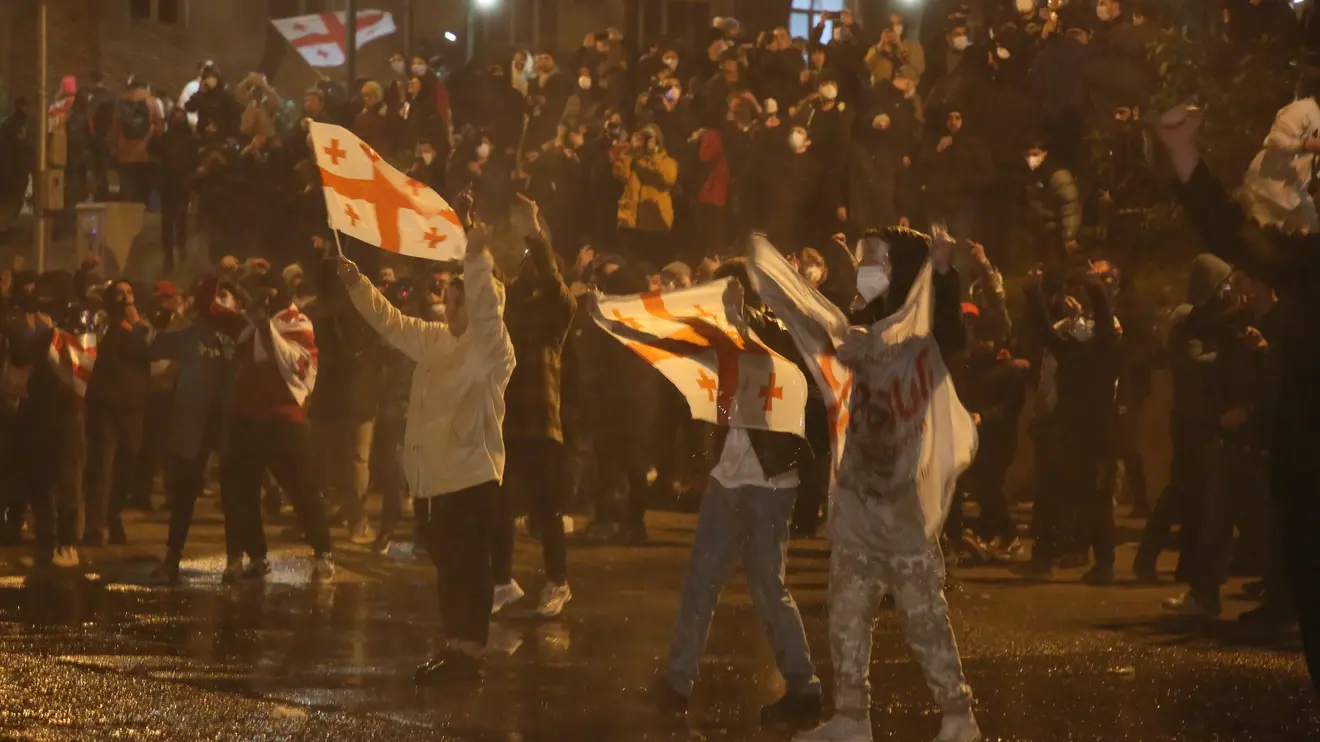
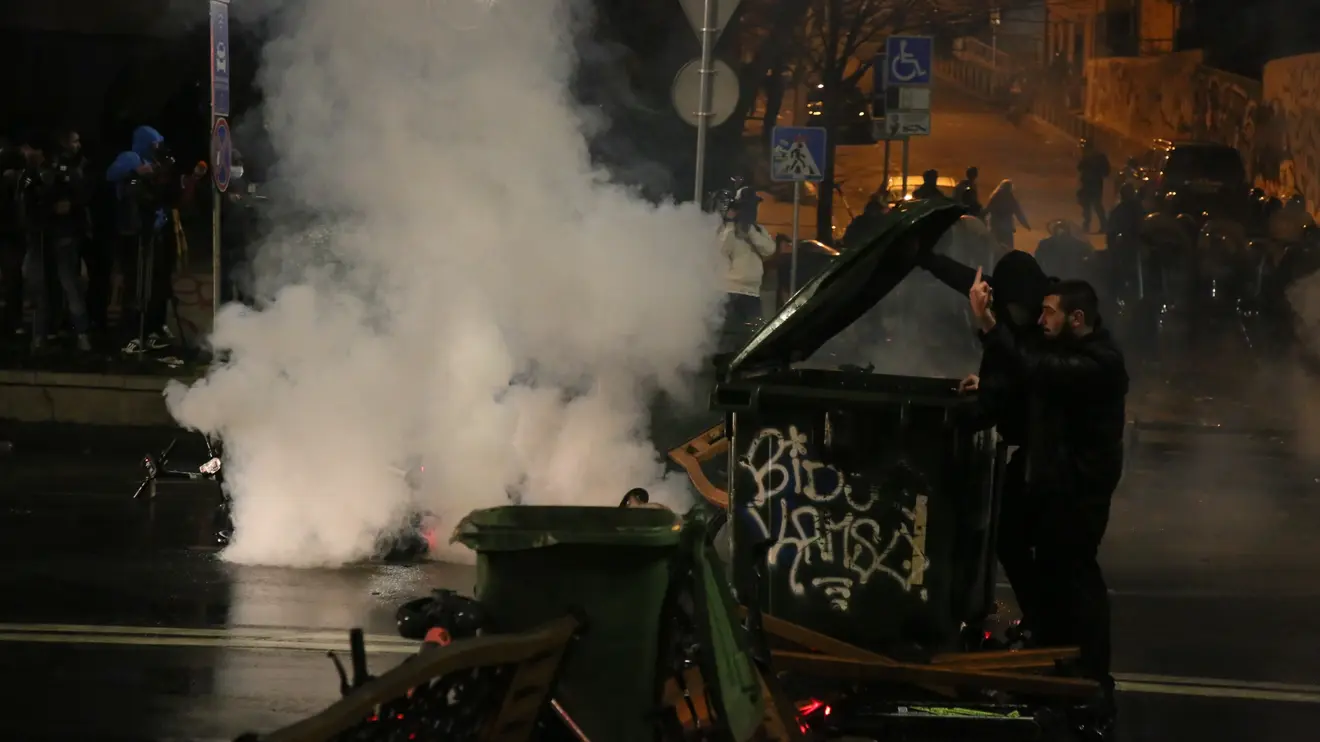
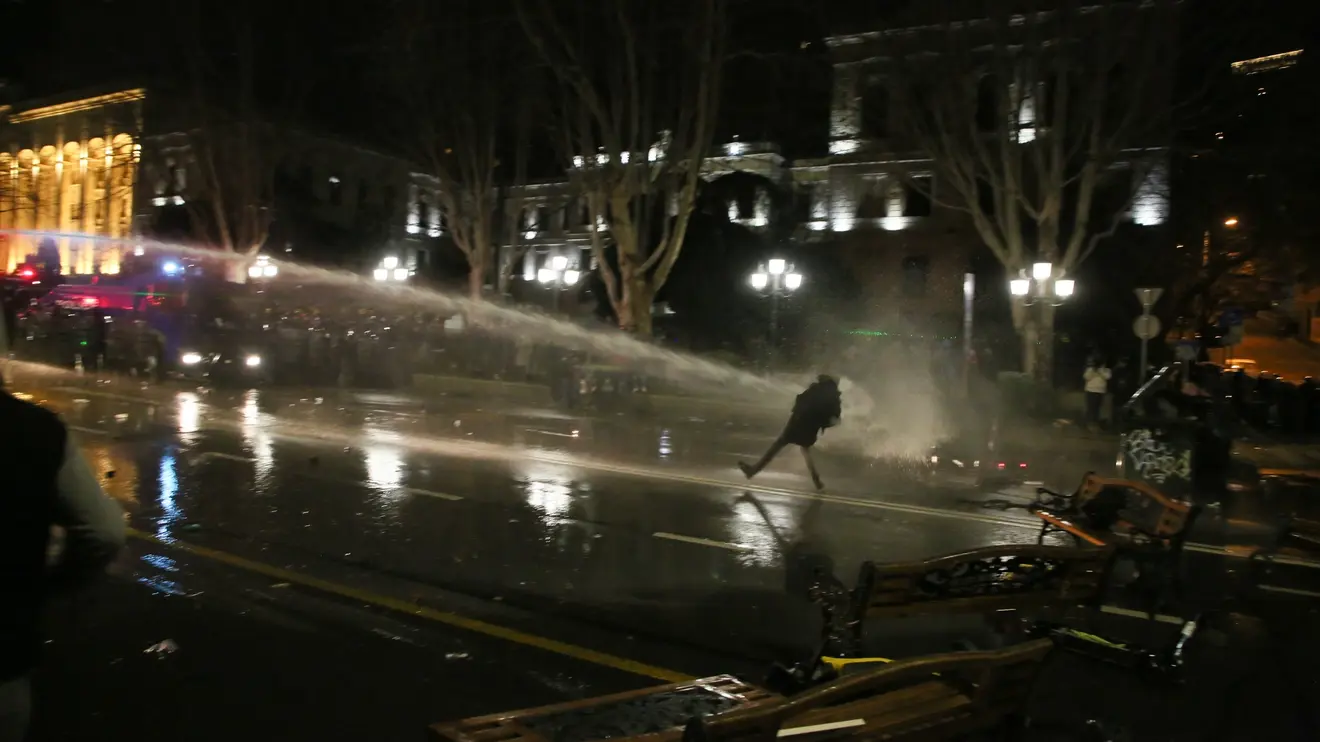
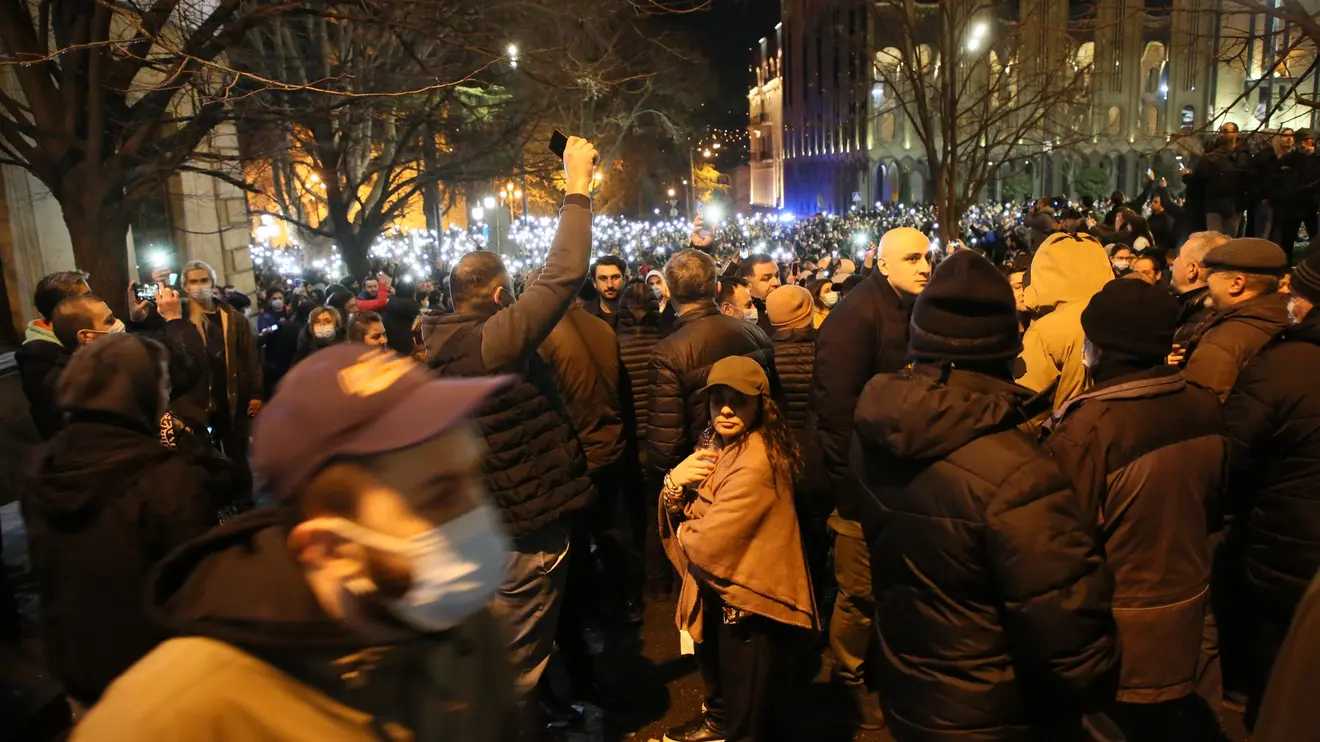
Protests in Tbilisi on March 7
Dacha, even if he considers it a little victory, is sure that the battle is not over:
“They are not pro-Russian, not pro-European, non-grim, they are Pro-Themselves.” What does the Georgian Dream want?
Since the acquisition of independence in 1991, and especially after Mikhail Saakashvili came to power, Georgia actively strengthened relations with the West. In 2006, Saakashvili expressed the desire of Georgia to join the EU. However, the Russian invasion of Georgia in 2008 undermined relations with Russia, and slowed down the process of joining the European Union. The Georgian Dream, which came to power shortly after the start of the conflict, did not stop relations with Europe. According to the joint letter of the President of Georgia, Salome Zurabishvili and the President of the European Council, Charles Michel from 2021, the EU remains one of the largest donors in Georgia with more than 200 specific current projects in the field of economic support of the country after pandemia and the development of the environment for future growth, whose total budget is about 500 million euros, and the European Investment Bank invested about 1.85 billion euros in economic Development, agriculture, education and infrastructure of Georgia. At a time when the Georgian economy is developing with difficulty, all parties, including the ruling and pro -Russian, agree in an effort to enter the international market and attract investment in the country that European integration contributes.
However, the “Georgian Dream” is often called the pro -Russian party. Georgia did not make any sharp statements regarding the war in Ukraine, and in 2022 the turnover between Georgia and Russia increased by 49%. Nevertheless, one of the demonstrators with whom I spoke on a rally on March 7 said that “they [“ Georgian dream ”] are not pro-Russian, not pro-European, not vigrian, they are Pro-Themselves.” Cottage believes that these positions do not contradict each other.
“When I say that they are pro -Russian, I do not mean that Putin calls Ivanishvili and indicates what to do tomorrow. It’s just that the Kremlin’s interests very often coincide with the interests of Ivanishvili. ”
We are talking about Bidzin Ivanishvili-the richest man in Georgia, the former Prime Minister and creator of the Georgian Dream. Formally, Ivanishvili left the Georgian policy in 2021, but the opposition is sure that he was still coordinating the actions of the ruling party.
On June 23, 2022, the European Union countries recognized Ukraine and Moldova, but not Georgia, candidates for joining the EU. Tbilisi received a list of 12 criteria for further advancement along the path of European integration. One of the most important points is the deoligarchization of the country. Obviously, this does not make European integration attractive both for Ivanishvili and his “Georgian dream”, only in words, but not actually declaring the desire for Europe.
The decision of the European Commission to grant Georgia the status of a candidate for the EU will be announced in December 2023. Dacha believes that the Georgian Dream fulfilled points that do not affect their power, but Georgia will not be able to get the status of a candidate. Now Shame is sure that their main task is to explain why Georgia is necessary for this status. But it seems that everything may not go according to plan.
“In general, there is a consensus on the issue of joining Europe and NATO.” How poisoned by the Georgian society?
The political course of Georgia is determined primarily by the European and Russian ways, since various groups of Georgian society and the state are interested in them, including the government, opposition, civil society, business and ethnic minorities. Some consider the European path as a way of modernization and development in the field of human rights, others see in it a threat to traditional values and relations with Russia in the field of security. Since the beginning of the Russian invasion of Ukraine, the Georgian Dream has been actively operating by preventing Russia to discover the second front in Georgia, while, according to the party leaders , the opposition and its financing West are pushing Georgia to unleash a new conflict. Supporters of the ruling party consider the Russian path as a way to restore economic and cultural ties with the nearest neighbor and the largest geopolitical player in the region, while the opposition sees in it the betrayal of independence and territorial integrity of Georgia.
On July 5, 2021, Tbilisi was supposed to take a “march of advantages”, organized by Tbilisi Pride with the support of Shame Movement and other NGOs. But instead of the march, there was a pogrom. On that day, the police did not take to the streets of the city, and aggressively configured homophobic groups made reprisals against journalists illuminating the events. 53 people were injured . The radicals also broke into the Shame office and defeated it, and in the entrance they beat the operator Lexo Lashkarava. A few days later he died. Then people who are configured against the LGBT community actively brought to the streets the ultra-right ALT-Info media platform already mentioned.
On March 14, after the shares against the bill on foreign agents, the party “Conservative Movement”, the founders of which are Alt-Info leaders, gathered their own rally. Its participants burned the flag of the European Union, which is a violation of Georgian legislation, and also defeated several windows with stones. The police at that time was inactive.
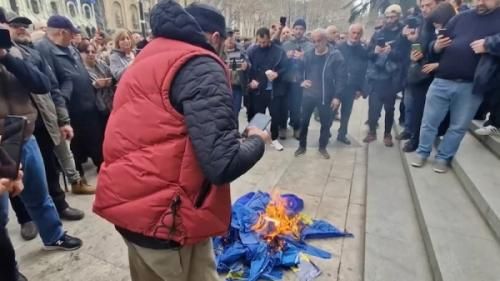
Activists burn the flag of the European Union
There is a feeling that Georgian society is polarized, that not only power, but also citizens trusting it, resist the European integration of Georgia. However, the cottages do not think so:
Cottage believes that people who want Georgia " be a member of the Eurasian Economic Union, CIS or other pro -Russian coalitions, less than 6–7% ."