
Translated material
Fish and capitalism
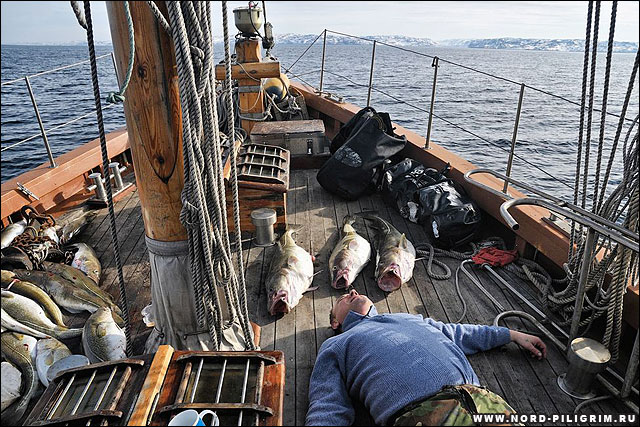
In Russia's entry into the WTO there is not only economic, but also “regional” and social dimensions. The Institute of Regional Problems (IRP), using the example of an analysis of the state of the fisheries complex and coastal territories of Russia, estimated the risks of Russia's accession to the WTO for the fishing industry and the coastal regions.
During the study of open and closed sources available to experts of the institute, about 30 current documents were analyzed - concepts, reports, projects and strategies, more than 40 representatives of federal and regional ministries and departments, industry unions and associations, fishing and fishing companies, industry experts and journalists of specialized media were interviewed. The survey data were reduced to the analytical report of the IRP “Development of fisheries complexes of the coastal regions of Russia: problems and prospects”.
According to the director of the Institute of Regional Problems Dmitry Zhuravlev, “Russia's entry into the WTO will affect many spheres of our lives, fishing and fish processing are no exception. As a goal of research, we tried to find out what awaits this most important sphere of economics in the new conditions. It must be understood that the fish industry is the core of the economy of a number of subjects of the Federation, including such regions as St. Petersburg, the Leningrad Region, Primorsky Territory, Kamchatka, Sakhalin, Kaliningrad, Murmansk and Arkhangelsk regions , ”Zhuravlev notes.
According to the authors of the report, not only economic, but also social, but, ultimately, the political situation, depends on the state of affairs in these regions. Especially given the fact that today food security is the most important factor in stability. The conclusions of the report confirm the words of Russian President Vladimir Putin voiced this week, that "serious tests are waiting for the Russian economy at the first stage of membership in the WTO , and it will not be possible to achieve positive results immediately." At the same time, the authors of the study appeal in numbers: within five years (until 2017), import duties for fish products will be reduced - from the current 10% to 3%. And this is more than a serious challenge for the industry.
Most importantly, experts note that today in the absence of special analytical structures, in principle, it is difficult to assess the scale of risks. “We have been joining the WTO for 18 years and still do not know what to defend ourselves from, we have no appropriate expert centers,” says one of the participants in the survey. The protection methodology has not been developed, which Vladimir Putin also spoke about the other day. According to the authors of the report, the main protection could be the criteria for regulation and veterinary and sanitary measures: “We must have specialists and equipment for examinations. At the moment, we have no laboratories, equipment, nor scientific personnel who understand how to do this. ” Another risk is the scale of business of foreign competitors. “The capitalization of Russian fishing enterprises is strongly lagging behind world companies,” the report says.