
Translated material
49 conversation: Conversation eight
The end of the past and the beginning of this year was held under the sign of discussion of Russian education. They argued about the Orthodox traditions of education, about eternal ethical values, about the new educational standard.
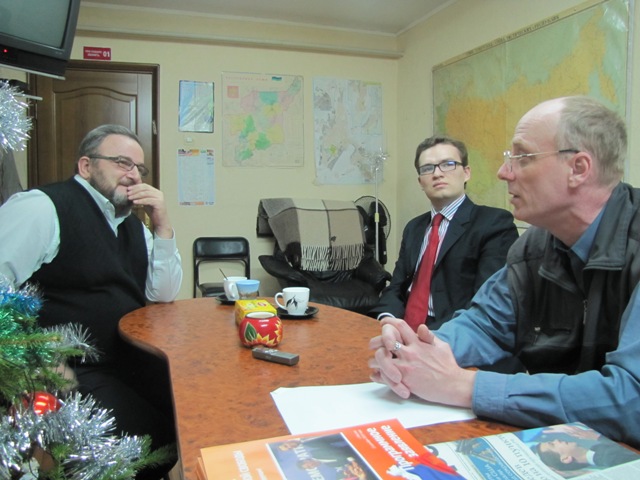
Naturally, these topics could not but interest our bloggers. The eighth conversation was attended by writer Grigory Speescak, culturologist Oleg Chub and journalist Oleg Kublitsky.
Oleg Kublitsky (O.K.): - The theme of the conversation asked by itself - only the lazy does not say about education and education now. Everything here: spiritual education, which is almost certainly associated with the Orthodox, and in connection with the idea of introducing a new educational standard, in which it is upbringing, and not education, this issue is given to the forefront, this issue acquires special significance. Who will be our graduate students? Somewhere in the comments of the Internet, I read that the graduate will be fast, jumping, will be able to quickly assemble and disassemble the machine gun and will strive to get to the army ... Naturally, it will be very much loved ... maybe so it is necessary? Today, the school, in principle, is rejected from education: “We give knowledge. And then - parents "...
Grigory Stychak (G.S.): - No, no, no ... a second ... The school admits that it gives a system of values? The volume of knowledge?
OK: - The volume of knowledge - yes.
G.: - So, we admit that every school and every person (and personality, of course, is among teachers), one way or another transmit their system of values. Even if not in the amount of knowledge, but at the emotional level, its attitude to one or another phenomena is still transmitted.
Everywhere where the value system develops, a reaction system is formed to these values in a child, which means that education occurs.
OK: - Naturally, it cannot be denied that everything is brought up in one way or another: if a student sees an obscene cleaner, he also gains a certain experience. But then there can be no reason for any purposeful state education, education as discipline and there is no talk ...
G.S.: - This is another question. Then let's emphasize the question in this way: the school has lost the function of targeted education.
OK: - Plato also believed that the main and only task of the state is to educate citizens ... So now the state, it seems, has taken up the fulfillment of this task. The new educational standard involves in high school not so much training as education.
G.S.: - And in high school - is it too late?
OK: - Late. And as far as I agree that it is necessary to educate at school, I just do not agree with how it is done. It is necessary to start with the elementary grades, and just they would have to unload the curricula.
G.S.: - The personality is practically formed up to twelve years, then we must think about it first. Of course, the education of a person occurs to the coffin, but the matrix, some basic reflexes, the basic reactions of a person to fundamental values are laid in childhood itself.
OK: - This is where the question arises: where to get them, fundamental values? And what is it?
Oleg Chub (O.Ch.): - It seems to me that here it is necessary to determine some, already current trends today. There are not even trends, but a trend that can be completely identified. These are two directions that have been actively pedalized recently. Here I have one document so as not to be unfounded. On February 3, the order of the Russian government was published last year, approved the concept of the federal system of preparation of citizens for military service. It says black and white here that high school students become objects of military-patriotic education ...
OK: - By the way, the moment that personally really bothers me very much: why do we have a patriotic education of the military?
G.S.: - True. Moreover: I have already raised this topic. At one time, even under Spiridonov, on round tables I asked the question: why do we have patriotism - this is “militarians”? Why is it necessary in this vein? But the Afghans, veterans of local wars took part there, and they agreed with me.
In Helsinki, one of the central streets is named after the famous local brewer. He was not a patriot? Why do we not have streets named after librarians or teachers? Why do we have either a street, then a marshal, then Hero of the Soviet Union? This is the Militari - the problem is really. It seems to me that this is a reflection of the Patriotic War: we have celebrated the victory for too long. It was Brezhnev, because until the sixty-fifth year there was no veteran movement. And for the first time noisily noted the victory in 1965. Then the "trench truth" of the writers of Bykov, Bondarev, it went to the people, reached the people. But on this topic they were too actively speculated for twenty to thirty years. They parasitized, played. In the end, why did no one ever raise the question of honoring the heroes of the First World War? They were still alive thirty years ago. Did they defend another country?
The second point: where is Bakuleva Street, for example? Yes, in the end, the postman, who worked for forty years in some rural branch, for forty years wore letters through the blizzard and snowstorms, is it not worthy to name the street in his honor?
OK: - So we have no Sorokin streets ... or the Jacob school. What can we say about teachers and postmen.
G.: - So, returning to the topic: And the Afghans agree with me and believe that a military theme is an overkill, that patriotism does not have to be khaki. But the flywheel continues to work ...
OK: - So after all, there is nothing else!
G.S.: - And who is it, should offer? Power, or what? It won't. Only civil society. It should be our initiative. So ask the question: how do the reward departments of the "Yellow House" work? Where do the papers come from, who decides: we will give it, but we will not give it? This is a completely opaque mechanism. And in my opinion, public organizations must have the right to nominate people for awarding. Now, in the name of Mikhail Rogachev it is time to call the street right during his life!
OK: - We have no civil society yet. There is just a society. Does it offer some values on which can be based?
GS: - Question ... I can not answer ...
OK: - So! The state, maybe it would have gone to meet ...
O.Ch.: - You see, the fact is that if the state goes towards, any idea will be simply buried. Here is an example I can give. Every year from around the world, students of Academician Amonashvili gather in Moscow. In my opinion, this is the last living classic of pedagogy after Sukhomlinsky. People themselves come, with their own money, they themselves organize all this. There was a time when the Minister of Education. Mr. Filippov supported this initiative. He recommended these methods, achievements, the ontology of humane pedagogy for use in schools. An active opposition from the regulatory authorities began, from the part of the Protestant churches ... They began to look for underwater trends in the system, began to say that the teaching was connected with the Roerich Center, occultism, and so on ... that is, as soon as the state begins to maintain one or another idea, everything turns into a collapse ...
G.S.: - Here, it seems to me that the problem is not even in the state, but in the fact that it (and society with this according to) arranges certain monsters centers. Why are all these readings in the singular and in Moscow? Why are there not fifty?
OK: - Because for the report.
G.S.: - Absolutely. A fund is created for the "laundering of dough", that's all. The same is Skolkovo. I recently read in the journal that if there were fifty centers, this would be modernization. And here everything is turned into a flag that is good to wave to remind: we have it.
O.Ch.: - Well, I think, everything cannot be reduced to the wash of the money, but the problem is serious. There is no, as you said, a civil matrix. Yes, these people themselves gathered and will gather, will develop these wonderful humanistic ideas. Only in this way can the desired matrix can find-only from below, by creating some private techniques, and not hoping in any case to the state.
OK: - But so far the society has not developed, the state, as it seems to me, has already realized that it was impossible to let the issue of education on its own. It was frightened that no one was engaged in the education of the younger generation and decided to do it. But-in its own way.
O.Ch.: - What will this lead to? That's what it seems to me, it is interesting to discuss.
G.S.: - wonderful. We have now touched on the topic that was already raised on the 7x7 website - in the material where my mother refused to put her son to a special anti -nation. Then the topic will sound like this: today parents “hand over” their children. On incomprehensible methods, on incomprehensible education, on incomprehensible chaos.
OK: - and at the same time have no opportunity to influence these methods ...
G.S.: - And they do not want! That's the horror! Why not come to school and not ask: but, in fact, why do you stick to my child a Kalashnikov assault rifle? And why do you have an hour on Khalkhin-Gol, and for the whole world-two? Who decided that? I assure you that out of thousands of parents, two questions will ask such questions. That's what monstrous!
OK: - Familiar. My daughter tells that in the kindergarten they march to the table. But if I protest, I know that none of the groups of the group will support me - I am already with them in conflict. Because the main installation of the majority is in any way not to spoil relations with educators and the leadership of the kindergarten ...
G.S.: - That's it. I think the degree of influence of parents on the formation of these matrices is still negligible. And it should be different.
OK: - But a lot is being done to limit this influence. So, again, from the words of my daughter, I found out that they were taken to church. I ask: “What did you do there”? “Baptized,” replies. Shows somehow. Well, let's say. I have nothing against Orthodoxy as such. And if I was an atheist? Or a Muslim family? But no one thought to ask parents to ask - it is supposed, a priori that everything is “for”. Despite, by the way, to the law prohibiting the entry of young people in religious practice. And the visit to the service is what? They were not just told in the kindergarten about the church.
O.Ch.: - And here, in continuation of this topic. I am now reading to psychologists, and these are adults, adversities, cultural course. These are mostly over thirty people, most are women. Well, the question arises about the church:
- How? Go to church "?
“Yes,” they say, “we go.”
“What are you doing there”?
- We pray, the priest gave us a broch.
I ask them:
- And in what century did the Lord preached?
- In the seventh ...
- And the ancient Judea whose colony was?
- We don't know, American, probably ...
These are people who quite seriously consider themselves churching.
G.S.: - I, speaking in a pedagogical institute, before a giant audience, said that education, in fact, is from the word "image". Because the school was born at the church in the image and likeness of God. So the grave silence was ...
OK: - Well, when I taught the Law of God, I got into the opinion that the Holy Trinity is when in the corner of the icon of Christ, Nicholas the Wonderworker and the Mother of God ... and at the same time, the widespread of Orthodoxy, it is it that is imposed on us as the only faithful paradigm of education.
G.S.: - I do not know where such information comes from. After all, St. John of Kronstadt said that the spiritual sphere, of course, was much wider than the sphere exclusively Orthodoxy. Of course, I understand what you mean - these pushing into the school of the Law of God, the foundations of Orthodox culture. But I think that most parents and teachers understand that spirituality is wider.
OK: - But do not tell me! Against the backdrop of our modern interethnic clashes, they unobtrusively inspire us that Islam, for example, is not just far from spirituality - that it is almost demom ... People shy away from Muslims, like from a plague ...
GS: - By the way, a strange thing: everyone understands that anti -Semitism is bad. And anti -Islamism? It blossomed with us with magnificent color ... Especially when they carry outright nonsense about Islam. I was lucky - the Lord gave me the opportunity to get acquainted with wise and deep Muslims. I am all friends - both Orthodox and Muslims that our holy and righteous Siluan Athos on Mount Athos prayed to death for everyone, including Buddhists. Maybe that's why he is a saint?
O.Ch.: - There is a very interesting thought of the philosopher Grigory Solomonovich Paranets, which I constantly bring to the audience: the depth of each great religion is much closer to the depth of the other than to its own surface.
G.S.: - Definitely! When you begin to plunge into the depths of Islam, the fewer questions ...
O.Ch.: - So how would this idea translate this idea into school practice?
OK: - And is it necessary? Is a religious component needed in school education and education?
GS: - I don't know. Not ready to say right away. I don’t know ... In any case, one cannot strive to do it obsessively.
OK: - True, you can not return to the lessons passed. It should be borne in mind that today's society is different than the one in which we grew. We mainly relied on book knowledge, we considered ourselves the most reading country. Now everything has changed. In the information world, young people are leaving books, they do not read them, and, probably, this is even normal - there are a lot of other ways to obtain information.
G.S.: Exactly. After all, when we say a “school”, we seem to mean something, hundreds of years ago that has arisen and at all changed. In fact, the Internet has long turned over the world, and, of course, the school and everything that is connected with it. And a long time ago, the parables in the tongue were downloading coursework and abstracts. But the school is still conservative. You saw a teacher who would write the addresses of the sites on the board: guys, look here, look here ... I have not seen.
OK: - Yes, but spirituality is not transmitted through the networks.
G.S.: - Transmitted, why not? On the Internet you can read wonderful sermons, materials from the life of saints, and so on.
O.Ch.: - This is understandable. But here are the realities of today: what can they lead to? The same military-patriotic education? It is good that human rights activists periodically put this issue for discussion.
G.S.: - Oleg, it, this upbringing, has not yet begun, and I am already confident in his bankruptcy. You know why? In my opinion, the main catastrophe today is what. We, growing to the Internet, of course, are different from the current generation. The spiritual field of our upbringing was quite wide. But in the map of the personality of each of us, some basic seven notes were still increasing. This is a family, homeland, personality, culture, and so on. Of course, the order of these values could change. In this constellations, someone had money in the first place, someone has a culture, and the church is far away, and for someone it was the Church that came to the fore ...
But the seven notes were the same - basic, fundamental values. What happened to the advent of the Internet? Such a background, such a chaos, fog of fragmentation information, pseudo-information, just “desi”, some scattered puzzles, that all these seven values turned out to be curtained. Spray of social networks, pornography, adrenaline, games, emotions, associated with them - all this is covered with eyes. Today we were interested in “Dom-2”, tomorrow with new machines, the day after tomorrow-with the clarification of interethnic relations. There is an emasculation of these seven notes. But on seven notes you could play, even if you argued about the melody. Now - hissing of torn strings. This is what is happening in the mind.
O.Ch.: - Did I understand correctly that this postmodern type of consciousness will not be susceptible to authoritarian rhetoric?
G.S.: - Absolutely sure.
OK: - And therefore do you think that the system of patriotic education invented by power will go bankrupt?
G.S.: - Yes. Not having time to start working. No, of course, they will catch some of the youth on their nets. You can always process someone. There will be groups, enclaves ... always leads a person. And always some fanatic will be able to put together a group, the core of like-minded people. But not for the mass.
OK: - Maybe I'm mistaken, but it seems to me that any person has a clear notes somewhere inside the longing. I want something definite. And “these”, with their military-patriotic education, just offer a very simple, clear system: love the homeland, Russia-forward, hit the Blacks! And it seems to me that many, just in longing for these seven notes, will just go for a similar call. You don’t have to think!
G.S.: - For this it would be necessary to sharply limit access to alternative sources of information. And so far it is only expanding.
OK: - So at school they want to do this - at least reduce the number of subjects studied! They will leave this most “patriotic education”, and that’s all.
G.S.: - Yes, nonsense! The child comes home, turns on the computer, and there-sex, drugs and rock and roll-a completely different system. Nevertheless, the state conceived is unlikely to work at eighty percent. For eight tenths - wherever it went. But the general, total hobby of “khaki” in the current information world simply cannot be by definition. Of course, if peripheral local wars begin to come again in Russia, wounded relatives will begin to come home and arrive with zinc coffins, a “man with a gun” will be in demand. But here they will not work “their” education, but network self -organization.
OK: -I would not rely on the Internet with his sex, drugs and rock and roll as a remedy for zombies. Because, speaking of education, one cannot help but talk about the education of morality. And how? Опять же, кроме православной этики ни нам, ни нашей молодежи ничего не предлагается.
Г.С.: - Да нет, есть же еще народная этика.
О.К.: - А она не меняется, не изменилась за десятилетия?
Г.С.: - Там такие защитные недра работают… От природы. Это блоки, воспитанные веками.
О.К.: - Не знаю. Мне кажется, что на многие вещи мы теперь стали смотреть «сквозь пальцы». Именно потому, что нормы этой народной этики весьма и весьма снизились.
О.Ч.: - Прошлым летом я был на конференции в Высшей школе экономики. И вот туда съехались очень много светлых умов. Так вот, там рассказали потрясающие вещи. Изучая ментальность латиноамериканских крестьян, социологи выявили систему традиционных ценностей, препятствующих самоорганизации этой цивилизации. И когда эти данные экстраполировали на цивилизацию российскую, оказалось, что отличия в менталитете латиноамериканского крестьянина и современного русского человека, который пользуется. Кстати, Интернетом, не столь уж и велики. Это целый спектр показателей, таких, например, как радиус доверия, не простирающийся за пределы своей семьи, отношение к успеху, к богатству, к власти, и так далее…
О.К.: - Интересно вот что: и там, и там речь идет о странах традиционно аграрных и с традиционно высокой набожностью – католицизм в Латинской Америке и православие в России…
О.Ч.: - А это уже замечено: в ООН есть показатель уровня развития стран в соответствии с религиозностью. Высший уровень – единица, низший – 162. Протестантские страны стоят примерно на уровне 9, католические – 22, а православные – где-то 70-80. What is the reason? И не нужно ли нам отказываться от неких ценностей, которые препятствуют развитию страны?
Г.С.: - Модернизация чего ради? В чем смысл жизни, и в чем смысл модернизации? Если мы говорим о комфорте, тогда – да. А если мы говорим о спасении души или о глобальном видении смысла жизни – тогда, наверное, нет… Я бы не стал принимать подобные показатели как однозначные критерии необходимости тех или иных ценностей.
О.К.: - Я согласился бы, наверное, что православие действительно тормозило внешнеэкономическую модернизацию страны. Но вместе с тем я, разумеется, абсолютно против модернизации за счет потери души. Может, и слава Богу! Махатма Ганди говорил, что Индия, нищая страна, будет существовать до тех пор, пока будет держаться собственной духовности, не предавая ее в обмен на Западные ценности. Кстати, я вот посмотрел по Интернету: огромное количество людей ищет работу на селе. Люди хотят уехать из городов с их комфортом, Интернетами и спермаркетами, они ищут чего-то другого. Думаю, люди оглохли уже от суеты, от хаоса, от шипения разорванных струн, как ты сказал. Так может, и хорошо, что эта наша ментальность пока сохраняется?
Г.С.: - Это работает та самая защита, о которой я говорил. Базовый инстинкт. Есть мудрость головы, а есть мудрость чувств, интуиции, когда люди умом не могут понять, что «это» - плохо. Но в ужасе бегут…
О.К.: - Так может, нам как раз и надо в таком случае еще больше внедрять в сознание православные ценности?
Г.С.: - Вот меня смущает слово «внедрять». У нас вот в конце мая картошку сажают, а в начале июня хотят ее собрать. Вот у нас спешат куда-то. Есть же период роста – хоть в Церкви, хоть в школе, хоть у картошки. В воспитании не может быть бройлеров: сейчас посадим, через месяц – соберем. Есть жизнь поколения, а потому надо перестать мыслить какими-то программами пятилеток. Наталья Чернавская. Которая тоже появляется иногда на нашем сайте, как-то использовала замечательный образ: православие вливается в тело народа как через капельницу капельками причастия. И оздоровление будет длиться еще поколение, может – два… Пока мы имеем только устойчиво тяжелое состояние. Не смертельное, но тяжелое. А «внедрять» - вкачать всю капельницу разом – так и убить можно…
О.Ч.: - А транслировались ли православные ценности иным способом, без «внедрения», без насаждения и так далее? And how to do it?
Г.С.: - А мне кажется, надо научиться жить. Жить и любить. Какие две важнейшие заповеди? Первая и вторая: люби Бога и люби ближнего. У нас и в школе, да и везде учат чему угодно. Не учат только уважать и любить друг друга. И, к сожалению, слишком многие люди хотят быть богами. А потом обществу навязываются фантомные страхи по отношению к чему угодно – к тем же «инородцам». У той же молодежи подчас совершенно дикие представления о Северном Кавказе – как о территории зла.
О.К.: - Так у них и о России подчас дикое представление: «Нищая, жалкая страна. А я хочу быть богатым и успешным»… И это понятно: молодежь хочет с семидесятого места на девятое.
Г.С.: - я бы вообще не употреблял абстрактно понятие «молодежь». Думаю, если бы можно было представить карту молодежи России в цвете с переливами, мы бы очень удивились. Я сам был удивлен собственными мифами, когда в прошлом году побывал в Красноярском крае. Я вообще немало езжу по стране, но там я увидел какой-то новый, незнакомый мне тип русского человека: спокойный, с достоинством, уравновешенный… Получается, мы думаем, что мы знаем страну. А наши дети – еще хуже. К тому же СМИ создают какие-то фантомные образы страны, Кавказа, самих себя.
О.К.: - То есть, наше представление о бездуховности молодежи – тоже фантом?
Г.С.: - Кстати, может быть. Мы же не знаем пропорций. Сколько людей нацелено на карьеру? А сколько ищет Бога? Громадную часть русского, российского организма мы просто не видим. Видна пена, грязь – она всегда виднее. И опять вопрос: а почему не видим? Кто нам не дает этого видения? Чья это игра?
О.К.: - Вот какой предмет нужен в школах: представление о самих себе!
О.Ч.: - Чтобы подытожить, скажу: мне кажется, необходима опора на собственную глубину. Глубину личности. И если школа даст необходимую для ее развития информацию, без навязывания, даст историю духовности, этических личностей, нравственных исканий, каждый сможет сам разобраться и в себе, и в обществе.
Advertising. Учебный центр института ЭПСУ Песоцких предлагает пройти курсы ВЭД Киев . Программа обучения на курсах выполняется с использованием примеров, разбор конкретных ситуаций на каждом занятии. По окончании курса выдается сертификат международного образца.