
Translated material
Governor's fake

The State Duma in the first reading supported the bill on the introduction of responsibility for the creation and distribution of fake news. Familiar journalists and bloggers began to actively discuss actions strategies. Some stated that it was time to immediately end with writing, there is no point in risking money and freedom. Others, out of habit, called for to blame. But on the clarifying questions "who?" And "where?" They never found a definite answer. Still others hastened to sign up for the Azopov language courses and increase Internet anonymity. The fourth in every possible way supported the bill, having begun to say words about the standards of professional journalistic ethics and any such nonsense, which they like to endlessly teach others, but never applied to themselves.
Of course, how many people are so many opinions, and in the case of journalists, opinions will most likely be even more. The common denominator, however, is that, as they move away from democratic rules and norms, the political regime cannot behave differently. He simply is obliged to focus on the concentration of political power, the restriction of the rights and freedoms of citizens, the regulation of not only the socio-political, but also the private life of subjects. It would be strange if the rapidly becoming undemocratic regime behaved differently.
The bill in its absurdity is surprisingly timely in its absurdity in front of the second reading - the form opens up great prospects for abuse by representatives of power (including judicial) structures, because it consists of too abstract and previously never used in the system of Russian law of formulations. Now two semantic areas can be distinguished in it: on the provision of false information that puses the life of Russians or public security, and about disrespect for power and society.
On the first jurisprudence, it is worthwhile to dwell in most detail. Since no one knows what fake news is to the end, the application of the future law becomes really foggy. In the text discussed by deputies of the State Duma, the intentional distribution of in advance information is supposed to be intentional. But after all, information plums, gossip, Newsmakers (including factual), emotional statements and the so -called “News from the Future” also fall under the heading of fakes.
So, for example, in May 2018, the head of the Republic of Karelia, on his official page on the social network, VKontakte turned to the author of these lines: “By the way, by the nades. At the end of last year, the construction of the industrial park in TOSER [the territory of ahead of socio-economic development] was completed and in the next month the first two investors come there. Who knows Reuta, let him know about it. ”
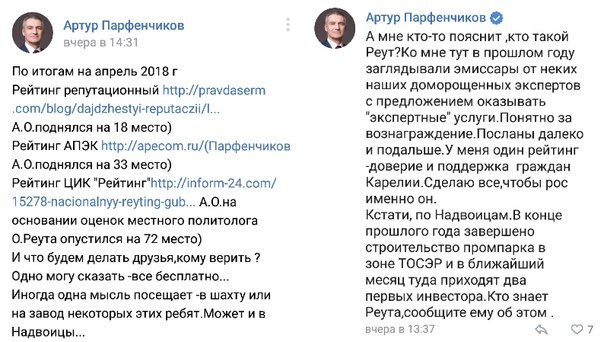
The quote given is an example of a 100 % fake. Neither in the nades, nor in Karelia in 2017, the construction of any industrial park was completed [unlike an industrial site, where enterprises themselves create the necessary infrastructure, the industrial park involves the presence of a unified management company responsible for providing tenants or owners with engineering communications, electricity, water, heat supply].
In our region, to date, there is not a single industrial park (or technopark), and their creation is not even planned [in November 2018, the Karelian media published information about the intention of the republican authorities to apply for the construction of the first stone technology park in Russia]. There is a fact of intentional distribution of in advance of inaccurate information.
The “two first investors” in the non -existent Nadvoitsky industrial Park did not “come” to the next month after the publication of the governor's post. Residents of the region are perfectly informed that on the basis of the infrastructure of the industrial site created in the names of the industrial site, not a single enterprise to date the production of products has not begun, no payments and taxes in the republican and local budgets are received.
Of course, you can begin to make excuses endlessly and try to explain that in May 2018, the governor could not in principle know about the events that would occur or would not occur in the “coming month”. Did Parfenchikov know that he initially deceives his readers, placing a fake on his page on social networks? If so, then it is worth admitting that he violated the law. If not, how can he prove that inaccurate information cannot be characterized as in advance in advance?
A peculiar paradox of the current situation is also as follows. Despite the fact that in case of adoption, the bill on fakes will not have the return force, it will still be possible to get to fines and blocking for what was said in May 2018. After all, some attentive reader of the governor's VK page can see a replica about the never-existing industrial park after the document entered into force, find fake and demand satispulation.
It sounds absurd, but the administration of the head of Karelia and Arthur Parfenchikov personally would be advisable to reconsider all its previous publications and make them not even forming a space for potentially possible pre -investigation inspections on the facts of intentional dissemination of false information.
In general, of course, the bill complicates the situation of all citizens who, according to the Constitution, have the right to free access to information and its distribution. If someone heard or read some kind of hearing or “news from the future”, then fellow citizens also have the right to hear and read it. Reasonable restrictions in information policy are quite acceptable, but only in an emergency or martial law. But why do it in peacetime?