
Translated material
network-centric warfare

Network-centric warfare (or “Network-centric warfare”, “ Network - centric warfare ” ) is a military doctrine (or concept of warfare ) first put into practice by the US Department of Defense .
Network-centric warfare is focused on increasing the combat capabilities of promising formations in modern wars and armed conflicts by achieving infocommunication superiority and uniting combatants into a single network.
Unlike network warfare, this is a purely military concept that has gone a long way from intellectual developments and brainstorming through experiments and simulations to practical actions that influenced changes in US military strategy and, accordingly, the infrastructure of the Pentagon. It was largely made possible thanks to the infocommunication era (the creation of a global infocommunication environment) and infocommunication technologies.
The US Army was the first to develop and practically implement this concept. In their final form, options for network-centric warfare are presented in the American military doctrines “ Joint Vision 2010 ”, “ Joint Vision 2020 ”.
The founders of network-centric warfare
The founders of network-centric warfare are considered to be US Navy Vice Admiral Arthur Sebrowski, Pentagon researcher John Garstke and Admiral Jay Johnson. The joint article by A. Sebrowski and J. Garstka “Network-centric warfare, its origin and future” is called the programmatic work on network-centric warfare. Jay Johnson said that “information superiority combined with networked, dispersed offensive combat power will create well-designed and precise early action, resulting in extremely high rates of change. This is what we call speed of command. This is what we call network-centric warfare."
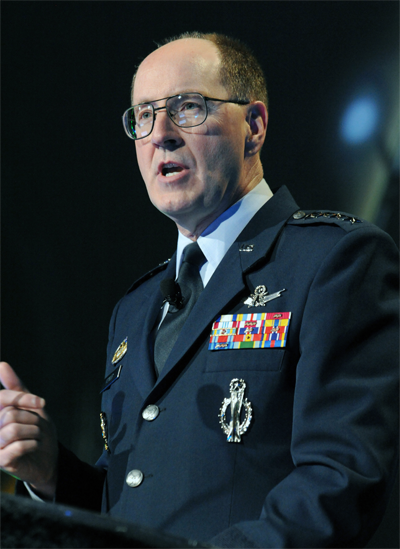
On March 31, 2009, at the 25th Space Symposium, General C Robert Kehler unexpectedly used a new term - “geocentric theater of operations” (Spherical Battlespace) and described it in a few phrases. The new theater of military operations extends from top to bottom from the level of geostationary orbit (36 thousand km above the Earth) to its surface, gradually absorbing all the previous arenas (domains in American terminology) of military confrontation - space, atmosphere, land, sea, as well as a new domain - cyberspace.
Network-centric warfare concept
This is a concept of combat operations that provides for an increase in the combat power of a group of joint forces through the formation of an information and switching network that combines sources of information ( intelligence ), command and control units and means of destruction (suppression), ensuring that participants in operations receive reliable and complete information about the situation in real time.
As a result, faster control of forces and assets, an increase in the tempo of operations, the effectiveness of defeating enemy forces, the survivability of friendly troops and the level of self-synchronization of combat operations are achieved.
Network-centric forces in the military sense are troops and weapons capable of implementing the concept of network-centric warfare.
The concept involves translating the advantages inherent in individual infocommunication technologies into a competitive advantage by combining informationally well-sufficient, geographically dispersed forces into a stable network. This network, coupled with new technologies and new levels of organization of processes and people, implies new forms of organizational behavior.
Principles of conducting network-centric warfare

The theory of network-centric warfare contains three principles in its hypothesis:
- Forces united by sufficiently reliable networks have the opportunity to exchange information in a qualitatively new way.
- Information exchange improves the quality of information and the level of general awareness of what is happening;
- As a result, the overall situational awareness is such that it allows for the necessary cooperation and self-synchronization, increases the stability and speed of command transmission, which, in turn, dramatically increases the effectiveness of the combat mission.
Main features of network-centric warfare
The three most distinctive properties of “network warfare” compared to traditional warfare in its current understanding are:
1. Wide possibility of using geographically distributed force. Previously, due to various kinds of restrictions, it was necessary for units and logistics support elements to be located in the same area in close proximity to the enemy or to the object being defended. The new concept removes these restrictions, and this has been practically confirmed.
Thus, to organize targeted logistics supply - the basis for the combat use of troops in maneuver warfare, the US Army in Iraq used the MTS distribution information system (Army's Movement Tracing System). In this system, based on radio-emitting sensors, stationary and portable scanners, GPS navigation satellite system, wireless access and tactical Internet, the position of all ground moving objects (tanks, armored personnel carriers, infantry fighting vehicles, etc.) throughout the Iraqi theater of operations is continuously monitored, from the crews of which the logistics authorities received requests for the supply of fuel, ammunition, spare parts and other types of support. In total, this system involved about 4,000 on-board computers and 100 servers running Windows NT . The MTS system cost the US Army $418 million, received by NSI Global Inc. and Comtech Mobile Datacom Corp. for the supply of necessary equipment for three years.
2. Only highly intelligent forces can wage a network-centric war. Such forces, benefiting from the knowledge gained from comprehensive surveillance of the battlespace and an expanded understanding of command intentions, are capable of greater effectiveness than when conducting autonomous, relatively disjointed actions.
In this regard: before the start of the Iraq War (2003), more than forty American satellites were deployed over the country, and the assets of the 5th Army Corps, taking part in Operation Shock and Awe, the main strike force of the group in Iraq, were already capable of independently tracking up to 1000 enemy ground targets within an hour. Commanders of carrier-based aviation squadrons could take part in planning the flights of their crews together with colleagues from army aviation, using a common information system, which, for example, did not exist in 1991. Moreover, 80% of combat aviation sorties, starting with the operation in Afghanistan , are already carried out “blindly,” that is, when there are no targets in the memory of combat computers and information about them comes from ground units directly from the front line. To do this, the Americans deployed a special system of combat planning and control of aviation in the theater of operations “TVMSS” (Theater Battle Management Core Systems).
During the operation in Iraq in 2003, they used the new distributed command and control information system FBCB2 (Force XXΙ Battle Command Brigade or Below), covering the brigade-battalion-company level. All commanders of combat units and forward artillery gunners received standard handheld computers (500 MHz) 4 GB ( Windows 95 | NT) with a rugged case from Elbit System for terrain orientation and transmission of combat reports.
3. The third difference is the presence of fairly effective communications between objects in the combat space. This enables geographically distributed entities to collaborate and dynamically share responsibility and workload to adapt to the situation. That is why the total bandwidth (up to 3 GHz) of satellite communication channels leased by the Pentagon for transmitting information has increased more than seven times compared to 1991.
Phases of warfare
Assuming that the features of network-centric warfare are taken into account in relation to each given theater of military operations, the concept provides for four main phases of combat operations.
- Achieving information superiority through proactive destruction (disabling, suppressing) the enemy’s intelligence and information support system (reconnaissance assets and systems, network-forming nodes, information processing and control centers)
- Gaining superiority (dominance) in the air by suppressing (destroying) the enemy's air defense system.
- Gradual destruction of enemy weapons left without control and information, primarily missile systems, aviation, artillery, and armored vehicles.
- The final suppression or destruction of pockets of enemy resistance.
The successful implementation of each phase of the operation is based on a significantly shorter duration of the combat cycle “detection - identification - target designation - defeat” compared to the enemy, which presupposes sufficiently accurate and complete information about the opposing group.
Thus, the sequence of fire damage during network operations looks like this: Sensors - controls - parts and subdivisions (units) - individual objects (objects) - (SCUO).
Previously, similar operational concepts (for example, “deep operation” ( USSR , 30s) and “air-ground operation” (USA, mid-80s)) were built in a different sequence.
The first network-centric war
In 2003, Iraq had numerous armed forces with many years of combat experience, including military confrontation with American troops. Iraqi forces included 23 divisions of ground forces and the Republican Guard with a strength of 230 thousand people and 200 thousand people in aviation and air defense forces, armed with 2,200 tanks (of which 700 T-72), 3,000 armored personnel carriers and infantry fighting vehicles, 4,000 guns, mortars and MLRS, 100 medium-range ballistic missiles, 500 combat aircraft and helicopters, 100 mobile air defense systems. In addition, there were irregular military formations numbering up to 40 thousand people, armed with small arms, rocket-propelled grenade launchers and off-road passenger vehicles. The number of reservists was 650 thousand people.
The forces of the US-British coalition included 6 divisions of ground forces and marines with a strength of 110 thousand people and 180 thousand people in aviation and navy, armed with 500 tanks, 1200 infantry fighting vehicles and armored personnel carriers, 900 guns, mortars and MLRS, 1100 medium-range cruise missiles, 1300 combat aircraft and helicopters, 200 mobile air defense systems.
The numerical superiority of the Iraqi armed forces over the US-British coalition was:
— in manpower by 1.48 times, including 2.09 times in the number of ground forces personnel;
— in tanks 4.4 times;
- in infantry fighting vehicles and armored personnel carriers by 2.5 times;
- in artillery 4.4 times.
The numerical superiority of the US-British coalition over the Iraqi armed forces was:
- in mobile air defense systems 2 times;
— in aviation 2.6 times;
- in medium-range missiles 11 times.
The defeat of an Iraqi armored column on the march
Baghdad was surrounded. For three days, American-British aircraft suppressed the defensive positions of Iraqi troops directly within the city, after which the advanced units of the 3rd Mechanized Division entered it. All counterattacks of the most combat-ready divisions of the Republican Guard of Iraq “Medina” and “Nebuchadnezzar”, as well as army special forces, were repulsed with heavy losses for the defenders. On April 9, mass desertion of Iraqi troops began throughout the country, with the exception of Tikrit, the hometown of the Iraqi president, whose garrison ceased resistance on April 13.
Captured Iraqi MiG-25
The reason for the rapid defeat of the Iraqi armed forces was the effect of the implementation of the concept of network-centric combat operations, first used in practice by the American armed forces. Without exception, all strongholds in the offensive zone of the coalition forces, regardless of their location (in the field or in the city), were destroyed by the attackers without much damage to themselves, despite the numerical superiority of the defenders in military equipment and manpower. During the period from March 19 to April 13, 2003, the US-British coalition lost 172 people killed, and the Iraqi armed forces lost 9,200 people.
All Iraqi airspace was monitored around the clock with the help of American long-range radar reconnaissance and AWACS control aircraft. Due to the Iraqi command's refusal to use its air force, this system was mainly used for air traffic control of aircraft and helicopters of the American-British coalition. For operational control of the ground situation to a depth of 250 km from the front line, alerting ground forces about enemy movements and launching air and artillery strikes, the J-Stars radar system installed on board Boeing E-8A/C aircraft was used. Sources of radio emissions within Iraqi forces, including radars, radio transmitters, repeaters and electronic warfare equipment, were identified, suppressed and destroyed using electronic reconnaissance aircraft and homing missiles.
A key role in the successful operations of the ground forces was played by the use of the new integrated communications and control system FBCB2 (Force XXI Battle Command Brigade and Below), developed since 1995, in the Second Iraq War. Its prototype versions were previously tested in military conflicts in Yugoslavia (1999) and Afghanistan (2001). FBCB2 connected automated systems for reconnaissance, positioning, fire control, situational awareness, combat planning and logistics of ground forces into a single network, and also ensured the exchange of data with automated systems of other branches of the armed forces and the unified command.
FBCB2 terminals were placed directly on board tanks, infantry fighting vehicles, armored personnel carriers, self-propelled guns, missile launchers and multi-purpose all-terrain vehicles of linear units of the US Army and Marine Corps. The terminals were also equipped with mobile command posts, technical reconnaissance and fire control complexes for artillery and missile units, and forward artillery and aviation gunners. The terminals were connected to a two-layer radio network, including the air segment of EPLRS/SINCGARS and the space segment of INMARSAT. Data exchange was carried out within the virtual network of the tactical Internet.
ACCS information network FBCB2
Commanders of combat vehicles and military units up to and including a platoon/battery had a real-time display of the current tactical situation on the displays of their terminals, including the location of enemy positions and their units. In this regard, all attacks on the defensive positions of the Iraqi army were carried out mainly from the flanks and rear. The artillery weapons of American tanks and infantry fighting vehicles were used at extreme distances outside the targeted fire zone of the artillery weapons of Iraqi combat vehicles.
The commanders of the forward units of American divisions on the battlefield were given communications opportunities to directly interact with artillery units and tactical, and in some cases, strategic aviation. Iraqi artillery was suppressed by multiple launch rocket systems immediately after its positions were determined based on radar reconnaissance data following the trajectories of projectiles during the first sighting shots. After gaining air superiority, the main combat use of US-British coalition aircraft (90 percent of missions) was to patrol the air in combat areas and provide air support to their ground forces on the battlefield (with the help of forward air controllers) or in the rear of Iraqi forces (with the help of radar guidance).
As a result, the fire contact between the attackers and defenders took place unilaterally, which greatly influenced the moral and psychological stability of the Iraqi military personnel. The inability to implement not only the defense plan, but also to simply fulfill one’s military duty (to cause damage to the enemy even at the cost of one’s own death) demoralized first the Iraqi army, and then the Iraqi Republican Guard.
On the other hand, full possession of tactical information, the preventive use of fire weapons, the virtual absence of losses among the attackers and uninterrupted logistics supplies allowed them to destroy enemy forces piecemeal, even without a quantitative superiority in ground weapons and manpower.
Destroyed Iraqi tanks on the streets of Baghdad
The few attempts by Iraqi forces to counterattack each time ran into the early situational awareness of American troops about the movement and accumulation of defending forces. A typical example is an attempted night counterattack by two brigades of the Republican Guard, supported by 70 tanks, against the bridgehead of one battalion of the 3rd Mechanized Division, reinforced by 10 Abrams tanks and 4 Bradley infantry fighting vehicles, in the urban area of Baghdad. Having encountered a bomb attack and artillery fire even before the start of the counterattack and having lost half of their personnel killed and wounded in the dense pre-battle formations, the Iraqis were forced to retreat.
The unwillingness of Iraqi troops to conduct urban combat in the face of precision bombing strikes and artillery fire at extreme distances is well illustrated by the tactics that the 3rd Mechanized Division used to establish control over Baghdad. The Thunder run technique was used - high-speed raids of columns of armored vehicles along city highways, striking enemy firing points identified during the raids. The last high-speed raid was accompanied by the landing of infantry at highway intersections with the deployment of strong points and ended with the capture of a complex of government buildings in the city center. Contact between the command of the Iraqi Armed Forces and President Saddam Hussein was lost. Night counterattacks were once again thwarted. The next morning, the resistance of the Iraqi army and the Republican Guard was broken. The armed conflict entered the stage of guerrilla warfare.
Scheme of the last Thunder run raid
Network Centric Warfare technology in the Iraq War was largely built on speeding up the delivery of intelligence to the front lines of the US Army. Increased situational awareness helped them outpace the enemy in making decisions every time. At the same time, special attention was paid to the priority identification and destruction of command posts of Iraqi troops, after which their combat control, built on a hierarchical principle, ceased to exist as an organized system.
The delay in receiving intelligence information about Iraqi troops immediately affected the pace of the offensive - the absence of the usual red icons (indicating enemy positions) on the displays of FBCB2 terminals acted as a stop signal to the commanders of the forward units of the American troops. For example, a sandstorm over Baghdad and the associated temporary cessation of reconnaissance aircraft flights forced US troops to move to the so-called siege of Baghdad, in accordance with the official statement of US Secretary of Defense Donald Rumsfeld. However, active offensive operations immediately resumed after changes in weather conditions.
Unification of automated systems Battle Command Systems of the US Armed Forces
After the Iraq War of 2003, the development of the material basis for conducting network-centric combat operations began at an accelerated pace. In the US Armed Forces, information linking of automation systems of the ground forces, air defense, aviation and navy was carried out using the DIB (DCGS Integrated Backbone) software interface. The transition to broadband communications is being completed in the space and air segments. The functionality of the automated FBCB2 system has been expanded to level C4. The equipping of all Army and Marine Corps units with portable terminals has been completed. Currently, in accordance with the Joint Battle Command Platform program, military personnel of permanent readiness units are being equipped with wearable terminals. In 2014, it is planned to test the Digital Battle Field technology, which does not require the mandatory use of a satellite navigation system and laser target illumination.
HART Intelligence Network
In 2012, the number of unmanned aerial vehicles (7,400 units) in the US military exceeded the number of main battle tanks (7,200 units). A large flight fleet of UAVs, together with a broadband radio network and a network of computers, makes it possible to form an extensive, fault-tolerant multispectral reconnaissance network of the HART (Heterogeneous Airborne Reconnaissance Team) type on the scale of a theater of operations.
Since 2010, the Cyber Command has been operating, under the jurisdiction of the Strategic Command and managing the work of the global information network GIG (Global Information Grid) of the US Armed Forces. Raising the information system to the same level as the nuclear triad (ballistic missiles, submarines and heavy bombers) shows the strategic importance of implementing the Network Centric Warfare concept to achieve technological superiority over the enemy.
Functional structure of the Global Information Grid network
network-centric warfare weapons
Self-propelled howitzer FH77BW L52 Archer (Sweden)
The FH77BW L52 Archer self-propelled gun is equipped with a modern digital fire control system. Electronic equipment and associated systems allow the crew to carry out all necessary operations without leaving their workplaces. In addition, the automation takes on some of the important actions related to preparation for firing: determining the coordinates of the self-propelled guns, calculating the required pointing angles and firing according to the MRSI algorithm. When using a guided projectile Excalibur or similar, the automation prepares the ammunition for firing.