
Translated material
Middle Ages IVS...

We left at 8 am. A businessman gave me a car, thanks to him. Snow fell on the republic. The road goes by.
All the way we discuss the trip to Udora and the inspection of the temporary detention facility there. There they found a man who had not paid a fine of 200 rubles and for this was punished very harshly by the magistrate - he received half a month of administrative arrest. I wonder what reasons caused such cruelty.
By 11 o'clock we reached Ust-Kulom. They were looking for the police. Unlike many regional centers, the police in Ust-Kulom are far from the center. We entered the duty room. They looked at our IDs. They are waiting. Let's go from the deputy chief to the street.
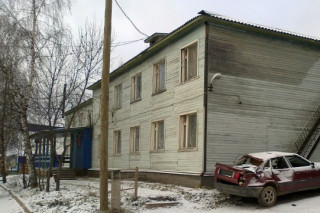
Department of Internal Affairs of the Ust-Kulomsky district, more like a two-story residential building
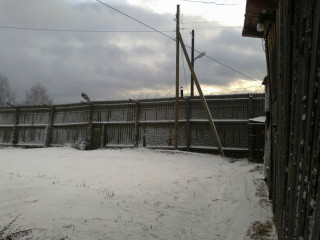
Below, on the banks of the Vychegda River, in the landscape of the boundless river valley covered with the first snow, there is a three-meter high fence with barbed wire. Landscape from the 30s and 40s. GULAG. We enter the courtyard. A large white dog barks behind the net. In front of us is a small wooden temporary detention center building that has grown into the ground. Let's go in. The door is opened by a completely gray-haired man. He limps slightly. The deputy chief and another officer accompany us.
A three-meter fence around the Ust-Kulom temporary detention center
Please open the cameras. Drivers and hooligans are sitting in the administrative detention cell. We talk and watch. There is a “bowl” in the corner. No water, no sewer. On the way out I ask about water. In the corridor there is a country washbasin; everyone washes their hands here: prisoners and policemen alike. And people sit for half a month without washing or washing themselves. In the corridor there are 6 large 40-liter water tanks. Everything is carried by hand every day. Hell of a job. We go into the next chamber. There is an iron shield with holes on the window, the holes are plugged with pieces of paper. I peer. I see broken glass through the holes. The police explain that when it was hot, the prisoners broke out the windows from the heat. Now the cold is coming through the holes.
In one of the cells they came across three men. The peasants turned out to be orphans, they have no relatives and no one brings them food. Therefore, they eat what they give. And they give you food in the Ust-Kulom temporary detention center twice. And then twice this is in words. They take food in the canteen - lunch and dinner. Dinner is a warmed up lunch. As the police said, sometimes, at the request of prisoners, they give food one (?????) time. When we entered the cell with the orphan men, it was about 12 o’clock. And they hadn’t eaten anything that day yet. In another cell there was a woman, she also had no relatives, but she had breakfast with what she had left from dinner.
The management needs to figure it out and change the prisoner feeding schedule.
After examining the cameras, they asked to show the utility rooms. The door was opened. And there is a toilet for workers and prisoners - two holes in the wooden floor, and shit sticks out of there. Creepy. Cold.
- So what, you go there?
- Let's go, but where to go?
- But it’s terrible, isn’t it?
- This is our job.
It turns out that the police have already been promised three times that the temporary detention center will be transferred to another building and it still doesn’t work together. This is a mockery not only of prisoners, but also of police officers. This is how you have to hate your subordinates in order to decorate the offices of the Komi Ministry of Internal Affairs in euros, and the police have to go to the toilet like in the Middle Ages.
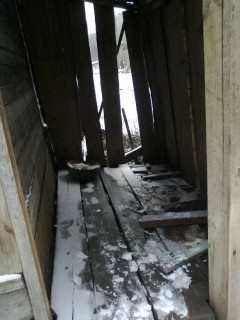
But that wasn’t all. We went out to inspect the exercise yards, and they showed us another toilet for the staff. Broken boards, holes filled with piles of shit.
Medieval toilet for workers of the Ust-Kulom temporary detention facility
After all this, we sat down in the temporary detention facility duty room to write complaints. There were more than a few complaints. We wrote down as many as 16 comments. We talked to the employees. They themselves really want something to change. But we need money and we need political will for something to change.
Let's go out. The dog is silent, he is tired of us.
We get into the car. It’s a pity, it’s a pity that a large fence prevents both workers and prisoners from seeing the beauty of Vychegda and its large valley.
We are driving through the village. We stop at the store. I want to eat. It's one o'clock in the afternoon. We buy kefir. The store has a small selection of food, but the selection of alcohol is simply impressive, especially the selection of vodka.
We left the village. The road is just as slippery. We meet an overturned car in a ditch. We drove up to the town of Podtybok. There's a tavern there. Let's go in. Lots of people. We're picking up food. Stewed cabbage, vile taste. The rest seems to be nothing. Let's move on. It's getting dark.
At half past four we arrive at Kortkeros. The familiar building of the Department of Internal Affairs. We wait for a long time in the duty room. The documents are checked by the policeman on duty. Then an officer checks the documents. Before entering the temporary detention facility, which is right here in the police department building, the documents are checked by the temporary detention center duty officer. I'm indignant. Are they going crazy with the desire to check documents?
- When do your powers end, in December? - the accompanying officer asks.
- Yes.
- Extended.
- No, initially it was until December 8th.
We enter the temporary detention center. We were here in the summer, visiting the Queen. There are only two administrative detainees in the temporary detention facility. Let's go through the cells. Unlike the temporary detention center in Ust-Kulom, everything is fine. Food three times a day. Warm. Plumbing. Sewerage. But on the windows there are the same iron shields with holes. Through the holes I again see the absence of glass. The police say that the windows were removed during the heat.
- Why didn’t they put it back?
The answer is silence. They are waiting for instructions, apparently. The windows are boarded up from the outside, so no daylight comes through. We measure everything with a tape measure. The main enemy of these places of detention is overcrowding.
We go to the duty room. I am writing comments. Wrote 13. The head of the police department appears. He calls upstairs to the office. We take our things and leave. He is a civilian. Determined. I feel like he wants to give an intellectual fight.
We go into his deputy’s office, he reads the comments. We are silent. We discuss comments. About the comments about the poor furniture for police officers and the floors, he is surprised.
- This is our internal matter.
- No, the rights of police officers are also a matter for the PMC.
Then he suddenly asks to explain what good the commission has done over the two years of work: “What has been changed?” I explain what has changed and become better in the special detention center of the Syktyvkar Internal Affairs Directorate, what has changed in their temporary detention center since our arrival in the summer. The chief states that all this applies to prisoners, but not to police officers. Next, our conversation concerns police reform. We talk for about 30 minutes. In the end, we come to the complexity of police work without the trust of the population and the need to gain this trust. We part at about 17:20. It's dark outside. My stomach hurts - the cabbage from Podtybka plays in my intestines.
The car drives through half-melted snow slush. Syktyvkar creeps up unnoticed. We are talking about what we discussed with the head of the Kortkeros police department, about the fact that we need to visit the pre-trial detention center, about the fact that we may not get into the new composition of the PSC. The pain in my stomach is getting worse. Night. Talk. The sound of the engine. The sound of wet snow.