
Translated material
Anti -Semite to save Israel

Everyone knows that Richard Nixon was an ardent anti -Semite. The glory of Yudophoba has firmly entrenched him since, as a young congressman, he played a noticeable role in the investigation of the subversive activities of the Communists who penetrated into state institutions, and especially in the exposure of the deputy Secondary Supervisor of Hiss as a communist agent. This impression was further strengthened after the legend of the vowel of tape recordings of conversations in the oval office of the White House, where President Nixon to the right and left sprinkles with anti -Semitic expressions.
But what is curious: the famous journalist William Safair testifies that anti -Semite Nixon as a lawyer bowed to the members of the Supreme Court by Jews Luis Brandais and Felix Frankfurter; that his beloved writer was a Jew German Vuk; What he chose his foreign policy adviser to the German immigrant Henry Kissinger, the main domestic political adviser-the Austrian-Imigrant Arthur Burns, and the main adviser in science-Jew of Ed David; That he put the Jew Herbert Styun at the head of the Council of Economic Consultants at the White House, and the Jew of Lenard Garment is at the head of the State Support for Arts and Humanities Program. Yes, by the way, the chief speaker of Nixon was also a Jew - that same William Safair.
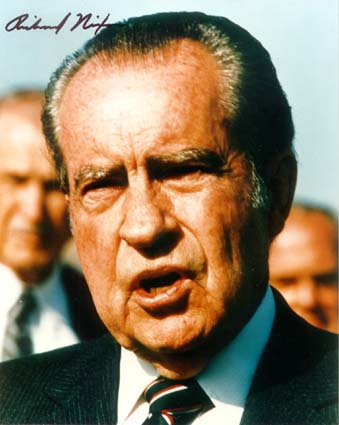
Richard Nixon
The historian Herbert Parmet in his book “Richard Nixon and his America” notes that Nixon’s negative attitude towards Jews was very typical of his time and circle: he, in particular, was completely shared by Harry Truman - it would seem the opposite of Nixon. But if Truman did not let the Jews on the threshold of his house in the city of Independence (Missouri), no one will recall that Nixon in any way distinguishes Jews from non-Jews in his environment.
According to Lenard Garcket, whom Richard Nixon really hated - this is the left intelligentsia, and first of all liberal journalists, especially those from whom he and his family have suffered a lot. By the will of fate, many of these people were Jews, but Nixon’s hatred was associated with political views and illegibility in the means of his enemies, and by no means with their nationality.
In the 1960 presidential election, Jewish voters voted for Democrat John Kennedy. Eight years later, Nixon again ran for the president. Once, during the election campaign, he was preparing to speak to the Jewish audience, and one of his assistants expressed the opinion that, perhaps, there is no point in impending the Jews-they will still vote for the democrat. So, maybe you should not so burst out in your love for Israel?
Nixon categorically rejected the advice. “I know perfectly well that this does not bode for a single extra voice,” he explained to William Safer. “Well, they will pat me, and then they will vote against me anyway. It was always the case this time. But I am convinced that my position on Israel is the only right thing that Israel’s support is fully responsible for the interests of the United States. So why should I be cunning?”
During the first term of the Presidential powers of Nixon between America and the Jewish state, unprecedentedly close relations were established. Especially after in 1970, at the request of the US President, Israel tore off the Syrian invasion of Jordan and saved the government of King Hussein.
But October 1973 came, the war day began. A few days after the sudden attack of Egypt and Syria, Israel was on the verge of disaster. A desperate dispatch flew to Washington: without massive supplies of American military equipment, Israel will not be able to achieve a fracture in the war. The fate of the Jewish state was in the hands of Richard Nixon. The US President ordered an emergency to provide Israel with everything that is necessary for victory. Starting on October 14, for 32 days, the American transport aviation made 567 flights to Israel, delivering a total of 22,300 tons of military supplies.
It should be noted that all this happened at a time when the president’s political positions were seriously undermined. Despite the fact that Nixon had fulfilled his election promise and withdrew American troops from Vietnam (and rather, for this reason), hatred of him from the left intelligentsia was heated every day. The liberal press declared an open war to the White House and with all her might tried to inflate the flame of the Watergate scandal. Democrats in Congress, who had an impenetrable majority, without hiding their goals, were a course to completely paralyze the administration. To top it off four days after the start of the war, he was forced to resign the vice president of Spiro Agnnya, convicted of corruption.
In such a situation, prudence suggested the need to behave quietly and carefully, not giving enemies of reasons for attacks. But Nixon went to the battle with the raised climb. According to the unanimous testimony of all eyewitnesses, the merit is that Israel received the required deliveries without delay, belongs to the president. The usual bureaucratic borders in such cases were overcome only due to the fact that he took the matter under his personal control.
Walter Boyne’s book “War at 2 a.m.” tells about the meeting held in the White House on October 9: “Nixon said that in no case would be allowed to defeat Israel. He ordered the supply of delivery and let Tel Aviv that the Israeli army could, apart from expenses, fuel, spare parts and spare parts and spare parts and spare parts and spare parts and spare parts. etc.), for the United States guarantee completely and without delay to compensate for any decline. ”
Alexander Hayig, who at that time headed the presidential administration, writes in his memoirs that “as soon as the scale of Israeli losses in military equipment became known, Nixon ordered to immediately make up for them from the American arsenal, and to supply the best of what is. It is necessary to save Israel, whatever it costs, he said to Kissinger.”
The Minister of Defense James Schlesser initially wanted to send a small batch of military equipment to Israel - only three transport, fearing that a larger supply of supply could cause irritation among the Arab states and the Soviet Union. But Nixon, according to Hayig, barked at the helmer: “Spit on them! No matter how much we put - three or three hundred transports - all the same will be dumped on us. So act without looking back.”
Alexander Heig recalls that on October 12, the president, alarmed that the Soviet Union began supplying Egypt and Syria through the air, called Kissinger and invited him to read out the list of everything that was primarily necessary for Israel in the presence of the Minister of Defense. At the end of the report, Nixon ordered to double the number of supplies provided in the list, and ordered the Schlesinger to immediately begin to send them.
After some time, when he was reported to the next delay, this time in connection with the disputes in the Pentagon about which type of aircraft to use as transports brought to white potassium, Nixon yelled at Kissinger: “Raise everything that we have in the air, everything that can fly!” And when the Soviet Union threatened to intervene in the war on the side of its Arab allies, Nixon immediately ordered the United States’s armed forces throughout the world to a state of increased combat readiness. Moscow understood a hint and saved.
At the same time, the US President had to overcome the resistance of not only the dignitaries of his administration. “The European allies of the United States,” writes historian Melvin Small in the monograph “Richard Nixon’s Board,“ in fear of Arab oil blackmail was banned by transport aircraft that delivered military supplies from the United States to Israel to use American air bases in Europe.
At the same time, the US allies in NATO Türkiye and Greece opened their airspace for the Soviet air bridge in Egypt and Syria. Under the pressure of the Arabs, the American company Exxon instructed its German Esso branch to stop the supply of oil to American bases in Germany. Ultimately, Washington managed to tear out permission from Portugal to refill American aircraft on the Azores. ”
Nixon's merits to Israel are so great and undeniable that even the editor of the Left newspaper Forward J. Goldberg recognizes in his book “Jewish influence” that the “Creator of the American-Israeli Union was Richard Nixon”. “It is thanks to Nixon,” writes Goldberg, “Israel is now in the first place in the list of American recipients. It was Nixon who stood at the source of the policy of the almost unlimited sale of American weapons to Israel. It was Nixon who formulated the doctrine, within which the United States considered it necessary to support Israel not only for moral thoughts, but also as a strategically important alien.”
Nixon biographer Stephen Ambrose writes: “It was one of the fateful moments of world history. If it weren’t for Nixon, who knows what kind of turnover the events could be accepted. In all likelihood, the Arabs would have managed to partially regain the territories lost in 1967, or maybe even destroy Israel. However, it should not be guessed that this lesson could happen, this occupation is ungrateful. But in any case it is clear that it is clear that it is clear that it is clear that it is clear that it is clear that it is clear that it is clear that it is clear that it is clear that it is clear that it is clear that Nixon ensured the victory of Israel, risking his own reputation and the health of the American economy.
In the face of the frankly proselair policy of the republican administration, the Jewish electorate, who gave Nixon in the 1968 elections only 17% of the vote, markedly softened in relation to the president. In the next elections, twice as many Jews voted for him - 35%. But this means that two -thirds of the Jewish voters supported the opponent of Nixon - Democrat George McGovern.
What would happen if Ultraliberal McGoven in 1972 became president? What would Israel expect if this pacifist and isolationist had come to the White House, demanding a sharp reduction in military expenses and stated that Israeli pilots do not have the right to fly in American aircraft in the airspace of the Arab states? What Middle Eastern policy would the president lead, whose closest surroundings of the teems of people who have proven themselves as frank enemies of Israel? This would not hurt to reflect on his leisure, thereby sixty -five percent of Jewish voters who voted for McGover.
As for the Nixon anti -Semitism, the late President of Israel Chaim Duke wrote: “Did the personal sympathies and antipathies of Nixon affect his relations with Israel and Jews? In no way. He gave us weapons and provided us with indestructible support at the moment when the very existence of our state was put on the map. Do not forget about it, remembering anti -Semitic statements. Nixon.
As soon as it came to a break between words and deeds, how not to recall another president of the United States - the true idol of American Jewry Franklin Delino Roosevelte. For some not quite understandable reason, it is considered him a great friend of Jews, although, judging by all evidence, he showed contemptuous indifference to them at best. At the height of the war, President Roosevelt was deaf to requests to accept 8,000 Jewish orphans from Europe. In 1939, he ordered the Saint-Louis ship back to Germany, on board which were 900 Jewish refugees, announcing that the Jewish quota for immigration, they say, was exhausted.
Moreover, the refugees were ready to accept the Cuban president of the batist, but he was besieged from Washington - Tsyts, do not go before the gate. “Saint-Louis” had to return to Europe. Two hundred refugees managed to attach in England, the rest were planted in France, Belgium and Holland. With the advent of the Germans, most of them died in the gas chambers of Nazi destruction camps. Roosevelt’s “Jewish friend” refused to bomb access to Auschwitz on the grounds that American aviation has more urgent and important tasks.
It should also be taken into account that Roosevelt would not risk anything by accepting refugees from Saint Luis. But Nixon put his presidency on the map, decisively speaking in support of Israel. The day after the head of the administration turned to Congress, asking for extraordinary appropriations in the amount of $ 2.2 billion to assist Israel, the furious Saudi king Faisal introduced an embargo for oil supply to America.
The Iron Law of American Policy says that the fate of the politician is ultimately determined by the state of the economy. Bill Clinton is amusing himself with illusions if he believes that he was saved by disinterested folk love: they say, people, outraged by the shamelessness of the Republicans, breastfeeding his beloved president and saved him from impeachment. In fact, Clinton owed at that time his high rating primarily high economic indicators, with all his might inflated by the media. While everything is in order with the economy, the voters will not give offense to the president, no matter how he was poisoned.
Nixon's fate confirmed the justice of this rule. The oil embargo, which was joined by all other Arab states, caused a sharp economic decline in the United States. The unemployment curve crawled up, prices jumped up, the living stands began to fall - and the rating until then the popular president rolled down uncontrollably. The Watergate scandal, which for two years quietly smoldered, without a special resonance contrary to all the efforts of the press, suddenly flared up with a bright flame. On the horizon loomed a formidable ghost of unwaster impeachment. The fate of the head of the administration was decided.
It can be without exaggeration to argue that the Anti -Semite Richard Nixon saved the Jewish state from death at the cost of his political career.
Yorktown, Virginia
http://berkovich-zametki.com/2007/zametki/nomer18/vvolsky1.htm