Date
Author
Радик Хабибрахманов

Preserved copy
Translated material
Twelve days

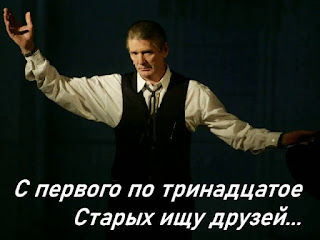
The Soviet song Andrei Voznesensky and Igor Nikolaev is a day ( old New Year ) performed by Alexander Abdulov
Soviet poetry is the same age as October. Soviet poetry is a kind of chronicle of the era. Soviet poetry reflects all stages of the revolution, socialist and communist construction
The ideals of the struggle for the reconstruction of the old world inspired the literature and art of the New Age from the very first steps, so it is no coincidence that the great socialist October Revolution became the main theme of Soviet poetry born in its crucible. It was from poems, as Vladimir Mayakovsky rightly claimed, and the literature of the revolution began
Soviet poetry is polyphonic, multicolor, multi -diapason, it was reflected in not only the most important stages of social development, but also the spiritual life, the artistic consciousness of the people, the dialectics of the human soul, its most intimate movements
Soviet poetry is in its ideological and aesthetic quality a new, revolutionary phenomenon, at the same time inherits and enriches the national traditions of all developed fraternal literature, absorbs the artistic experience of world literature, accumulates its experience, which serves as an inspiring example for many progressive poets of the world
The most important conquest of Soviet poetry is the further development of an international topic. The prerequisite for this was the successes of socialist construction, the cultural revolution in the country, overcoming national isolation, limitations that prevented general cultural development
Now poetry is an inquisitive interest in the life and culture of other nations, goes to the All -Union Arena. Civil, journalistic and plot Soviet poems are based on specific facts of reality and are devoted to the friendship of peoples, the Soviet homeland. They occupy a large place in the national poetry of the socialist republics
The theme of the Great Patriotic War found a great reflection in poetry. And then the Soviet poets found themselves in the front rows of the movement of supporters of the world. They took a direct active part in rallying progressive forces to prevent the threat of a new world disaster. Their work was a direct continuation of social activity. The fiery word of Soviet poets about the world and the happiness of people on earth found a wide response in the hearts of millions
Russian literature, which has worldwide recognition, as literature of the greatest humanistic and revolutionary traditions, has the greatest influence on all multinational Soviet literature, and the Russian language, as the language of interethnic communication, plays a huge communicative role in the interconnections of fraternal literature. From the artistic experience of national literature, a vivid aesthetic diversity consists of. Multinational Soviet poetry contains a genuine ideological and artistic wealth
Twelve days ( old New Year )
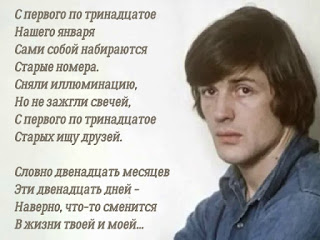
From the first to the thirteenth
Our January
They are gaining themselves
Old numbers.
Removed the illumination
But they did not light candles
From the first to the thirteenth
I'm looking for friends.
Like twelve months
These twelve days -
Probably something will change
In your life and mine.
Probably something will change
On these twelve days
Twelve days
I buried champagne
Under snowfall in the garden.
I will go out with you with a cautiously
Suddenly I will not find him.
We are condemned as hastily
Fairy -tale blizzard
From the first to the thirteenth,
And forever now.
Like twelve months
These twelve days -
Probably something will change
In your life and mine.
Probably something will change
On these twelve days
Removed the illumination
But they did not light candles
From the first to the thirteenth
I'm looking for friends.
These twelve days -
In your life and mine.
Probably something will change
On these twelve days
Twelve days
The old New Year is a poem by Andrei Voznesensky, written in 1975. Gained wide fame in 1987 as a song for twelve days to the music of Igor Nikolaev performed by Alexander Abdulov
The first to the poem the old New Year was written by the song Stas Namin in 1983. With the Flowers group, he took a video clip for this song, which was not broadcast in the USSR and first aired only in 1986 in the United States. The song of the old New Year has not gained popularity ...
In 1985, Igor Nikolaev wrote music for a shortened version of the poem as a song for twelve days , and it was performed by actor Alexander Abdulov in the music film “Stained -ups of the Stained Life Master”, which was completely based on the work of Andrei Voznesensky. But the song gained real popularity for twelve days after its release in 1987 on the television program "Morning Mail"
According to Igor Nikolaev, twelve days the song could not fall into television from due to one line. In the midst of the anti -alcohol campaign, the editors did not miss the lines: “I buried champagne under snowfall in the garden, I will go out with you with a bitter, suddenly I will not find it”
Igor Nikolaev and Alexander Abdulov had to call the author with a request to remake the text. Andrei Voznesensky right there, on the phone, he dictated a politically correct version: “I will go out with you with a bloom, I will not find it”
P. S. Do not part with your loved ones - stream (the live broadcast of the editor -in -chief of the website we from the USSR with the example of a Soviet film with loved ones do not part - in the main roles Irina Alferova and Alexander Abdulov ) / Read more on the link with your loved ones, do not part
Alexander Abdulov Twelve days song Soviet poetry of the USSR Old New Year