
Translated material
To the enemy - thirty meters

17:59, January 9 #
"Favorite
Demagogical reception of nationalists - a directed selection of facts and surnames in
a description of which - not a dirty event in which there are many
The defendants, but only those who clearly indicate the desired ethnic are given, ” - this is not about you, by chance? Not in the eyebrow, after all.
Reply | Notify the answers? | | To actions with the noted ↑

18:34, January 9 #


0
I did not quite understand what you mean. Which is my surname involved in some kind of "dirty event"? As far as I know, neither my maiden surname nor the surname for my husband is not involved in any dirty event. But the surname for her husband appears in a very positive publication about her husband’s relative.
http://www.lechaim.ru/arhiv/218/shlyahterman.htm
I really hope that you did not have the goal of offending me, otherwise I would simply not answer.
Reply | Notify the answers? | | To actions with the noted ↑
The specified link is worth it to open it.
Lehaim June 2010 Sivan 5770 - 6 (218)
To the enemy - thirty meters
Vladimir Shlyakhterman
In Moscow, Zoya Kosmodemyanskaya was buried in the Novodevichy cemetery. Above the grave plate is the figure of a brave Komsomol. And next to him, literally half a meter from her grave, there is a short memorable obelisk. It has a small oval photo of a young man in the Red Army Ushaka and with an automatic machine. Around the picture of the inscription: “You gave your life for your homeland”, “Beloved and only son”. Below are the dates of birth and death: “1923–1943 / Captain Vladimir Grigoryevich Sheinzvit / Member of the CPSU (b) / Order -bearer.”
Why is the young man buried next to Cosmodemyanskaya? Was it a part of the same intelligence group as she? At the request of the editorial office, the main intelligence department answered that the information about the Sheinzvit V.G. It does not have what it followed that it was not listed in their personnel. The GRU recommended contacting the Central Archive of the Ministry of Defense of the Russian Federation located in Podolsk.
So far, in GUK (the Main Directorate of the personnel of the Ministry of Defense of the Russian Federation) and in the Central Archive prepared answers to our letters, I got acquainted with documents on the activities of Soviet intelligence and sabotage groups in the Moscow direction. It was here, in the suburbs, that Zoya Kosmodemyanskaya acted. The fact that Volodya was buried next to her could not be an accident. In 1943, the territory of the Novodevichy cemetery was relatively free. On August 4, 1941, the head of the intelligence department of the headquarters of the Western Front reports to the chief of the GRU Red Army: “489 people were abandoned into the enemy. Over the past ten days, 17 partisan detachments have been thrown across the front line - 469 people. 12 small sabotage groups were thrown - 164 people. ”
Two months later, the intelligence department of the Western Front reports what these detachments and groups had done. Dozens of names are given, there is no Sheinzvit among them. But Zoya is mentioned in the list of the group P.S. Korova and in the report of B. Kraynov: “... Kosmodemyanskaya, Clubs remained with me. I decided with two comrades to set fire to objects. We reached Petrishchev and lit 4 houses. They did not appear at the place of gathering puffs and Cosmodemyanskaya. Waited until the morning ... I crossed the front line on 11/29/41. "
The central archive answered quickly: we have stored a personal file of the Scheinzvit V.G., the accounting and service card, the card with information about its death. Permission to work with personal affairs gives the Hook. And the latter did not detain the answer: “The Main Directorate of the Humanities of the Ministry of Defense of Russia does not object to the admission of the journalist“ Lehaim ”to familiarize ... taking into account the requirements of the federal laws“ On Personal Data ”and“ On State Secret ””.
They advised me where to look for the necessary documents, helped to remove copies. Other papers were filled with hand. Then, almost seventy years ago, no one thought about history: it was not before that - the enemy stood with Moscow. The main document is an autobiography. Volodya - Levsha, wrote with a characteristic inclination to the left. And from the very first lines - a surprise: Born 10.06.1923 in ... Berlin! Father and mother worked in a trade and enforcement of the USSR in Germany. He studied at a German school, where he also studied French, they spoke Russian at home, so from childhood he was perfectly in three languages. In 1929, he became a pioneer, which served as one of the reasons for the departure of the family to his homeland. The boy was in every possible way for the offspring of the Nazis, he was often beaten. In 1937, the family returned to Moscow, Volodya graduated from school No. 336 and entered in 1940 to the Faculty of Biology of Moscow State University. He was a Komsomol member, was engaged in public work and even became deputy secretary of the University Committee of the Komsomol. He was friends with many children of German political emigrants who went to Moscow, with many were familiar in Berlin.
The war broke out, Volodya signed up as a volunteer in the student battalion, but he was not sent to the front, and therefore in early November 1941 he voluntarily went to the army.
The erudite guy was appointed head of the library of the 360th Infantry Division. Apparently, the authorities decided to take a closer look at the soldier, a fluent in German and an excellent knowledge of Germany’s geography. Three months after the persistent requests of the Sheinzvit, the 4th shock army was enlisted by the announcer-translator. The translator in the army is clear, and the announcer? In service - without quotes! - Our troops were the recreation stations of MSU -39 (powerful loud -speaking installation). They were used to propagate among enemy soldiers. It looked schematically like this: a place was looking ahead of the battle formations, closer to enemy positions. At night, it was somehow equipped: they pulled out a tissue, masked it, if the conditions allowed, covered it with a boulder. Several people served the station: the boss, operator, assistant operator. But the main character was the announcer. He prepared the text in German, was supposed to imperceptibly, with the onset of darkness, to get to this trenches and transfer through the mouthpiece. It required considerable courage - often the shelter was located a hundred meters from the German trenches. Often, only hearing the first words, the enemy opened the fire to impress the leading gear or drown it out. It was necessary to wait out the shooting and continue their work. One of my good friend, recently passed away by Alexander Drinder, worked for some time at such a station. Although he did not live in Germany, he decently knew German. He said: “Twice it was not recommended to conduct programs from the same place. The Germans shot this square. In my last program, I only said “Ahtung! Ahtung!”, As two mines exploded nearby. I woke up only in the hospital - the guys opened the fire and dragged me. And so easily could go to the Germans, before their trench was no more than 150 meters. ”
“I spent about 2000 oral and sound programs,” Volodya will write in November 1942. Think about this figure: two thousand times not in the silence of the studio hundreds of kilometers from the front, but on the forefront, more precisely, for his advanced, near the enemy’s trenches, conduct a conversation with him and convince him, and he shoots at you at that time. And not from the windfill, but from the gun, mortar, machine gun, machine guns. But in order to convey convincing material, it is also necessary to prepare it.
Sheinzvit, like his colleagues, did everything himself. And the transfer is not for 5-10 minutes, but for an hour and a half. And if it is also addressed to a certain military unit, then, so to speak, “local” material is needed. Where to get it? Interrogation of the prisoner, letters, diaries, and even think about ensuring that the families of involuntary authors are not injured. It was ridiculous to expect that, after the most important transmission in 1942, the Germans ran in groups to our side with their hands raised. But to sow in their souls doubt, to make you think ... And as a result, it is not so blindly to fulfill orders, to think: for what I have to die here? Do I need this war? For the sake of such an insight of the German soldier, the night and days, Volodya Sheinzvit worked on end.
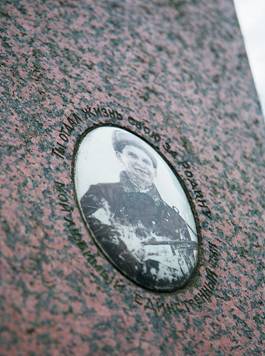
Photo by V.G. Sheinzvita on a memorable obelisk at the Novodevichy cemetery
In the report for May 1942, the head of the political department of the division indicates: “On May 22–23, 14 programs were held near the village of Lobok. Duration - from 1 hour 20 minutes to 1 hour 30 minutes. On May 25, 8 programs in the Velizh region ”(it was in these sites that Sheinzvit fought). But the lines from the report of Volodya himself: “For the period from 11 to 17, 156 sound transmissions for the enemy troops were carried out through the sound machine. For three days from different positions, programs were made for soldiers and officers of the 547th Infantry Regiment of the 328th German division. On the night of June 11 to 12, the car worked in the area of the village of Pozdnyakovo. The distance to the enemy is 700-800 meters. 27 sound programs. June 12-28 programs, June 13-June 26-June 27 and 15-24. Before German trenches-800–1000 m, 1,500 meters. Transmission for soldiers and officers of the 205th Infantry Division, for the garrison in Demidov. "
The sound machine worked flawlessly, audibility is excellent. The scouts, who were three kilometers in the German rear, then said that they had heard the program perfectly. And there were also those that they heard the voice of the Shanzvit 6–8 km from the place of transmission.
Senior Politrok I. Leonov writes a brief report on sound and oral programs from May 31 to June 2, 1942 for enemy troops located in Veliga, from the defense section of our 332nd Infantry Division. “In total, 45 sound transmissions through MSU -39 and 13 oral transmissions were carried out. The text was read by the 2nd rank technician Shancvit from 22.30 to 23.30. The distance to the enemy is 30–40 meters. The audibility is good. The wind is weak, the weather is clear. The enemy repeatedly interrupted the transmission of rifle-machine gun fire. I listened to the report of the InformBuro about the battles near Kharkov carefully. ”
“30–40 meters”! .. Any puny soldier easily goodbye grenade. And a sniper rifle is not needed - the machine has a slaughter force at such a distance. Yes, just to run or crawl to a bunker with the installation of a German would take no more than five minutes. It is unlikely that a company was exhibited to protect the dictator. Frontlines know what “30–40 meters” is to the Germans.
And how did German soldiers react? “In various places in different ways,” said Volodya. - In the area of the village of Pozdnyakovo, the enemy usually leads machine gun and mortar fire in the evening and night. During the programs, he did not make a single shot. On the site of the Yamna, only single shots were heard on the first night. On the second night, the enemy opened mortar fire, feeling the whole village for them. One of the mines exploded in an old position. In Demidov, the enemy on the first night at the beginning of the programs opened a hurricane machine -gun fire, but in the middle stopped it. On the second evening, I had to change the position, because the enemy during the day led the shooting of this position by artillery. At night, a German correspondent appeared, flying at a very small height. He threw a red rocket about a hundred meters from the working station. In the trench, in which there were senior political instructor Bikmaev, instructor Politruk Zilberman and the head of the car Junior Lieutenant Drozdov, a German gun grenade fell, but did not explode. "
At the end of the report, a certificate: “15 sound programs were held by the 2nd rank technician retouching, 141-the 2nd rank technique-engineer of Sheinzvit.”
Volodya needed to know how intelligible their sound programs were. Maybe all this is wasted, in vain risk life? He is brought by the next prisoner, the intelligence department of the army desperately needs certain data, but Shanzwit manages to ask him about the programs. The answers are different, but from them it follows: German soldiers listen, do not perceive something, talk about something, even argue, but most importantly-they listen! And the German command was alarmed: even a plane with special equipment was equipped to find a hated sound station. No, it is not in vain that they work for nights, constantly risking being killed or worse - to be captured.
At the Army meeting, Sheinzwit is a report on the influence of war on the moral state of the German rear. There are many facts, episodes, drawn from interrogations of prisoners, letters, diaries of soldiers and officers. And of course, he talks about the quality of our programs: “We need to prepare good announcer personnel. Because the announcers with poor pronunciation or with a Jewish accent of the enemy’s troops obey without attention, which the prisoners of war themselves tell. ” Agree, from the mouth of the Jew to hear this was surprising. Volodya Shanzvit cannot be abandoned - he has an ideal pronunciation. Judging by the surnames mentioned in various documents, there were many Jews among the announcements. And most likely, they did not live in Germany. It seems like a trifle is an emphasis, but go, they listen to without attention.
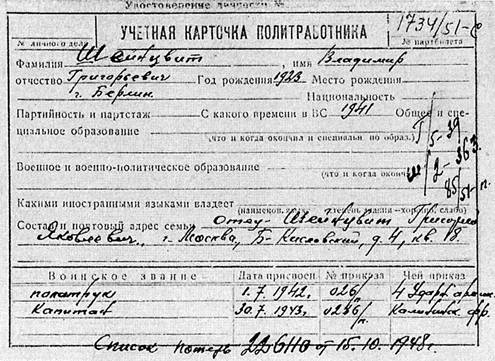
The discount card of the political worker V.G. Sheinzvita
One of the duties of Vladimir is the preparation of leaflets addressed to German soldiers. This case turned out to be not as simple as it seemed. It is not enough to speak German well, one must have an idea of those whom you turn to, know their way of life, find the words, turns, comparisons that they understand. In order for the soldier to understand: those who are well aware of his life, be addressed to him. Unfortunately, many compilers of such leaflets, although they knew the language and could competently build phrases, were never in Germany.
The Sheinzvit in this regard was easier, and he tried to ensure that his leaflets were intelligible. In one of the characteristics, the head of the department of the political department of the army writes: “Senior Lieutenant Sheinzvit ...> German knows perfectly, Germany knows well. He compiled a number of sound programs and texts of leaflets for enemy troops, which at one time were sent by exemplary by the political department of the KF (Kalinin Front. - V. Sh.) To other armies. In the work, Comrade Sheinzvit is neat and shows a lot of initiative. ”
But the leaflet is compiled and printed. How to deliver it to the "addressee"? The easiest is an airplane. Simple, but not always effective. It seems to be thrown over the location of the German part, and the wind took them far into a clean field or carried them to the forest. Going at night with groups to German rear for reconnaissance or to capture the “tongue”, Volodya takes a pack and, crawling to the barbed wire in front of German positions, carefully attaches leaflets to the thorns. When it dawn, German patrols will go around their positions, they will probably take them to the officer, and some will still put them in a pocket: it is still interesting what Ivan Fritz writes there. Someone will then throw it away, and someone will leave it-the leaflet is not only a piece of paper, but also a pass for surrender.
Not every night the groups went to the German rear. Yes, and it was dangerous: often barbed wire was pulled closely from their trenches. Often the “thorns” was with the “secrets”: you just touch it - it makes a signal, and immediately they open fire on you. But leaflets must be distributed. And Volodya is amazed: what a savvy people we have! One craftsman even offered to shoot from a slingshot: they wrapped a pebble with leaflets. Tried. Flies! Another made ... the box -shaped snakes. Apparently, in childhood he was fond of them. The prisoner later showed that these snakes especially annoyed their officer. He personally shot snakes when they appeared above his trenches. Another voluntary assistant made ... small rafts, leaflets were laid on them and launched with the flow. There was a lot of rivers in the district. Received information: the Germans caught such boats. Know was curious: what is there?
It was almost impossible to convince the German soldier in the spring and summer of 1942 that Germany wages and that the defeat of the Reich was almost impossible. As the German reasoned in 1942: no matter what Russians write in their leaflets, the Wehrmacht tanks rush to the Volga, the alpine arrows are preparing to hook the flag with the swastika on Elbrus, German soldiers are treated in Crimea, Kyiv-the rear city, Leningrad is suffocating in the blockade. Yes, here I myself am not so far from Moscow, but where is Berlin? Yes, they retreated a little, straightened the front, the damned frost helped the Russians. Soon we’ll take Moscow anyway. The Führer promises to equalize her with the ground. And he knows how to keep his word.
In April 1942, Volodya Sheinzvit was talking with fighters and commanders of the 49th separate rifle brigade. And for the conversation to be more intelligible, he took with him ... the captured - corporal Karl B. Say, listen to the German, and you will understand who you are fighting, so to speak, from the firsthand. And a hail of questions rained down on the corporal. They asked: who, in his opinion, started the war? “Germany,” the German answered, “but because the Soviet Union was going to attack Germany.” They asked the following question: how does the working class of Germany relate to Hitler? And the prisoner who knows what the true answer threatens, nevertheless says: "Hitler is very popular among workers."
Of course, leaflets and sound programs were not useless, forced to think about something. In one of the documents I read: in March 1942, six soldiers and non-commissioned officers voluntarily transferred to the division divisions. Only six or already six? Two years later, there will be thousands of them, and in 1945 the number of prisoners was already calculated hundreds of thousands. Yes, of course, Katyusha and T-34 tanks turned out to be very effective arguments. But we will not discount propaganda from the accounts. It was important to turn to the troops, but to the soldiers of certain units. Thus, intelligence found that the 360th division is opposed by the Jaeger battalion and the so -called "redeeming" battalion (the "redeeming" fell for small sins, it consisted of Germans, Austrians, Poles). Volodya writes leaflets addressed to these soldiers, leads the facts that he recognized from prisoners and defectors. Sometimes the texts of the leaflets were transmitted through the ships of the sounding stations. Once the Sheinzvit was informed: tonight, listening to the program, where episodes were given, the statements of specific persons, soldier Fritz Kurtush moved to our direction.
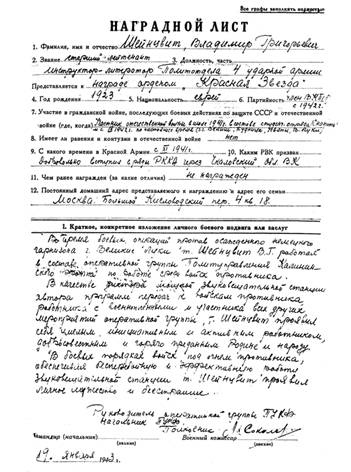
The characteristic issued by V.G. Sheinzvit the head of the 7th branch of the Political Department of the 4th Shock Army, the senior battalion commissar V. Nemchinov.
December 31, 1942
In autobiography, Volodya writes: “He participated in the battles for Velizh (February, March, April, May 1942), Radunitsa (February, March),” lists other points. Of course, he doesn’t report where he went on the attack or how many times had to take up arms when he was lying in a tomb with MSU -39 in front of the combat guard. He just participated in the battles, what to spread here.
The head of the political department of the Kalinin Front, Colonel Sokolov - he also headed a special operational group on that site - more speech, although very concise. Presenting the Scheinzvit to the government award, he notes: “Skillful, initiative, active worker; In the battle formations of troops under the enemy fire, he ensured uninterrupted and effective operation of the sounding station, showed personal courage and fearlessness. ”
The performance was signed on January 19, 1943. And the very next day, the commander of the troops of the 4th Shock Army, General Galitsky, on behalf of the Presidium of the Supreme Soviet of the USSR, awarded Senior Lieutenant Sheinzvit Vladimir Grigoryevich the Order of the Red Star. As stated in the document, for the exemplary implementation of combat missions and the valor and courage shown in this case. Other members of this sound transmitting installation received combat awards. Unlike other similar documents, this one was not published, passed under the heading “secret”.
Vladimir not only interrogated prisoners (in official protocols, for some reason it appears as a survey), but also got acquainted with documents, diaries, and letters. And the facts cited in the programs sounded truthfully - they were from life.
And once the authorities received from the Sheinzvit "Appendix to the protocol of the Polls of the Pale-Corrector of the 328th Infantry Regiment of Hans Schroeder." Hans turned out to be talkative. When asked by Volodya, whether he knows jokes about Germany’s leaders, he “betrayed” several.
Those who read the memoirs of our scouts or documentary novels about their activities know that illegal immigrants of all their messages - “lightning” or analytical notes - were addressed to the director (with a capital letter). So the chief of the GRU, the main intelligence department of the General Staff of the Red Army, was called. The director sent their reports to Sorge, Philby, Radi, Gurevich, Kuchinsky and others. Often the scout did not know who exactly at this time leads the GRU, that is, who is the director today. The leaders of this special services, alas, changed quite often. Someone became a marshal, while others rehabilitated posthumously.
If I were a director, I would certainly pay attention to a young officer who has perfectly owned German with the Berlin accent, with impeccable manners, which was at ease in contact with the Germans, who was in battles and invited him to his department. He would have studied specific techniques, put it in German uniform, supplied reliable documents, legend, “awarded” with a real iron cross and transferred to the German rear, but closer to the front line. So that he was consumed there for some time, and then directed, well, say, to Berlin. Here, with the help of a Stirlitz, the Frontovik officer, the Cavalier of the Iron Cross, would get into the military department, and soon encryption in the name of the director would flew in another wave.
So inspired, I fantasized before the cousin of Vladimir Evgenia Davydovna. And he heard in response a stunning:
- In fact, it was. I don’t know which director - in Moscow, in the intelligence department of the 4th shock army or the Kalinin Front - but he reasoned something like that. You did not pay attention to the fact that in the personal file of Volodya there are no documents about what he did after February 1943? There is no order to assign him the title of captain, other records. Meanwhile, I know for certain that he crossed the front line several times.
“Did he tell you that?”
- Of course not. In 1943, I myself was in the front-line hospital-a nurse, bursting into Moscow once or two, spoke only with Volodya's father. Grigory Yakovlevich and my dad are his native brothers. Dad was at the front, and Volodya's father worked in the People's Commissariat of Non -ferrous metallurgy. And only after the death of his son did he talk about it. And after the death of Uncle Grisha, the German form turned out to be with us. By the way, on the last “business trip” to the German rear, Volodya left his father’s apartment in Bolshoi Kislovsky Lane. He was unhealthy, the authorities let him go home. Suddenly they called and said that it was necessary to urgently leave, the car was sent after him. Grigory Yakovlevich said that his son had not yet recovered. But where is there ... When the front line crossing the front, Volodya spent the night in some village and picked up a typhoid. In Moscow, he was put in a hospital, but alas, it was not possible to save him.
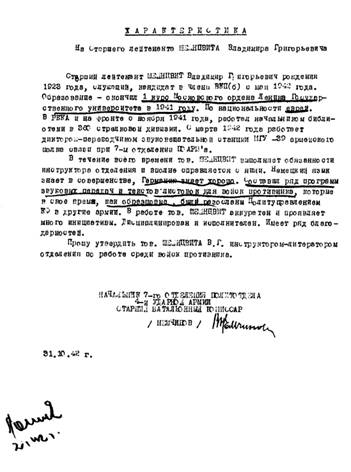
Award sheet V.G. Sheinzvita.
January 19, 1943
We have until last year, ”continues Evgenia Davydovna, - his German officer uniform was stored - a tunic, trousers, a cap, an iron cross and a medal. Unfortunately, a moth ate clothes, and the awards have been preserved. You can assume different versions: why in the personal file of Vladimir Sheinzvit there are no documents about this side of his activities at the front. Maybe he reported verbally that he found out what he had seen. And those with whom he talked somehow formed this information. But they walked, so to speak, to another department. Maybe there were written reports, they passed, of course, under the heading “secret”, which has not yet been removed today.
Although so many years have passed since then, it is probably still alive of the acting faces of those events, and in order not to involuntarily not damage them, it is worth it to postpone with the declassification of their names.
Captain Vladimir Sheyintsvit died in the fall of 1943. He was only twenty years old. The only son ... He was not introduced at Hitler’s headquarters and did not inform the director about the secret plans of the Supreme Command of the Wehrmacht. He fought in the battle formations of our units, extracted specific information about a specific enemy in a particular section of the front: about the number and composition, about weapons and moral condition, worked to bring down this condition, weaken. And it was very important, no less important than knowing about Fuhrer's directives.
The editors of the magazine thanks the employees of the Central Archive of the Ministry of Defense of the Russian Federation for help in the search and selection of materials for publication.
http://www.lechaim.ru/arhiv/218/shlyahterman.htm
