
Translated material
Non licet vos esse

Yesterday we tried to hold a round table on the film “You Shouldn’t Be.”
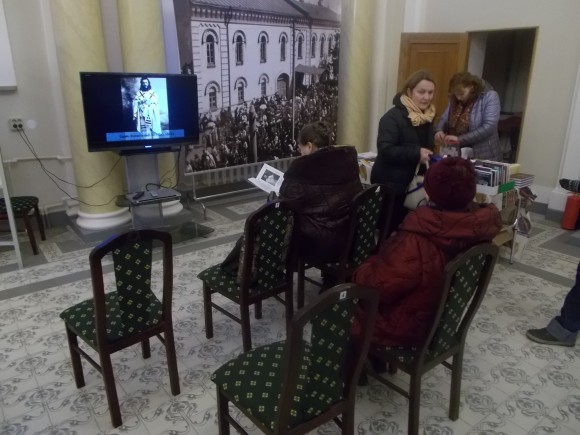
Screening of the film "You Shouldn't Be" at an exhibition in Moscow. I took the photo here .
The film had to be shown twice. Over time we got confused. The film is quite simple and tells how the Soviet government plundered churches, and those who resisted the looting were repressed. The film indicates that there were about one and a half thousand protests against the looting of churches by the authorities, and many priests and ordinary laymen were shot and convicted for this. A typical film about historical horror.
After the film, all participants were asked the question, so what’s the matter, how long will we continue to do this. 9 people spoke in two rounds. From all that has been said, we can conclude that in order for this not to happen again, it is necessary to prevent: 1. intolerance, 2. lack of freedom of religion, 3. people’s rejection of Christianity as love for each other, 4. rejection of the traditions of their ancestors, 5. a formal approach to faith, 6. falling into consumerism, 7. rejection of faith as such.
I got the impression that people were talking about the same thing, but did not want to hear each other. Some were frightened by the words "liberalism" and "democracy", others were frightened by the words "tradition" and "faith". At the same time, everyone agreed that the world cannot be built on hatred of each other, but they immediately took some kind of aggressive pose: freedom - permissiveness, faith - obscurantism.
I always have the feeling that we want to hear from others only what we want to hear, the internal beliefs of others, a priori, interest us only in the area that is closer to us or help us accept us as less good, to be proud of our own righteousness. Why are we drawn to our opponents, only because against their background we feel our own worthlessness; the resistance of others interests us only to cultivate our own pride, our own importance.
“Why didn’t they rebel?” asked one of the viewers of the film while watching and Grigory Spichak answered: “Because this is not the essence of Christians.” Why is it not the essence of Christians to rebel against another, but every day we rebel against something we don’t like and are strengthened by this, while we choose for rebellion not the one who is stronger, but the one who is weaker than us, who will certainly lose and will let us again feel the strength of our own faith. Our faith is not in the search for brotherhood in order to seek spiritual strength through help, but in the search for the weak to trample underfoot. We don’t hate the devil, we hate weak and sick people who are susceptible to the devil. And this is a disaster. We ignite our own passion by denouncing sick people who have lost God and succumbed to the devil. We despise them and are not going to extend our hand to help them, we are not trying to look for our weak brothers in order to save them through brotherhood. We don’t want to extend a helping hand to the sinner, we don’t want to, we want to trample him, rise on this trampling, and we ourselves find ourselves trampled.
At the very end of the film there is a story about the Alexander Nevsky Brotherhood, which arose in 1919 and could turn out to be the birthplace of a new clergy class to replace the one lost during the years of terror, but this became possible precisely because, despite the violence and robberies that fell on the church, people began to look for ways of fraternal help and fraternal unity and turned out to be attractive even to non-believers. What was valued in the years of early Christianity and what created Christianity as a human movement suddenly turned out to be a lifeline for Russian Orthodoxy in the 20th century.
And today, looking at these films, which should give rise to hatred for those who trampled Christianity, we give birth to only one brotherly feeling for those who are sick and mistaken, for those who, due to circumstances, were defeated by the evil one. Paradoxically, the words love and tolerance turned out to be the most important ones heard at this show. Everyone can love the good, but one must cultivate in oneself a love for the ugly and unpleasant. Everyone can be tolerant of the tolerant, be tolerant of the irreconcilable, this is real tolerance, real Christianity.
The organizers of the film screening would like to bring the exhibition “You Shouldn’t Be” to Syktyvkar.
Special thanks for participating in the round table: Grigory Spitchak, Mikhail Rogachev, Igor Babrakov, Leonid Zilberg, Marina Kuzbozheva, Oleg Kublitsky, Mnatsakan Nekogosyan, Father Mikhail, Elena Sherbina, as well as all other participants from the Preobrazhensky Brotherhood. I would also like to thank those guys from the Public Chamber who organized all this and, despite the day off, came and put up with us.