
Translated material
Significant non -return
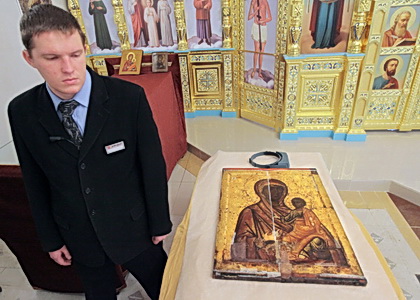
After the adoption of the disputed bill “On the transfer of religious property to religious property”, the question arose of religious museum exhibits on the agenda. It seems that the existing law “On the Museum Fund” gives guarantees for the preservation of museum meetings and collections into inviolability. But in Russia, according to the proverb, the law that was drawn up. The case with the Toropetsk icon of the Mother of God Odigitriya demonstrates this with all the clarity.
Recall that the icon of the XII-XIV centuries, despite the protests of the employees of the Old Russian art department of the Russian Museum, was at the insistence of the Ministry of Culture, was transported to the temple of the elite village near Moscow. The initiator of the move was the president of the Sapsan group of companies Sergey Shmakov, Patriarch Kirill supported his request. The length of stay of the shrine was extended several times. And finally, Deputy Minister of Culture Andrei Busygin states that the icon will soon take a place in the Korsun-Bogoroditsky Cathedral of the Toroptsa, from where it was seized in the 30s of the last century. This cathedral, by the way, restores the same shmakov, for which it can only be thanked, but why risk the most valuable icon? On the way to the district center of the Tver region, the icon will be brought to St. Petersburg for examination and restoration. Then, in a special capsule, where she is now, they will be sent to the place of permanent stay.
By doing so, the Ministry of Culture formally does not violate the letters of the law. Indeed, according to the existing legislation, it is possible to transfer to temples to temporary unlimited exhibiting museum objects. But this action gives a certain signal to the church and museum community and demonstrates by what scheme the movement of ancient Russian painting from places with temperature and humidity regime to the burning places of stearin candles will be carried out. The experience of such a transfer in the nineties and zero years showed that it is not possible to do without serious losses here. It is enough to recall the story with the icon of the Virgin of Bogolyubskaya, who actually died during liturgical exploitation.
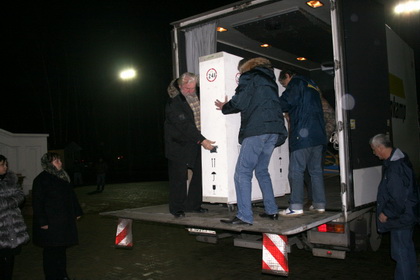
Supporters of moving the icon to the cathedral say that such a fate does not threaten a widely revered icon: the conditions in a hermetic capsule are better than in the museum storerooms. However, experts say that a lot of air is needed for normal storage. The chronicle icon should breathe. Otherwise, the inner crack existing between the boards will diverge. It was because of this crack that the icon in the mid-90s was removed from the exposition and sent to the storerooms.
There is no doubt that this iconic transmission will give rise to a whole wave of requests from dioceses and individual parishes. And if the metropolitan museums will still be able to fight back, then the regional museums are unlikely to resist. At the same time, the church will also suffer heavy losses, and not only reputation. Indeed, raking up ancient Russian painting from museum halls, the Russian Orthodox Church MP actually opposes a wide sermon in the language of colors.
Why cannot modern parishioners be satisfied with good copies from ancient shrines? Does it come from pride? From the reluctance to remember the common good? Questions, of course, rhetorical. There are many laity and even - it’s scary to say - priests need to be announced, that is, to be instructed in the foundations of faith, because their ideas and lifestyle are often far from Christianity. In the patriarchate of Alexy II, church life was sometimes constructed around the traffic of shrines and superstitions. It is not easy to get rid of this heritage. In addition, in the large process of the formation of the ROC MP as the owner of church managers, the temptation is intensified from a nationwide cake, regardless of long -term benefit.
The position of the Ministry of Culture, designed to maintain a popular treasure, is not entirely clear in this matter. It seems that after the abolition of Rososhranchkulture, the Avdeev department began to pay attention to the museum workers even less. Until the last day, the Russian Museum did not know that the term of stay of the Toropetsk icon in the village near Moscow was once again extended. Vladimir Gusev stated that the agreement was like this: in September 2010, the icon would return to the museum. "It is a pity that the icon has not returned to the deadlines stated by us. I consider this a wrong decision that can interfere with a further cultural dialogue," he says now.
Of course, it is wonderful when the minister states that the Ryazan Historical and Cultural Museum-Reserve will not move anywhere until he gets adequate areas. But why does he not denote his position in other similar situations? What to do, for example, with a Uglic museum that lost the Transfiguration Cathedral? Several dozens of unique icons were exhibited here. Now they are removed in the storerooms. The administration of the region did not offer any compensation to the museum, and the Ministry of Culture is silent. Or with the Kostroma Museum, expelled from the Ipatiev monastery. The museum’s collection is stored, stands with stacks, and the ministry does not experience any discomfort from this. The monastery also looks like a bunny: I threw a museum into the street, and at least henna. The decency for the sake of at least began the plate fee "for the needs of the museum."
It is curious that President Medvedev does not take as a clerical position as the Ministry of Culture. After all, he signed a document that secured the status of museum-reserve for the Kulikov field, Mikhailovsky, etc. It is important that one of the key provisions of the document provides for the possibility of creating museums-resorts based on ensembles, including church buildings.
Unfortunately, the museum community has become strong today. Directors of museums often openly serve the interests of Avdeev’s department, not culture. The same Vladimir Gusev, transferring the icon to the temple, went against the opinions of most employees of the Old Russian department. However, a year ago, he voiced the idea of creating a house church at the museum. A similar temple - St. Nicholas in Tolmachi - was created in the Tretyakov Gallery. Here, in practice, the idea of the interaction of the church and culture is implemented. Now the director of the Russian Museum does not remember this venture. Are things really so bad that there are no icons soon to place them in a museum temple?
Officials promise that on the way to the Toroptsy, the ancient icon of the Mother of God for some time will linger in the northern capital. Of course, it would be good if she stayed here. But what can the cultural community do so that the realized “comrades” stop to manipulate her fate?
Boris Kolymagin
Source: "Hedgehog"
Photos of RIA Novosti