Date
Author
Татьяна Желудовская

Preserved copy
Translated material
Breakthrough

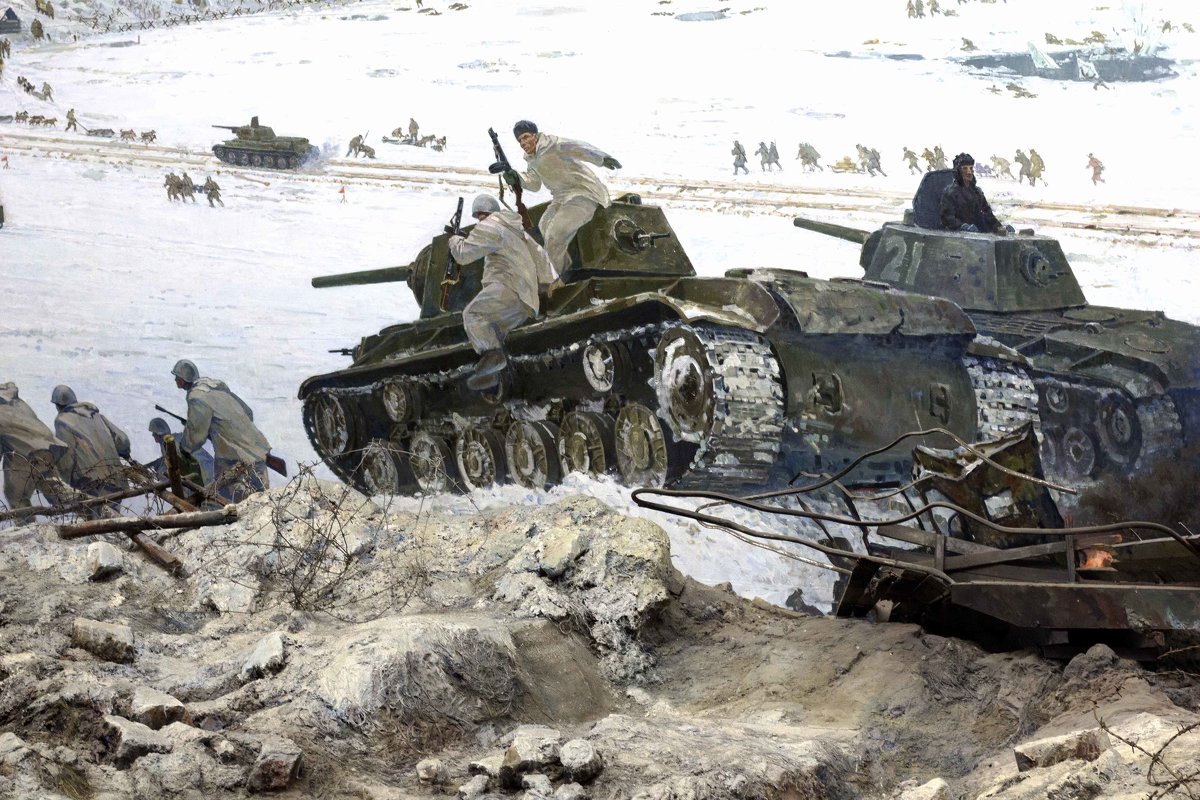
January 18 is a special date for Russians and especially for St. Petersburg residents. On this day back in 1943, during the Great Patriotic War, the blockade of Leningrad was broken. Despite the fact that the city remained besieged for another year, with the breaking of the blockade the situation on the entire Leningrad Front improved significantly.
According to the plans of the Headquarters of the Supreme Commander-in-Chief, Soviet troops, with attacks from two fronts - Leningrad from the west and Volkhov from the east - were supposed to defeat the enemy group holding the Shlisselburg-Sinyavinsky ledge. Command of the fronts was entrusted to Lieutenant General L.A. Govorov and Army General K.A. Meretskov. The interaction was coordinated by representatives of the Headquarters - Army General G.K. Zhukov and Marshal K.E. Voroshilov.
On January 12, 1943, after artillery preparation, which began at 9:30 a.m. and lasted 2:10 a.m., the 67th Army of the Leningrad Front launched a powerful attack from west to east. The offensive was supported by the 2nd shock and 8th armies of the Volkhov Front, ships, coastal artillery and aviation. Despite the stubborn resistance of the enemy, by the end of January 13, the distance between the armies was reduced to 5-6 kilometers, and on January 14 - to two kilometers. The command of the fascist German troops, trying to hold Workers' Villages No. 1 and 5 at any cost, transferred its units from other sectors of the front. The enemy group unsuccessfully tried several times to break through to the south to its main forces.
And 6 days later, on January 18, on the outskirts of Rabochy settlement No. 1 near Shlisselburg, units of the 123rd Infantry Brigade of the Leningrad Front joined forces with units of the 372nd Division of the Volkhov Front. On the same day, Shlisselburg and the entire southern coast of Lake Ladoga were completely liberated.
By January 18, 1943, about 800 thousand people remained in the city. Around midnight, a message was broadcast on the radio that the blockade had been broken. The townspeople began to take to the streets, shouting and cheering. All of Leningrad was decorated with flags. There was hope that their hometown would be liberated. And although the blockade ring was completely lifted only on January 27, 1944, and as a result of breaking the blockade ring, only a narrow corridor was recaptured - a strip of peat bog, the significance of this day for the future fate of Leningrad can hardly be overestimated.
A corridor 8-11 kilometers wide, punched along the coast from the Volkhov Front to Shlisselburg, restored the land connection between Leningrad and the country. Construction of the Shlisselburg–Polyany railway, 36 km long, began along the southern shore of Lake Ladoga. On February 6, trains began traveling along the new “Road of Life” to Leningrad. The first, main step towards the liberation of Leningrad had been taken.
And on January 27, our country celebrates the Day of Military Glory of Russia - the Day of the complete liberation of the city of Leningrad by Soviet troops from its blockade by Nazi troops .