
Translated material
49 conversations
Today we publish the record of the next, already fourth conversation “ 7x7 ” , in which journalists Dmitry Sakharov, Valery Chernitsyn and Oleg Kublitsky took part. A formal reason was the forty -fifth anniversary of the adoption of declarations of the second Vatican Council, and the topic of discussion is the problem of Christianity relations with other religions.
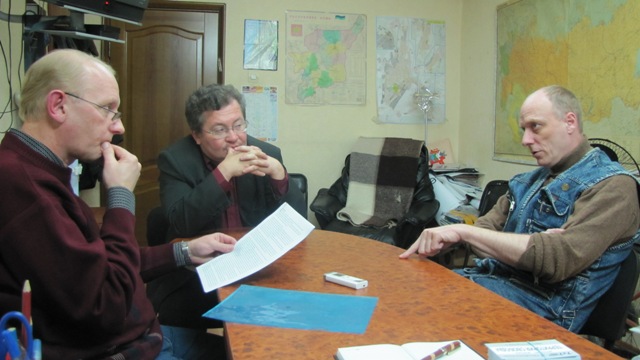
Dmitry Sakharov (D.S.): - Today is just the anniversary - on the twenty -eight of October sixty -fifth year, at the end of the work of the cathedral, the declaration was adopted and signed. It would seem that we are before? From my point of view, these documents are completely revolutionary in nature and are comparable in meaning with the epistles of the apostles. They summarize the two thousandth period, when the Catholic Church looked at the world around the world, at other religions and denominations through the sight and through the torture windows.
Valery Chernitsyn (V.Ch.): - Well, I would not use such epithets ...
DS: - In any case, the declarations say that all non -Christian religions are not enemies of Catholicism.
Oleg Kublitsky (O.K.): I can’t quote exactly, but approximately there it is said that the Catholic Church is ready to accept everything that is truly a saint in all these religions. Naturally, there could be no question of any “truly saint in non -Christianism”. A lot is said about the kinship of “in Abraham” of Christianity with other religions.
DS: - Yes, and at the same time there is especially a point regarding Judaism. There they list all the issues related to the previous discrepancies in the views and say that the church condemns these persecution, "remembering the legacy common with the Jews, driven by not political considerations, but spiritual love in the gospel." And here it is also declared, in the development of this thesis that anti -Semitism is a sin against God and humanity, which is impossible to be a Christian, being an anti -Semite.
V.Ch.: - And there is the concept of "anti -Semitism" that uses there?
DS: - Anti -Semitism, yes. Since that time, the process began, not so much declarative as institutional - the process of extrusion from Catholic liturgics, from the Catholic personnel of the anti -Semitic element. All prayers were seized in which Jews and Jews were impartially mentioned, those hierarchs of the Church that allowed themselves anti -Semitic statements were punished. Actually, this process began in Catholicism earlier, but it was at the second Vatican Cathedral that was legally designed and fixed declaratively.
It is clear that only the Church cannot be considered the cause of world anti -Semitism - there are a lot of factors, but, of course, for many centuries it has been one of the most powerful, influential and branched institutions that threeps anti -Semites. And for many centuries, believers went into the world, having heard about the sermons with curses to the Jews ...
V.Ch.: - But I am not only not convinced that it was the church that breed anti -Semites, moreover: first of all, anti -Semitism, possibly was generated by clashes at everyday level, at the domestic level.
OK: - This is all about Western Europe. And here, in Russia - from where is anti -Semitism where?
V.Ch.: - The same thing is with us: I think that this is not so much the original attitude of the Orthodox Church as a real contact in public and purely household planes.
OK: - So this is an anti -Semitic statement: they came across villains and treated them like villains ... or how? What did you touch with?
V.Ch.: - With something that caused anti -Semitic sentiments.
OK: - So, all the Jews “something like that” possess, why they do not like them? ..
V.Ch.: - For a minute, a minute ... I have not said anything like that yet. I only said that social reasons cannot be discounted. It’s just a matter not only of political, ideological or religious reasons - not only that a certain installation from the amvon was given, when a kind of priest said, and all parishioners began to relate to Jews badly. It seems to me that specific social situations have made a significant contribution to the development of anti -Semitism.
OK: - But the current nationalists use the inheritance of the church - in any case, the word "Jews" took up the church -Slavic language. Of course, in the text of the gospel it had no negative coloring before, but now it has become a beup.
V.Ch.: - It does not follow from this that the church thereby fueled anti -Jewish sentiments among the people. I can’t understand at all why often a spark that ignites negative phenomena in our society is considered almost everything that comes from church everyday life. Where does this opinion come from?
DS: - Well, given the influence of the Church in the past, the centuries before last, of course, this could not but affect such an idea.
V.Ch.: - I am forced to draw your attention to this: now, when someone uses the word "Jew", it will definitely be qualified as anti -Semite. It is impossible to evaluate the use of this word, say, in the nineteenth century from today's removal from the past centuries ... We tend to transfer today's assessments to situations in the past. That, in fact, is all.
OK: - And and all kinds of printing materials about Jewish -Masonic conspiracies? This is in Russia - Sergey Nilus, first of all. This is in the church fence ...
DS: - Perhaps. But, returning to the Vatican and everything related to the cathedral: they tried to get out of this system as much as possible, tried to establish a constant dialogue, the Pope in the synagogue appears almost three times a year, not to mention constant trips to the Holy Land, and so on. Similar processes were to some extent in the Russian Orthodox Church. The fact is known when the late Patriarch Alexy II visited the New York synagogue and made a serious reconciliation speech there, which I evaluate as a spiritual and moral feat. This speech was called "your prophets - our prophets."
OK: - For which he was accused of Judaism ...
DS: - That's why the feat - I think, Alexy II understood very well what this performance would turn out for him, and turned out, ultimately. Some hierarchs of the Church simply ceased to remember the patriarch, and this is already a sign of the beginning of the split ... But I believe that this impulse is worthy of all respect and praise for courage, for the moral and civil perception of the problem.
V.Ch.: - In any case, the Synod was not going to the Synod and officially nobody patriarch then condemned, no one raised the question of its replacement. And the fact that some fermentation began in near-church circles is natural.
DS: - Well, not at all "near -church". The main critic of the Patriarch was Metropolitan of Leningrad (later - St. Petersburg) and Ladoga John Snychev. “Near Church” can rather be called Sergei Nilus - the Orthodox writer. But when the act of the Patriarch condemns the Metropolitan of the second capital of Russia, this is serious. So this once again shows that in a sense, the Russian Orthodox Church breeds and brings up anti-Semitism. At least does not stop. I think that it was precisely because of such a reaction of church and “near-church” circles that Patriarch Alexy II was awarded to award the famous anti-Semite, editor of the “Orthodox” Dushenov and Simonovich-Khnicich, the head of the Union of Orthodox Borensers ... It was a gesture of retreat.
V.Ch.:-Let us recall this: Was the Catholic Church in any countries someday such persecution that the Russian Orthodox Church in our country was subjected to?
DS: - In France, during the French Revolution.
V.Ch.: - A very short period, not marked by mass repressions, and with the advent of Napoleon all this ended. It seems that from this absolutely nothing follows, especially, the church, like any Christian, in principle, must be able to forgive. But the genetic pain, the genetic wound, inflicted on our church cannot help but cause an appropriate reaction. And you perfectly understand that any person who is trying to understand history will begin with what party the persecutors belonged to, and will be willy-nilly to look at their surnames ... Next-in the text ...
OK: - True, on the other hand, one can ask: did the Orthodox Church ever be persecuted as Jews were pursued in their entire history? This is where genetic pain and memory ...
V.Ch.: - Undoubtedly, this is quite obvious.
OK: - Then the vicious circle turns out. Hopelessness?
V.Ch.: - If we have touched on this problem, I will say this: there are Jews and there are Jews. Some people solved their problems, participating in the Zionist movement, actively preparing the Palestinian lands and diaspora in Europe, and someone prepared a revolution with all the ensuing consequences.
OK: - Well, generally speaking, our revolutionaries destroyed not only Orthodox churches. Everyone suffered - and synagogues fell under the arm, and mosques. It was about the fight against religion in principle, and not only with Orthodoxy.
V.Ch.: - But the scale of persecution of Orthodoxy with this is not comparable.
DS: - At the same time, it is known from history that many Orthodox shepherds very actively opposed anti -Semitism and against Jewish pogroms. Another question is today. Of course, one can, and we must be understood with all the above historical circumstances. But what do we have today? I, a person who is a secular, non -church and distant from church life, develops a stable sensation of the identity of the Russian Orthodox Church with anti -Semitism and xenophobia. In modern Catholicism, this is not. They somehow began to get rid of this problem and obsolete with rare exceptions.
OK: - Perhaps it was easier for them to do this - the Catholic Church has always conducted the most active missionary work, there have been a long time to the Catholics in Africa and the Japanese in Japan. And all of them, regardless of nationality, felt full -fledged Christians and pious Catholics. In the nineteenth century, we scared children in the nineteenth century: demons and non -Christ ... The question of missionaries was seriously raised precisely under Alexy II, in connection with the spread of Protestant and Catholic preachers in the country.
You tell me what: we constantly say about the absence of a national idea, about the absence of a certain unifying factor, and Orthodoxy is proposed as an alternative to Bolshevism today. But, given all of the above, it turns out that Orthodoxy, used as such an idea, will not only not unite the Russians, but, on the contrary, on the contrary, will be even more briefing us?
DS: - As far as I understand it, even within the church there is a fairly clear and understandable majority of opinions that believe that Orthodoxy cannot be an ideology. Some moral imperatives - yes, but as an ideology ...
V.Ch.: - Of course, new ideological movements can exist and arise that will rely on the ideas of Orthodoxy. But no more. As practice shows, in many of these trends, Orthodoxy over time becomes just a butaforia, an external shell - people fulfill some church prescriptions, stand services and go on procession, but this does not determine their face. But it does not follow from this that these groups are the product of the Church itself, as a kind of spiritual power. This is a product of a specific social situation. Take at least the "borders of the North" - an artificial and controlled organization.
OK: - That is, society is not ready, so to speak, to true churching, or does it just not need it?
V.Ch.: - And it seems to me that raising the question of the churching of society as a whole is generally wrong. It is simply incorrect, since churching is a purely individual matter.
DS: - Nevertheless, I would suggest remembering this: the post -war situation in two defeated countries - Italy and Germany. Both there and there there were Christian parties, which played the role of an analogue of our modern “United Russia”. There was simply no other alternative to the fact that this society of broken and defeated to collect together. That is, in defeated Germany, Nazi ideology was unacceptable-something else was needed. The conductor of the new ideology, based on traditional values for Germany, became the Christian Democratic Party. But I still do not really understand how Russia fits into this scheme. After all, if we conduct analogies, Russia today just resembles a broken Germany - a destroyed, defeated country. Although the enemy did not go through our cities and towns, this is so.
V.Ch.: - You want to ask if it is possible to create such a unifying party, or is it already created in the person of United Russia? It is clear that no. United Russia is a completely artificial education.
DS: - No, is such a project possible in Russia - the creation of a certain mass block based on, say, Orthodoxy, Orthodox values?
OK: - I’ll say, perhaps the banality may seem highly, it will seem highly, but here the problem is that we, in Russia, were taught to hate too long. By the way, the “borders of the North” - on their site there is a hot button “Choose the enemy of the people”. But we somehow did not teach us to love someone. During the years of the revolution and devastation, the same Pope and all Catholics prayed for the persecuted Orthodox in Russia. When and where did the Orthodox prayed to help ... I don’t know, Mother Teresa, for example? From the point of view of Orthodoxy, it is a heretic and burns in a fiery hell, like Schweitzer, who put his life on spiritual nourishment and treatment of blacks in Africa ...
DS: - Some kind of arrogance in relation to other denominations in the Russian Orthodox Church and existed, of course, and exists. Moreover: anti -Semitism and this is arrogance in relation to the beonies - the phenomena of one order.
V.Ch.: - I don't know. I do not see any arrogance. The fact that from the point of view of the theological Catholic Church is a heretical is a fact. And if we begin to understand theology, it will matter. And if we do not touch theological questions, then no.
OK: - And yet, returning to our rams: all over the country, “Gentiles, foreigners, savings” ... How to be? Here, the material has just been put on the site: the General Staff decided to form military units on a national basis in order to avoid interethnic conflicts in the army.
V.Ch.: - I would somewhat crush this series: Gentiles, foreigners ... So what? For Muslims, we are also Gentiles.
OK: - So, after all, an equal sign is made: “Why do we need these mosques, these synagogues? Let them go to themselves, what they want, they build, as they want, they pray ”... And this is supported.
DS: - This is supported, and I have the impression that this is the grandiose heritage of John Snichev is still in demand, it is periodically thrown into society and there are circles that actively use it.
OK: - And what are they afraid of?
DS: - I think they are not afraid of anything - this is just such a position.
V.Ch.: - Strictly speaking, the Orthodox Christian should not be afraid of anything at all. The church as a whole should also behave. But there are organizations, currents, as I have already said, arising on the basis of Orthodoxy and not generated by the Church itself, but simply using its attributes. In addition, there are not so much religious as national problems - they are afraid not so much the mosque as that it will become a symbol. The symbol, firstly, is that “foreigners and foreigners” are becoming more and more, and secondly, the fact that the mosque will become the center of crystallization, attraction.
V.Ch.: - As for Syktyvkar, it seems to me that two public interests were intertwined here - the construction of a chapel on Stefanovskaya Square and the construction of a mosque. It seems to me that if you give the opportunity to bring the construction of the chapel to the end, all the energy will go there, nothing will remain to the mosque. If prohibited - then - yes, the Old Testament “eye for an eye, tooth for a tooth” will work, the diocese will support those who are actively opposed to the construction of the mosque.
DS: - - a chapel - like a bargaining coin?
V.Ch.: - I got such an impression, although all this is not very good. Cults should not become objects of such trade. But, speaking of the mosque, there is more artificial fear. Again, an equal sign is artificially placed between all Muslims in general, those who trade in the market and those who perform some illegal actions.
OK: - We are most often afraid of what we simply do not know and do not understand. That is why this should be introduced in schools the study of religious studies ...
V.Ch.: - This is one of our tasks, so that the population at least in the foundations of other religions is versed in. Go out and ask what is the difference between Sunnis and Shiites. Who will answer? And of course, we should know something, because Muslim problems, in my opinion, are coming to the forefront today compared to anti-Semitism.
OK: - But what about tsarist Russia? Did you get along somehow? And the Orthodox, and Muslims, and Buddhists ... Why then was it normal?
DS: - Then no one doubted the greatness of Russia and the identification of the state as a Russian state. Russia grew up, expanded, except for Poland, no one raised the issue of separation, no one was afraid of the collapse of the country.
OK: - It turns out, only a powerful empire can afford to be democratic?
DS: - Not democratic, but loyal to absolute minorities. It was then that the decline in the birth rate of the Russians was already outlined, and at first the Russians made up the vast majority of the population.
OK: - and at the same time, the vast majority identified themselves with Orthodoxy, and not nominally, but in fact ...
V.Ch.: - Most are the majority, but ... but why? Потому что с гимназий изучали Закон Божий… И уголовный кодекс преследовал проповедь инославия. Что, вообще говоря, сегодня - не выход. Так что еще неизвестно, какая воцерковленность лучше – дореволюционная или нынешняя…
" 7x7 "
* The material mentioned the organization of the border of the North, whose activities are prohibited in the Russian Federation