Date
Author
Александра Крыленкова

Preserved copy
Translated material
Now just like a scoop?
This is a personal blog. The text could be written in the interests of the author or third parties. The 7x7 editors are not involved in its creation and may not share the author’s opinion. The registration of blogs on 7x7 is open for authors of various views.
Recently, there is a lot of talk that “now it’s already like a scoop”, bearing in mind the scale of the repressions of the late Soviet time and their comparison with the scale of the repressions of the present. Is it correct to conduct such a comparison? And if such a comparison is still possible, is there any moment of Soviet history that corresponds to the current one?
The idea to compare the era is always ruined. Even if the task is only to compare the scale of political repression (I will dwell on this in more detail). Nevertheless, it seems to me very important to look around and at least make attempts to realize the scale of the disaster.
I begin from the idea that both now and then, we are dealing with a police and obviously repressive state, but still not with mass repressions regarding all segments of the population.
The period of the Soviet era analyzed by me begins with the onset of the post -Stalin period, or rather from the XX Congress. After the twentieth congress, serious reliefs took place in various areas of life. First of all, this concerned the freedom of speech and self -expression. Nevertheless, the repressive car has not gone anywhere: already at the end of the same 1956, after the Hungarian events, a rebound occurred: a wave of new political and motivated arrests went. However, in 1958, the active “prevention” was launched, the number of condemnations for “anti -state crimes” decreased, landings for “agitation and propaganda” were also reduced. At the same time, the anti -religious campaign began: Under the repressive rink, Jehovah's Witnesses, Baptists and Adventists of the Seventh Day, fell. In the same 1958, in the framework of the “struggle against the consequences of the personality cult”, the famous 58 article of the Criminal Code was canceled, and instead of it adopted the USSR Law of December 25, 1958 “On criminal liability for state crimes”. In 1961, the new Criminal Code entered into force: its section on state crimes included articles from the 1958 law. The last significant strengthening of repression against dissent occurred already in the late Soviet period under Andropov. However, it did not have a significant impact on the general tendency to reduce condemnations for dissent.
In our time, for comparison, I took the period from 2014 to 2017. For 2018, there is no judicial statistics yet (unfortunately, it will be most likely published only in April), and 2014 is more or less arbitrarily. In connection with the subjective sensation of the boundaries of “current reality”.
If with the period for comparison everything is more or less clear, then it is somewhat more difficult to determine the subject of comparison.
In Soviet times, dissidents often determined the political motive as: “Conviction for actions, beliefs and intentions that in a democratic country cannot serve as the subject of persecution” (from the statement of the initiative group for the protection of human rights in the USSR in connection with the establishment of a political prisoner day). In modern realities, this approach seems insufficient, or in any case, contradictory: if we consider the practice of different democratic states, we will be forced to admit that there is no single developed standard. Democratic states set the balance of fair protection / repressive policy in different ways. Here we can recall the criminal prosecution for the public denial of the Holocaust, adopted in a number of countries or, conversely, the complete absence of any restrictions on the statements.
I intentionally want to get away from reasoning how fair and correct the laws that determine the punishments for beliefs or statements. I just want to compare, the scale of the repressive policy for dissent today and in the recent past without discussing whether there is such a dissent for which it is necessary to send to prison.
Therefore, in Soviet times, today we take only those articles that in their very formulations aimed at punishing thought -crime:
Until 1958 -
58-10 of the Criminal Code of the RSFSR and similar articles in other republics of the USSR (anti-Soviet agitation and propaganda)
1958-1961 -
Article 7 of the Law of the USSR dated December 25, 1958 on criminal liability for state crimes (calls for violent overthrow or change in the Soviet state and social system or for a violent violation of the unity of the territory of the USSR) and 7.1. (Calls for committing crimes against the state).
1961-1987:
Article 70 of the Criminal Code of the RSFSR (and similar in the republican codes) - anti -Soviet agitation and propaganda
Article 190-1 (and similar in the republican codes) - the distribution of knowingly false fabrications that defeat the Soviet state or social system
Article 142 (and similar in the republican codes) - violation of laws on the separation of the church from the state and the school from the church
Article 227 (and similar in the republican codes) - an encroachment on the identity and rights of citizens under the guise of the execution of religious rites
2014-2017:
- Article 148 (violation of the right to freedom of religion)
- Article 212.1 (multiple violation of the legislation on rallies)
- Article 280 (calls to change the constitutional system)
- Article 280.1 (calls for violation of territorial integrity)
- Article 282 (excitement of hatred and enmity)
- Article 205.2 (support and justification of terrorism)
- Article 354 (public calls to unleash an aggressive war)
- Article 354.1 (justification of Nazism)
Accordingly, in comparisons, we do not take into account falsified condemnations on general articles (added drugs, forced and falsified affairs on economic articles, etc.), as well as those articles that are political in the sense of combating political opponents:
Anarchist or nationalist associations that are judged on charges of terrorism, for example. It should also be noted that with this approach in Soviet times, religious persecution falls on the list, since the articles are formulated discriminatory against religious associations, and today the participants in the objectionable authorities of religious associations are judged by accusations of terrorist (Muslims) and extremist (witnesses of Jehovah*) organizations.
I must say right away that I do not compare the severity of the punishment. Only the number of sentences. In order to compare sentences and terms, it is necessary to compare certain types of “crimes” and what “punishments” were for them. This is the topic of a separate study.
Only 2096 people have been convicted of these articles in the last 4 years (from 2014 to 2017). For 26 years of the Soviet period from 1961 to 1987 (with the missing of 1971, according to which there are no statistics) throughout the Soviet Union, according to articles that (I recall) include anti -religious persecution, 7154 people were convicted.
It turns out that in late Soviet times, for words, they tried at least two times less than in the modern Russian Federation. If we take into account that the population in the USSR was twice as much as today in Russia, then the difference will double.
This is not all bad news. As can be seen in the schedule below, the number of convicts under political articles in the USSR had a tendency to constant decrease. Some bursts related to the change of leadership or a change in the direction of the party line did not change this trend. Now the number of sentences is growing in 100-150 cases a year.
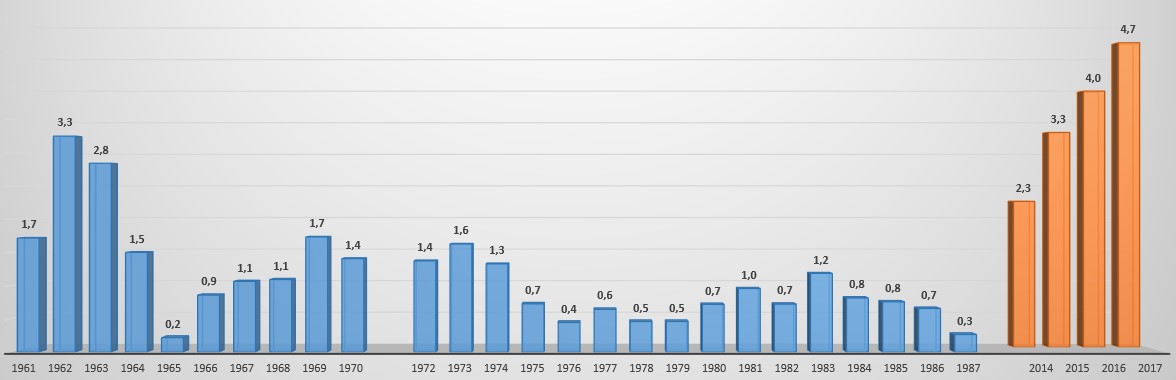
With the introduction of the new Criminal Code in 1961, the maximum recorded number of convicts under political articles for a year was nearly 4 people per 1 million people. In 2017, we already exceeded the indicator and reached the level of 4.7 people per 1 million. Moreover, the maximum surge of landings of the Soviet era was in years, which went immediately after the adoption of the new Criminal Code, in the future, the number of condemnations for thoughts, words and beliefs were reduced. Now we have a reverse tendency: the number of such cases is growing steadily, exceeding the indicators of the hardest dissident time.

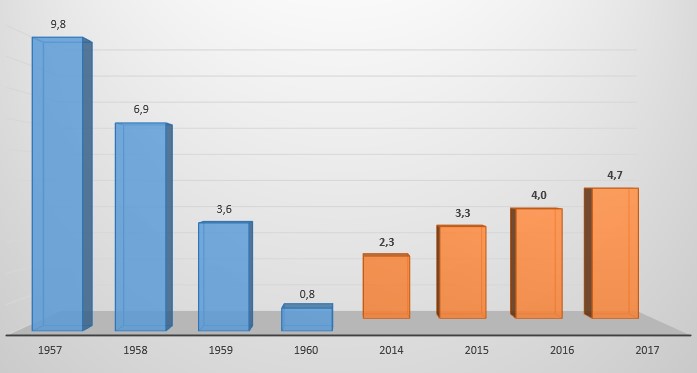
It turns out that in the sense of persecution of political dissent, we move strictly back on a temporary scale. If you look at convictions on political affairs from 1956 to 1961, then in 2017 we were already at about 1958.
In 1958, by the way, the Khrushchev anti -religious campaign was launched against the “sectarians” (and Jehovah's Witnesses, who are now arrested throughout the country) became one of the most unloved by the Soviet government).
And this I did not consider those articles that, in my personal opinion, are completely superfluous in the Criminal Code, which are not supporting any protection of either society or even the state and are exclusively a tool of repression. Such as 205.5 and 182.1 (organization and participation in organizations prohibited by court decision as terrorist and extremist, respectively). And 287 people were convicted of such people for 4 years. And their number is also growing steadily. Also (though slower), the number of people convicted of disclosing state secrets is growing and in these four years there are already 91 people. For state treason and espionage, they judge a little less and difficult to talk about some patterns with such small numbers for 4 years, but also in total for two articles - this is 44 people.
I have no exact numbers in years in late Soviet times, but there is an Andropov’s memo on the success of preventive work and a decrease in the number of convicts due to the effective prevention and “strengthening of the moral and political unity of society”. It contains average numbers on the statistics of the KGB. On average, from 1959 to 1966, 6 people a year were sentenced to espionage, and 9 for the disclosure of state secrets. In today's Russia, it is an average of 2 and 22 people per year, respectively. The only article on which from 1961 to 1987 was planted more than now - this is “treason to the Motherland” in the modern edition - “state treason”. 48 versus 10 with a constant decrease almost to zero by the end of the eighties. But this is more than “overlapped” by falsified sentences under articles on terrorism, terrorist and extremist organizations, for which, even for the 4 years studied in Russia, more than 25 years of Soviet times throughout the USSR.
A separate conversation deserves the recognition of people insane in the same articles. Unfortunately, there are no statistics on Soviet times and there is nothing to compare with us. But this practice did not remain in the past. For 4 years, exclusively under articles related to thought crime are recognized as insane and sent for compulsory treatment of 63 people. According to articles related to terrorism, extremist organizations, espionage and state change, they are not directed for forced treatment.
There is no doubt that statistics on 2018 will not bring a decrease in condemnations on political affairs - we continue to rapidly gain momentum, walking back in time.
The proposals that appear more and more and more often, including inside the Communist Party, to revise the results of the XX Congress “Establishing the whole historical era” do not seem so crazy.
Let this assume that we are on the verge of 1956.
However, it can be stated quite clearly that: 1) in our country, thousands of people who are deprived of liberty for political reasons 2) the scale of condemnations is growing steadily and is at the level of the hardest late Soviet period.
And what we will come to, in the end, to decide.
* In the material, the organization of Jehovah's Witnesses is mentioned, whose activities are prohibited in the Russian Federation