
Translated material
Karakol
This is a personal blog. The text could be written in the interests of the author or third parties. The 7x7 editors are not involved in its creation and may not share the author’s opinion. The registration of blogs on 7x7 is open for authors of various views.
In Kyrgyzstan, Andrei and I had two seminars for 4 days. Between the seminars, a break that Andrei decided to use for acquaintance with the regional center of the Issyk -Kul region - Karakol (black hand). We found an inexpensive taxi and rushed to this city, which stands on the eastern border of Kyrgyzstan.
We arrived in the city 2 hours after leaving Cholpon-Ata. Local human rights activists suddenly decided to load us well with different meetings. At first we stopped at the regional legislative assembly and met there with local civil activists. The dilapidation of the building of the Legislative Assembly and complete openness struck. A lot of people, everyone solves some problems. Officials and deputies are not pathos, but very business and attentive.
About 25 people were pouring into a small room for a meeting. They began to talk about problems. Basically, people talked about certain problems, their own and strangers. The woman complained that the police were beaten by her son and forced to confess to the murder. Two more women said that the authorities take the land from the bazaar, on which many local residents earn their bread, another woman complained about a neighbor. We answered, explained. All this has gone for an hour.
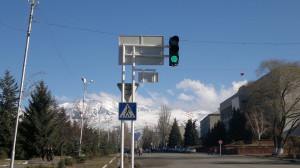
We move on. The street is warm. The sun shines. Around mountain peaks covered with snow. The city is located in the valley. We go to a meeting at a medical school. We go into the room. There are students and teachers. We are represented. We have long been discussing the issues of liability of civil society and the need to strengthen it, so that there are no revolutions. Andrei unequivocally declares: "There is only one effective way against any revolution - a strong civil society." We discuss this. Students sit quiet, argue only by teachers. An hour later we leave the hall. The corridor has a large portrait and something is written under it. We ask the teachers. They explain to us that this is the same person who created the Latin alphabet for the Kyrgyz.
- And they did not accidentally repress him?
- Yes, he was shot at the Soviet regime.
The story is the same.
We leave. The sun shines. We are being taken to the Law Academy. A small building near the mountains. We go. We are met and lead to the audience. In the audience, students and teachers. Again a conversation about responsibility. I follow the audience. Some clearly do not understand the Russian language, but more people who understand everyone. The discussion begins on good and bad laws. A teacher who rests, on the fact that "the law is harsh, but this is a law" argues with us. A small discussion. An hour later we leave the hall. I notice behind my back posters hanging on the board, something about Marxism-Leninism is written on the poster. Visual benefits are very old. Most of the visual aids in Russian. By the way, teachers are mostly Russians.
We go out into the street. The sun shines brightly. We go. We go to the cafe. We ask you to feed us with something very traditional. We are recommended to order Ashlyaf. They explain that this dish is eaten in very hot weather and in the morning after a terrible drinking. The activists accompanying us claim that Ashlyaf is properly prepared only in Karakol. Order. Everything is very cheap.
Soon they bring a bowl with a cold broth from which Lapsha balls peek out, on which a white sour poured substance is covered with a small slide in the form of neatly chopped slices, it is starch. Trying. The dish is spicy. Moreover, we are also offered to add sharpness, then the dish will be as it should. I refuse. Eat. Quite tasty.
After the cafe, we are leading to the local radio. The building in which the radio is also located musical classes. So I did not understand who is renting a room from whom. Either the radio at the music school, or the school at the radio. The radio consists of two rooms. We are being made in one of the rooms where we are poured with tea. We hang the microphone and we, drinking tea, write down our story about Kyrgyzstan and about Karakol. The presenter really liked Andrei's voice and she asks him several times to utter the phrase "This is a radio wave of Issyk-Kul."
We go out into the street. The sun shines, but it is already running out. The evening is approaching. The taxi driver, whom we asked to bring us to Karakol, calls to the phone and asks to hurry back to Cholpon-Ata. We agree that we will meet near the Orthodox Church. The locals told us that the city has a very beautiful Orthodox church. We run there. The temple is wooden and very old. With the Bolsheviks there was some kind of warehouse in it. Now he was restored. The temple was placed by the Cossacks. There were always a lot of Russians in Karakol. Before the revolution, in general, the Russians were the most numerous diaspora. Even Kyrgyz was less. In addition, there was a large Uygransky diaspora, Tatar and Chinese. Now there are almost no Chinese. The gates to the territory of the temple are closed. Calling. The guard comes out. He lets us into the yard. We examine the temple. Indeed, the temple is rare in beauty. Opposite the temple of a large old two -story house. Apparently he was once the house of the priest. We finish the inspection and run to the taxi.
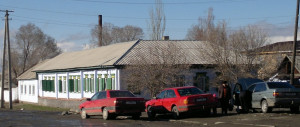
In general, there are a lot of old Cossack and merchant houses in the city.
We leave the city in descending twilight. The driver on a narrow road between the mountains and Issyk-Kul is taking us back to Cholpon-Ata. We are in a dozing. We never looked at the city, but we talked with people.