
Translated material
Samuel Galkin.

Do not forget that it will straighten again
But even falling into a deadly languor
And if the dust will cover you for a moment -
Enter it and be calm soul,
ICIC MANGER
From "Open Letter to Shmuel Galkin"
My dear Galkin, I write this letter to you, although I know that you are no longer among the living, that my letter will no longer reach you, because the exchange of letters between the living and the dead is a very difficult and unreliable business.
And yet I am writing this letter to you now, after your death, after your funeral, after your ashes are devoted to the earth. But I would not send such a letter to you during my lifetime, because it could hurt you, because you may not know, but the NKVD knows that I am a terrible capitalist (I hold Rockefeller in a lateral pocket). And the fact that I am a nightmare imperialist know old and young. I swallow the empire as gallows, and so far it has not damaged me, because in addition to terrible imperialist appetites, I have the ability to digest all these empires. <...>
And if I am such a type, you already understand why I did not dare to write a letter to you during my life. I often wanted to do this, especially when a new book of your poems came out, but I did not do this because ... You understand yourself. Who needs to explain this in the Soviet Union?
Now, after your death, is another matter. Now I can tell you that your death hurts me, that you were a noble and delicate lyrical poet and that most of your works will remain in our mournful Jewish pantheon.
Now I can tell you that among all those who created in Yiddish in the Soviet Union you were an exception in one thing: you have an address after death, a grave, a legal grave. Close can come to you and know that you are buried here; What is here, under this earthen mound, lies, silent forever, the heart of the noble singer Shmuepa Galkin - the poet. Who from the whole galaxy of Jewish poets in the Soviet Union can be compared with you?
Not a single Jewish writer, not a single Jewish poet in the country of Soviets reached what you have achieved.
Where is the grave of the Osher Schwarzman?
You all considered him the initiator of Soviet Jewish poetry. <...>
What is the truth? Osher Schwarzman was a cavalryman in the tsarist army. During the civil war, when the gangs of all stripes robbed and smashed Jewish cities and towns in Ukraine, he, a Jewish poet and a soldier, volunteered in a red brigade. He wanted to free, as he said in one of the poems, “the paths blocked by fear”, and in the struggle for this liberation, he died. His grave remained anonymous to this day.
Osher Schwartzman fell in battle. The young playwright Bainush Steiman became the victim of the pogrom. Again an anonymous grave.
This was the beginning of Soviet Jewish literature. How symbolic! Already the first, forerunners, petrels disappeared into nameless graves.
But Osher Schwartzman and countless Jewish boys like him, nevertheless, died to drive away "fear from the paths." Why are there so many anonymous graves in the Soviet Union? It was the fate of almost all Jewish writers. "Fear that overwhelmed the paths" was defeated. He was expelled, but did not give up. On the contrary, he spread his wings over the whole great country. He settled in every heart, forcing to shudder shyly at the sound of suspicious steps on the stairs,
A hint of inner fear, the underlying anxiety of the "times" is visible in one of the last poems of Leib Kvitko, which is called: "Anxiety". “The fear, which once,“ blocked the path ”of Osher Schwarzman, is now hanging around the room, preventing the poet from closing his eyes in the ominous silence of the night. A year later, after this poem was published, the ax fell. And the poet Leib Kvitko saw an anonymous grave in front of him. His fate is the fate of all Jewish literature in Soviet Russia.
I know that I do not need to tell you this. You yourself stood in front of an anonymous grave. If it were not for the death of the Georgian tyrant, who knows, you would have escaped only with a "sick heart" and shortened years. <...>
You, Shmuel Galkin, were one of those few who survived, but survived with a broken heart and a torn tongue. You saw how you "rehabilitated" your killed comrades. You saw the mummy of the killer in a glass coffin in the Kremlin. And your heart could not stand it.
The Union of Writers of the USSR prepared your funeral. There were, they say, a lot of wreaths. Among them is even one wreath with Jewish letters. These Jewish letters were probably the saddest of those who escorted you. Burned and disgraced. Trampled and humiliated. They silently swallowed tears and did not even look at the ceremonial Cyrillic. But you have an address, your own grave.
The colossal achievement of the country of Soviets. <...>
Translated from Yidish Velvla Chernin
http://vcisch1.narod.ru/galkin/galkin.html
Samuel Galkin
Leonid Catsis
The closest to our days, the publication of the translations of S. Galkin is contained in the collection “Poetry of the Prisoners of the Gulag” (M., 2005). It would seem that not with this it is necessary to start a story about the poet, who has become a classic of Jewish literature. However, the other classic of Yiddish’s poetry, ICIC Manger, who would inevitably find himself in our anthology, wrote, turning to the already dead Galkin: “Now I can tell you that among all those who created in the Yiddish in the Soviet Union you were an exception in one thing: you have an address after death, a grave, a legal grave who from the entire galaxy of Jewish poets in the Soviet Union can be compared with you? Not a single Jewish writer, not a single Jewish poet in the country of Soviets has reached what you have achieved. ”
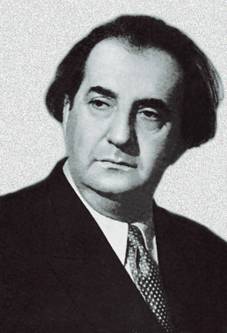
This was written by the ICIK MANGER that lived in Poland, the USA and Israel. And he wrote after the death of Galkin, when he could no longer damage his colleague in the USSR. After all, Galkin was sitting in the invalid camp of Abazi-the very one where the philosopher L. Karsavin, who once led the controversy with A. Steinberg about the fate of Jewry, and art critic Nikolai Punin, and many other worthy people, was serving.
For our selection, we chose the poems of Galkin translated by Anna Akhmatova, translated by Sideltsa Nikolai Zabolotsky, as well as in the translations of Valery Slutsky, who is now living in Israel.
Slutsky’s translations appeared in the Riga journal "Century" (1989, No. 3). Next to them, the letter of Itsik Manger was placed to his deceased friend, so reminiscent of a letter from his mother from the “Life and Fate” by V. Grossman.
One could briefly talk about Galkin’s biography, about his collections of poems before and after the conclusion, about his plays “Uprising in the Ghetto” (1946), “Sulamif” (1938) or “Bar-Kokhba” (1940). However, as the hero of Galkin said in Bar-Kokhba:
Enough! Shut up! .. Empire ...
Senator ...
Nasty words! Anthony,
Do not slander!
Politics down! Sing about love ...
And we will turn to the memoirs of the one who listened to Galkin’s poems “Looking at the Stars”, to whom Galkin read his poem “Der Stern” (“Star”), “accompanying, as usual, reading Russian translation”. This is Anatoly Vaneyev, whose memoirs “two years in Abazi” are considered the classic of the Gulag memoirist. “In addition to reading poems, Galkin told me about Hasides, since he himself was from the Hasida family according to Kabala’s teachings, Gd creates the world through the secrets of compression-the Hyda Zimtzum. Endless-Ensoph-squeezes itself into the letter “yud”, which is almost a point in size and is the first letter of the secret name of Gd. Squeezing himself, Gd, as it were, frees a place, since initially everything is filled with one. Then Gd radiates himself beside himself. This emanation, committed near the center, takes the lower forms of being on the periphery, which is the created world.
“Listen,” I said, “so your star is the letter“ Yud ”!”
“Of course,” Galkin answered. ”
The poem in question was translated by Anna Akhmatova. However, as Vaneyev recalls, “in Yiddish it sounds more courageous, and Galkin, retelling it without rhyme, handed the poem closer to the original. He said: “This star is precious to me - for the sake of the purity of its fire - for the sake of the fact that the light itself is wonderful - and for the sake of the fact that the whole radiance of its fire is in itself, as it contains in one drop”. ” Having finished reading and retelling, Galkin admitted that he wrote this poem under the influence of a sense of poetic envy to the poem of Innocent Annensky:
Among the worlds of flickering luminaries
One star I repeat the name ...
Important comments on Galkin’s poems sometimes continue to suddenly arise from oblivion. And it is characteristic that again before us a voice from Abzi. In New York, in 2005, a book of memoirs of the late Lubavich Hasid Joseph Nemotin “Where is this street, where is this house”. It tells a story that is surprisingly close to the story of the poem “Star”, who remembered the Russian comrade in the misfortune of the Jewish poet. It is only about this story, apparently, the poem “You,” he said, “an idol,”- / My old dad, listening to me ... ”.
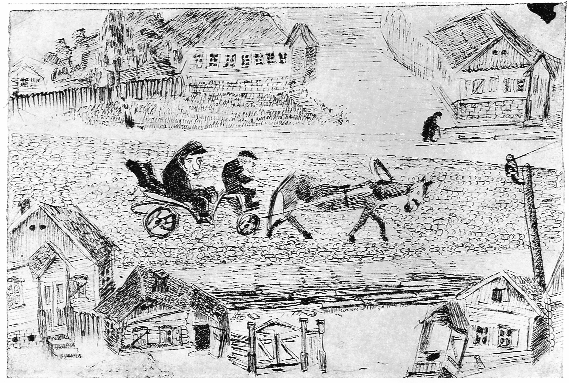
A. Kaplan. Rogachev, Bykhovskaya street. 1928.
I. Nemotin recalls the story of Galkin about when a happy poet in the 30s came to his native Rogachev with a new order. The Order -bearer solemnly met and congratulated everything except his father. When his father and his son were left together, Galkin recalled, his father, pointing to his order, said: “Son, you probably do a talented work, but your work is Ava Zora (“ Alien work ”).” This expression in Hebrew, in fact, means idolatry. To the end, only one who will hear these ancient Hebrew words in the phrase in Yiddish can fully understand the whole seriousness of the father’s words. The very language in which S. Galkin wrote his poems. Infrequently, Jewish Soviet poets who went to the Soviet literary world remained faithful to the world and ideas of their fathers. In this sense, Galkin is a rather rare exception.
I would like-albeit in a Russian translation, albeit not with the maximum courage, indescribable in Russian, with which the poet was standing, remembering the covenants of his father, before the Almighty and his star-but so that the energy and pure light of the poetry of Samuel Galkin reached us, his today's readers, who, as he predicted in the poem, "his letter" will be strange for the eye. " This is the same “letter” that Galkin Itsik Manger wrote about in his “open letter”: “You saw how you“ rehabilitated ”your killed comrades. You saw the mummy of the killer in a glass coffin in the Kremlin.
And your heart could not stand it.
The Union of Writers of the USSR prepared your funeral. There were, they say, a lot of wreaths. Among them is even one wreath with Jewish letters.
These Jewish letters were probably the saddest of those who escorted you. They silently swallowed tears and did not even look at the ceremonial Cyrillic. ”
Now Galkin is on the non -parallel Cyrillic alphabet of the poets who loved and loving him.
* * *
This star is encouraged to me
Purity and power of light,
The fact that not a single luminary
Similar light did not flow
The fact that her splendor is night
In a drop, one is enclosed.
This star is encouraged to me
The fact that it shines until dawn,
The fact that the shine on the waters is sowing,
It does not become dull
Big on its way -
With stellar height into the pond.
This star is encouraged to me
The generosity of immense light,
The fact that, absorbing her light,
I am more immense
The fact that I was immediately given
To the sky and the earth she.
1936, translation by Anna Akhmatova
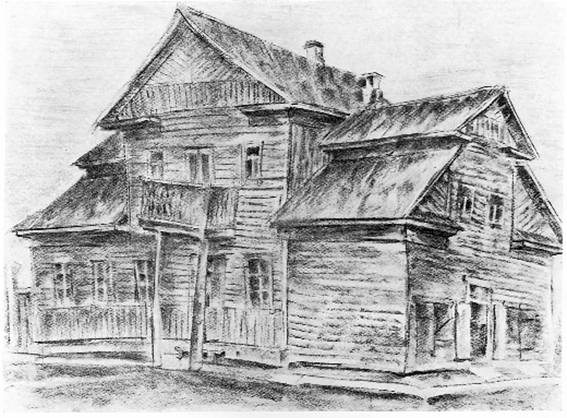
A. Kaplan. Rogachev, a stubborn house. 1928.
Friend
With you, friend, we have a long -standing account:
You wandered with me a road of hardships.
When I was tired
And the song in my throat was frozen,
Was I to the songs at this hour?
The soul was embarrassed ...
That his brother remained faithful to his brother
None of us will regret it.
So why now, my brother,
My friend,
So difficult for me it suddenly happens to me? ..
You, like a judge, remind you: “He will live
The current day ... where is its result? ..
Did you do everything that you could do,
What else to do for you
Can't? "
You demand: “Everything is upward and upward
pull! "
As if only to me - the stroke!
And I stretch, even though I fell on my shoulders
Double heaviness and good and evil,
Although height sometimes throws into trembling
And the middle you do not recognize ...
Do not listen, drive you, overcome? ..
What is the use of? .. You are the people of blood and flesh.
And I told myself a long time ago
What is designed to share everything in his fate.
You say: I am not a master
With the fate of the people, I am forever soldered,
And the fact that my modest gift creates,
It seems to come to the days of the future ...
And I believe, - I want to believe, friend! -
Let not descendants - no! Let everything around
My verse will hear and understand it
Upon learning of the spleen of your heart ...
About the most secret, expensive
I spoke my language
The peoples of different countries and languages.
I tossed the blocks of words day and night
And carved, squeezing the cutter to pain,
The human heart is fame and the crown.
Each verse sang praise to the people.
And I ... do not need me awards of others,
I just know that the lines
They will not die
That he does not disappear, my cherished work.
And let the letter that I write now
All passion of the heart,
the blood of the heart of all,
Once there will be a strange eye,
Alien for sons and daughters.
Let my tongue be unfamiliar to them
They will understand that this language
We sang happiness, cursed grief,
A wave into the general pouring the sea.
1957
Translation by Julia Neumann
If not me for myself ...*
* If not me for myself - who is for me?
If I'm just for myself - what am I?
If not now, then when?
(From the Talmud)
Who is for you when not you? ..
Who will you hand over your concerns?
After all, time with everyone takes scores,
Once put at the line
Where they will not ask you who you are,
And, all -able, you will leave ...
When I am not myself, then who?
Look, as long as he sees the eye,
And know - there is not enough life whole,
Therefore, do it beyond measure, -
When, if not now?
The time is insignificant.
With a number and a measure, be on guard ...
Kohl not today, when?
But from the number is not more detrimental,
And the measure is the main thing not in it;
Only for myself, trying - what am I?
Who am I? What am I standing
When yourself in one number
Am I affirming on Earth?
And "what am I AM" would be in the line,
But the insult pursed my lips
And, the thought of the bite,
It leads my hand
And whispers to me that I -
The devil knows what it is ...
1957
Translation by Valery Slutsky
* * *
“You,” he said, “an idolater,” “
My old dad, listening to me.
Here the lawyer would refer to the Talmud,
Dozens of prohibitions in the sprout, -
Not for any other motives,
But soil from youthful legs
He is knocked out, himself quite happy,
Probably could feel.
I would have exhorted me angry
For that, I would have scolded and trampled into the mud,
That I prefer Apollo,
I blasphemy, as captive to Venus,
That I dared to take a bit of the Greeks,
Putting yourself in shame,
That I climb into the vineyard, like a fox,
Which is nothing someone else's fence,
That I am dragged by a storm, what a shadow
I chase that in a dubious edge
Like a wild plant,
I drink alien soil juices.
But the dad was not embarrassed by the storm -
His approach was more significant,
He only smiled, eyes squint,
When he liked my fruit.
Once he only said: “Creation is marvelous.
Overshadowed in the eyes of your creator.
Singing - "How beautiful this tree is!"
But should this be inspired by the singer?
You, a tree of honor, its decoration,
He only turned his face to him,
Well, who created the Earth and space,
If you do not want to devote to a word.
And you think - you only need for the field,
So that light and haze are replaced by a turn,
But is it not his will for it -
So that your song comes in time?
Was King David, and his gift from Gd,
From the heart to the heart, he inhales the light.
In comparison with him, my son, so many
Lacking - that was a poet! .. "
And mom, at home work
To other immersed affairs,
Listening to us, and the share of the hundred
Probably did not understand from everything.
She approached me: “You see
I have no time for the troubles.
You explain to mom, son, on Yiddish -
I hear everything about you: "Poet ... poet ..."
How much, tell me, classes? .. "
Her, in four walls, spent days,
What will I say? Will I leave unanswered? -
When half a world is behind it - “Explain,
Poet ... poet ... what is it? " - I will meet me
Stermish the question on all dialects.
“Oh, if I knew that I would answer the world! ..” -
I already said in the first song.
But with dad and the lawyer today
I triumphantly finish a long -standing dispute:
Kohl tree is alive-the shadow of the g-region,
I am still an idolater.
1958
Translation by Valery Slutsky
Complete moon
When to order the waters in her power,
You will hardly be surprised
That a boy in Lithuania under the night
the sky
Wandering, enchanted by the light of the moon.
In the town of winter. And the trail is snowy,
And the lunar I smile at the ray.
And your own shadow, blackening timidly,
Carely "Sholom Aleicham" whisper.
And, it seems, the moon did not shine brighter,
And at least collect needles - light.
My face, having thrown back, I feel - the body
The radiation itself in the ray has gained.
And suddenly, freezing from the inner trembling,
I am aware of myself in the world ...
Who will hear this prayer? .. And yet
I have to finish my prayer.
But it is filled with a new meaning,
And they pronounce the mouth by themselves:
“My dear people, let it be
Light to you!
You are “Sholom Aleicham”, native places! ”
Ask me - I would hardly explain
Those tears when congratulated on full
The moon, and the greeting of the lips whispered
The native place in the Golden Night.
And now July - the summer is bewildered,
And drown in shine - wherever I look,
And each branch is offered to shine.
I again congratulate the moon with fullness.
At least the same words in the full moon were resurrected,
The prayer of another on the lips appears -
And how not to notice the difference if
The needles are already collecting the wrong one.
But I do not want to come to a word
And to the sky, I will prayerfully raise the gaze:
“My dear people, let it be light to you!
You are “Sholom Aleicham” and the world to everything! ”
1958
Translation by Valery Slutsky