Translated material
EmDrive


Last year, specialists from a NASA division called Eagleworks made a splash in the pseudo-scientific community by announcing the successful testing of their version of the “impossible” electromagnetic engine EmDrive , the operation of which defies some laws of physics . The success of NASA experts caused a wave of skepticism due to the fact that its tests were carried out not in a vacuum, but in air, and the tiny thrust force created by the engine could be a consequence of convection currents of air heated by microwave radiation.
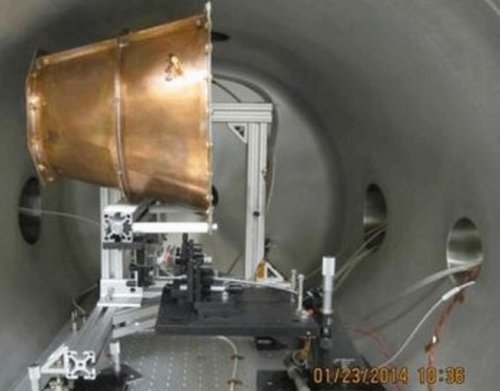
However, experts from NASA's Johnson Space Center last week dispelled all doubts about the performance of the EmDrive engine, which, in theory, can accelerate any objects to relativistic speeds. Engine tests carried out in a vacuum chamber showed that the engine is capable of generating thrust even in vacuum conditions, the depth of which exceeds the vacuum depth in outer space.
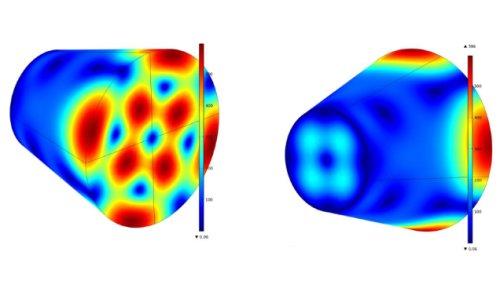
Let us remind our readers that the design of the EmDrive engine, invented by Roger Shawyer, is very simple. It is a cone-shaped vacuum chamber into which the output from one or more microwave radiation emitters is directed. This engine produces little thrust by consuming only electrical energy, which it can draw from solar panels, a nuclear reactor or other source. And this goes against some basic laws of physics, because the engine does not require any fuel to operate.

Scientists explain the operation of the EmDrive engine by the interaction of microwave radiation with the quantum component of vacuum, the lowest energy quantum state in which the vacuum can be considered as a medium filled with charged moving ions. The movement of these vacuum pseudo-ions, caused by the influence of magnetic and electric fields of radiation, provides weak jet thrust, which is sufficient for the slow acceleration of the spacecraft.
It should be noted that work towards the creation and testing of EmDrive engines is being carried out in parallel by American, British and Chinese physicists. And it is likely that in the future such engines will be used, despite the fact that scientists do not fully understand their operating principles, on satellites to maintain orbital stability, on spacecraft heading to the Moon, Mars or even further into the depths of bottomless space.