
Translated material
How AI is used in fundraising


As the Russian Civil Ecosystem perceived and used artificial intelligence technologies in processes related to the search and obtaining of grant tools in 2023-2024.
About the study
In 2022, the technology of artificial intelligence (AI), or rather its most ambitious direction-large language models (LLM)-became truly mass and affected most of the areas from business to education and science. A large language model, Large Language Model is a type of model of deep learning (one of the areas of “artificial intelligence”), which understands and generates the text in the human language.
As an illustration of the depth of the effect of changes associated with AI, the term AI Reset (AI-transload) even appeared, which means the restructuring of the work of organizations and entire industries, taking into account the possibilities of artificial intelligence.
In parallel with this, the Russian sector of civilian, human rights and media projects experienced a new stage of development-due to the full-scale invading Ukraine, many projects were forced to escape from Russia, and activists that were not previously related to the sector were united into new initiatives. Grant fundraising remained the only relatively stable source of resources and is one of the supports of the existence of the Russian non -profit sector.
The authors of this report proceeded from the hypothesis that these two trends (a change in the filming situation in Russian civil society and the widespread development of large language models) should sooner or later come in touch in the form of practice - what the authors of this report called “generative fundraining”.
If the hypothesis is true and the distribution of practices of using large language models among the fundraisers is already happening now, then two key issues can be formulated, which should be interested in both donors and the organizations themselves: the organizations themselves:
- What difficulties are the submitted in the preparation of applications, and can “artificial intelligence” help with them?
- What potential risks entails the use of AI, and how can they be reduced?
In search of an answer to this question, the authors of the report asked key participants in the civilian ecosystem, what stages of the preparation of a grant application are the most difficult for those submitting to grants (hereinafter referred to as submitting) organizations, as artificial intelligence is already used or potentially used in the preparation of applications, etc. During the study, a grocery approach was used: a combination of expert and problematic interviews. In December 2023-February 2024 We interviewed 18 experts, among whom were the leaders of new civilian projects (4 respondents), representatives of moving organizations (3 respondents), as well as experts (3 respondents) and representatives of granting organizations (9 respondents).
2. Basic observations and conclusions
The study hypothesis was confirmed: generative fundraising in 2024-reality. The study showed that LLM is already quite actively used when writing parts of grant applications. Of the 10 submitting applications for grants of respondents (both projects and experts), AI use 7.
Projects work in conditions of extremely limited human, temporary and financial resources. The preparation of applications is most often engaged in one person who simultaneously combines several functions. Specialists are interested in writing applications in any ways to optimize their work, so the products on the basis of LLM fall on the fertile ground, because supported by a deep user stimulus. In the work on applications, projects are forced to balance between safety and increasing their effectiveness. One of the most important priorities is the optimization of the process of preparing the application, so most organizations came to the use of artificial intelligence. The attitude to the security aspect is heterogeneous: some consciously do not load sensitive information into AI, some less attentive to this.
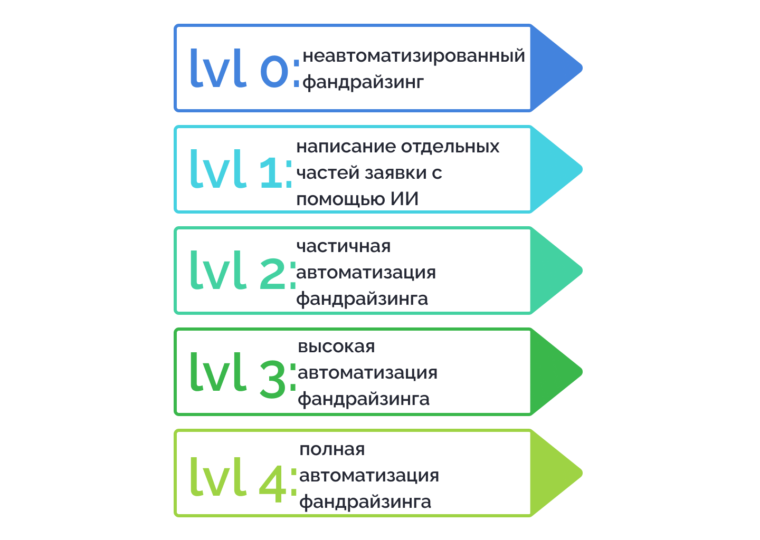
Illustration 1. Automation levels of fundraising
AI can only help with the writing of some parts of the application, but without a person, he will not be able to make an application. In the case of generative fundraising, an analogy with the levels of autonomy of cars from 0 (without autonomous driving) to 6 (completely autonomous driving) can be used. By this analogy, the level of automation of Russian independent fundraising we discovered is somewhere at 2-it is generative, but far from fully automated. AI helps well with summation of information, Brainstorming of project ideas, formulation of parts of the logical model of the project (outcome, output, impact) and implementation steps. However, he cannot offer a unique idea and often “hallucinates”: everything that AI writes must be carefully checked by the human eye.
The study showed the uneven adoption of generative fundraising by various ecosystem participants. So, the adoption is quite high among employees of projects who submit applications for grants: almost all of them use AI. Compared to project representatives, the adoption of technology among professional fundraisers is lower: out of 4 respondents, only one respondent regularly uses AI, the other two - rarely, never one more.
The smallest openness and the greatest alertness to AI showed the donor community. Following the security politicians of donor organizations, their employees cannot use AI. As for the preparation with the help of AI applications for their grants, on the one hand, donors are afraid of a flurry of similar applications, and on the other, they are worried about the security of these projects. However, now they do not notice the use of AI in applications.
Chapter 1. Civil Projects
1.1 context of civilian projects
Work in conditions of increased load. Among the respondents of this study, many organizations were created in 2022 or were forced to move to another country and significantly rebuild their work. The context in which you have to work is also quickly changing, and it is necessary to respond vividly to external circumstances and change plans.
Working strategies for 3 years or 5 years, but rather are rare. Nevertheless, most research respondents have a work strategies for at least a year. The staff of the projects is limited, about 15 people are constantly working in the largest organizations. The work of most organizations relies on the help of volunteers. Some projects initially worked as volunteer initiatives, but became full -fledged projects. Employees and volunteers are overloaded and often exposed to burnout. Many projects are constantly looking for resources and are on the verge of survival.
Fandraizing is a new skill owned by a narrow circle of employees. Most of the participants in the new projects had not previously engaged in activism, so they need to be mastered in the processing skills in the course of work. The filling of grant applications in the team is most often engaged in one person who spends only part of the rate on writing grant applications. The rest of the employees are not much or at all involved in the process. Joining the project, the activist usually does not plan to engage in fundraising. He comes to a certain position, usually directly related to the essence of the project. The search for existence resources is not included in the basic expectations from participating in the project: "I want to engage in activism, not pieces of paper." The tasks of fundraising are not discussed when hiring and, as a result, are not perceived as the responsibilities of employees. How one respondent shared: “Sometimes I let the guys get a submission of grants and write an application themselves, but I don’t count on this money.” Respondents several times noted that applications scare activists with their volume, unfamiliar terms, there is a fear of writing an application for a grant.
Psychological unreasonableness is also reinforced by the low financial literacy of colleagues from the sector: they don’t understand how the grants system are arranged, what money the funds are distributed, they do not take into account taxes, they are poorly versed in the contracts in English and in legal aspects.
Putting in conditions of limited time. On average, the organization is submitted for 2 grants per month, it takes 6 hours of work to prepare one application. Representatives of long -existing organizations and more experienced fundrays celebrate those grant ads on the calendar (they are often called “collis” from English call in jargon), which they would like to apply for, so they may not rush so. Less experienced recipients of grants have not yet developed a system for tracking grants and noted that they often find a request and fill it out at the last moment “on the night of the deadline”. In conditions of limited forces and resources, the help of any tools, including artificial intelligence.
During the interview, the respondents noted that it was most difficult to accurately formulate the idea of the project, as well as draw up a budget.
1.2 AI in the preparation of applications by civilian projects
Six out of seven surveyed organizations use artificial intelligence in preparing applications. The most common tool is ChatGPT. During work, some of them take into account the aspect of security and try to anonymize or upload only publicly accessible information into the system.
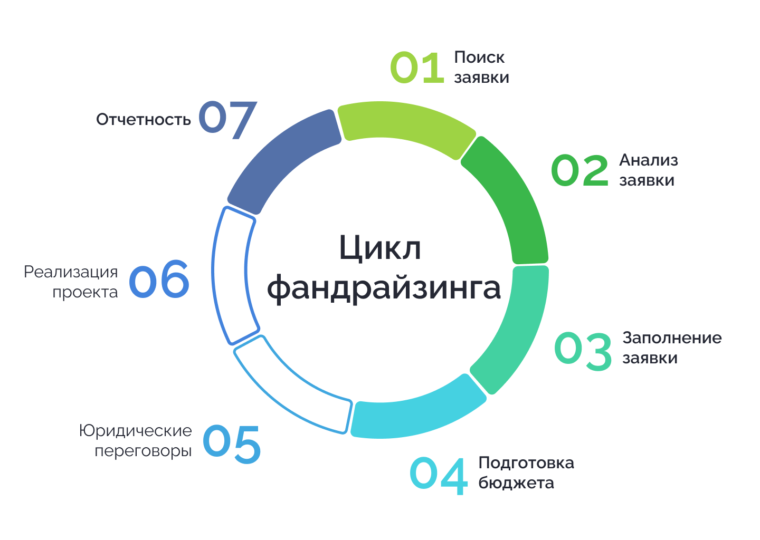
Illustration 2. In the "painted" stages of fundraising, you can potentially use AI
Artificial intelligence is useful for such tasks (in order from the easiest for AI to the most complex):
- Summage information from selected links. The strength of AI - make squeezes from a large amount of data (for example, based on information from several articles, write a squeeze about the situation on the problem).
- Ask to translate, edit or subtract the text so that it "corresponds to the level." The language and connectedness of the text are very important. ChatGPT is often used for this task with industrials that set the intonation of the text with the role in which LLM writes (for example, “Write as an experienced candidist from the charity sector”).
- Write the "non -standard parts" of the application. Some grants ask to include such points as “a decrease in environmental impact” or “a policy of counteracting corruption” - documents that are not in submitting organizations. AI can help with writing well -formulated documents.
- Describe the action plan. As introductory chat, a brief description of the project is given and ask to formulate the course of its implementation. “It turns out very well, you have to rewrite minimally.” It is important to note that here the result is not final, it cannot be inserted directly into the application: AI formulates the main steps, but a person still needs to add details and numbers to them.
- Register direct results, social results, social effects (outputs, outcomes, impact) of the project. Based on the general introductory about the project, formulate parts of the logical model.
- Offer the vectors of project ideas. This can be useful when the authors of the projects first see a description of the grant competition and face the White Leaf problem. Example of Prompt: “Write a project about supporting communities through DJing”, and ChatGPT offers possible ideas for projects. However, II answers are usually too general and can only be used as a starting point. To finalize the idea of the project and make it unique, a person is needed.
AI restrictions that respondents note:
- AI cannot come up with a unique idea.
- The result is not immediately. Sometimes, to obtain the desired result, patience and 10+ icmpt items are needed.
- AI can "hallucinate". Any result that he issues needs to be edited and checked.
Chapter 2. Experts for writing applications
2.1 Context of experts
Increased responsibility. For their part, experts noted low financial literacy among colleagues. As those responsible for writing applications, they personally are responsible for the implementation of the grant, expenditure and reporting. If colleagues from the organization are not responsible for money, the final responsibility falls precisely on the expert. For the donor, it is he (a) that is the face of a granting organization. As a result, a personal reputation of a specialist may suffer.
Experts noted the following difficulties in writing grants in the sector:
- Projects do not always hear what the funds want to say. Filing applications inattentively read the call or information about donors, do not understand the priorities and tricks of the donor. As a result, they offer an inappropriate idea.
- They do not know how to describe the idea of a project from the point of view of the theory of changes and the logical model. They do not understand what the differences between the goal, task, outputs, outcomes, impact.
- They unrealistically paint the actions: either too much, or too little.
- Projects do not understand what amount of funds can be asked. Often they ask less money than they really need.
- Almost no one knows how to independently conduct administrative support of grants: they do not understand how to issue an invoice, how to fill out reporting sheets, why it is important to do on time.
- The big problem of new projects: they do not understand the “project” logic of grants and count on institutional support (coating of operating costs), which is rarely found.
- New projects do not always understand that organizations need to develop a grant history. Often they see the main task of receiving grants, reporting fades into the background. This attitude threatens that next time it will be more difficult for them to get funding.
2.2 AI in the work of experts
The use of AI is uneven among experts. Some respondents do not use artificial intelligence at all. They understand the logic of applications and enjoy what they come up with how to formulate parts of the application. In a conversation about AI, there was a fear that he could take work from experts. The second group of respondents is distrusting the technology, but occasionally addresses it with simple tasks - edit the text or prepare a summary.
There are at least 3 AI-BASED tools for writing grants: Grantable , Grantboost , Elgranto (created by the Russian Fandraise Expert Anton Prainov). These are commercial projects that offer a service for drawing up a draft of a grant application using preloaded industrialps adapted to grant logic. These tools help reduce the time to write the separate parts of the application: to issue a “one-page” (or 1-Pager-a short document that concerns the organization’s work), fill out the logical model and the theory of change, and some of them even help to quickly draw up a budget in the form of a table. Price - about 20 euros for a monthly subscription or 1 grant draft. Reducing the time to write an application, these tools cannot completely replace a person - they can’t come up with a unique rare idea.
Chapter 3. Granting organizations
3.1 context of donors
The first filter that takes place is the coincidence with the priorities and values of the grantor. Priorities change depending on the context and are most often recorded in the internal documents of the organization. Nevertheless, donors spend a lot of time in live communication with projects. It is then that you can clarify whether the idea of a project coincides with the priorities of a donor organization. This part of the AI interaction is now not able to replace.
While priorities in the country/region are changing slightly, each donor organization has common vectors and values that determine its work. They are public and are located on donor sites. For donors, it is necessary that the activities of the submitting organization and its application reflect the commitment to these basic principles. Thus, AI can help check how well the priorities of the donor are reflected in the application.
If the project is suitable for priorities and values, the following that many donors are looking for is the uniqueness of the idea . An application for a donor is a way to see the individuality of the project, to see how the presenter thinks. Each of the parts works to “highlight” the relevance of the problem that the proposed project solves. Thus, part of the “context” can be used to show those details that the donor may not know. Most respondents converge that AI cannot offer unique ideas, but you can try to ask LLM to generate ideas based on open documents on the priorities of the donor and publicly accessible information about the project.
It is important for donors that the project that they support to achieve the goals. Therefore, in the application, they also pay attention to the realism of the project. Different donors have different tricks of attention, among them:
- whether the overwhelming context is reflected in which it works, what risks notes;
- Does the submitted have sufficient relevant experience for the implementation of the project;
- Is it realistic to describe the steps of the project;
- whether the planned costs correspond to real prices for equipment and rates on the local market, are taxes taken into account;
- Whether all the necessary rates are laid, including the rate of a financial manager;
- думает ли подающийся о том, как организация может существовать в будущем, сможет ли существовать без поддержки донора и т.д.
Для доноров важны все части процесса: заявка, реализация, отчетность.
Среди этапов, наиболее сложных для подающихся доноры отмечали:
- умение объяснить, как проект будет способствовать решению глобальной проблемы;
- индикаторы успеха проекта;
- корректный бюджет с учетом налогов, комиссий и т.д.;
- отчетность, в том числе финансовая.
Доноры утверждают, что всегда открыты к общению. Они знают, что подающиеся работают в сложных условиях, и стараются максимально идти на встречу и сокращать объем заявки: «Чтобы ни они, ни мы не тратили время». Доноры открыты к общению и готовы разъяснять, как заполнять разные части заявки, в том числе бюджет. Респонденты отметили, что профессионализм заявок вырос.
3.2 ИИ глазами доноров
Как мы отмечали выше, важнейший приоритет доноров — безопасность. Большинство донорских организаций получили от собственных служб безопасности предостережения по использованию ИИ. Основное правило звучит как «если ты не хочешь, чтобы информация появилась в Х (Твиттере), не загружай ее в ChatGPT». Таким образом, доноры-респонденты говорят, что не используют ИИ в повседневной работе. На момент написания отчета доноры сообщали, что продолжают проверять входящие заявки вручную без использования автоматизации и в случае подачи в вышестоящие инстанции не могут использовать ИИ для написания заявок.
По состоянию на февраль 2024 года доноры не фиксировали массового использования ИИ в приходящих заявках. Доноры опасаются, что при использовании ИИ при подготовке заявок могут быть раскрыты чувствительные данные проектов.
Во время интервью несколько доноров поделились обеспокоенностью тем, что ИИ будет широко использоваться для написания контентных частей грантовой заявки или генерации идеи, что в итоге приведет к шквалу «похожих друг на друга» или «стандартных красиво написанных» заявок. В этом случае сама суть заявки будет потеряна, невозможно будет увидеть индивидуальность и понять, как мыслит подающийся. Некоторые доноры отмечали, что если это случится, они будут готовы быстро адаптировать систему отбора и добавить, например, видео-интервью, чтобы все-таки иметь возможность понять больше о подающемся проекте. Реальных прецедентов применения такого решения не было озвучено.
Хотя в заявке доноры хотели бы продолжать видеть как можно больше уникального, написанного человеком содержания, они отмечали, что приветствуют инновационность у своих грантополучателей и высоко оценивают проекты, которые используют ИИ в работе.
Отдельная боль доноров – оценка грантового конкурса, подготовка бюджета и отчета. В этих областях они были бы рады видеть автоматизацию работы. Несмотря на сомнения доноров по поводу использования ИИ при подготовке заявок, в интервью с ними прозвучали некоторые потенциальные области для применения ИИ. Звучали такие идеи по использованию ИИ:
- выделить ключевые моменты грантового конкурса и проверить, подходит ли он организации по формальным критериям;
- помочь корректно составить бюджет: автоматически добавить комиссии банков и налогов, рассчитать курс обмена валюты, внести наиболее удобный и выгодный маршрут путешествия. ИИ помог бы решить проблему неправильно рассчитанных бюджетов.
Conclusion
Гипотеза исследования подтвердилась: генеративный фандрайзинг — реальность. ИИ может помогать человеку писать части заявки на финансирование и уже делает это. Отдельный момент — безопасность загружаемых данных. Этот аспект требует большего внимания со стороны пользователей.
Исследование показало, что на начало 2024 года стейкхолдеры по-разному воспринимают появление искусственного интеллекта. Перегруженные проекты (просто из необходимости) и наиболее технологически продвинутые эксперты (из видения перспектив) уже используют ИИ, а последние даже выстраивают свои бизнес-модели с учетом ИИ. Донорское сообщество не так широко принимает этот инструмент и скорее опасается его распространения. Технология не используется в работе сотрудниками донорских организаций. Ее применение при подготовке заявок вызывает опасения по поводу безопасности данных, а также возможного избытка сгенерированных однотипных заявок. Важно отметить, что пока этого не происходит, и доноры не замечают использования искусственного интеллекта при подготовке заявок.
Сейчас ИИ далек от того, чтобы написать заявку за человека. Продолжая аналогию с автономностью автомобилей, мы находимся на уровне 2 — частичная автоматизация. Хотя технология широко используется в написании заявок, без человека обойтись сейчас невозможно, и мы далеки от перехода к автономному ИИ-фандрайзингу.
Recommendations
Для проектов:
- Проектам следует уделить большее внимание аспектам цифровой безопасности и не загружать никакой сенситивной информации в открытые LLM.
И донорам, и экспертам важно учитывать, что генеративный фандрайзинг – это реальность, и быть готовыми к тому, что тенденция будет нарастать.
Для экспертов:
- Изучить возможножности LLM в написании грантов. Как минимум быть осведомленными о том, на что способна технология, как максимум — использовать ее возможности в работе.
- Лучше понять особенности технологии с точки зрения безопасности, использовать это знание самим и делиться ими. Рекомендуется по возможности изучать правила использования LLM-сервисов перед использованием.
Для доноров:
- Донорам может быть полезно сформулировать свою официальную позицию к заявкам, в написании которых использовался LLM. Например: «Необходима пометка», «ИИ запрещен», «ИИ разрешен или не проверяется».
- В зависимости от позиции, принять соответствующие меры: добавить в рекомендации по заполнению заявок дополнительный блок про правила использования LLM, обратить внимание подающихся на безопасное использование LLM; при необходимости протестировать и внедрить ПО для определения использования LLM при подготовке текста.
Gratitude
Авторы отчета – сотрудники команды Теплицы.
Научный редактор – Алексей Сидоренко, со-основатель и руководитель «Теплицы» (te-st.org).
Авторы приносят благодарность всем экспертам, участвовавшим в подготовке отчета.