
Translated material
Cavaller-transgender
About the book about the life and work of Nadezhda Durova
Nadezhda Durova is a writer and cavalryman, a participant in the Patriotic War of 1812, out of love for military service, who decided to social change his gender and became Alexander Andreevich Alexandrov. A lot of myths have developed around the name Durova, and many of them are debunked in the recently published book by Elena Kosschikova “The Divine Phenomenon of the Moral World”: the life and work of the Kama Amazon of Nadezhda Durova ”. At the request of Gorky, Maria Nesterenko tells about this work and her heroine.Elena Kostrizchikova. " The marvelous phenomenon of the moral world " : Life and Creativity of the Kama Amazon Nadezhda Durova. ECB: Cabinet scientist, 2018
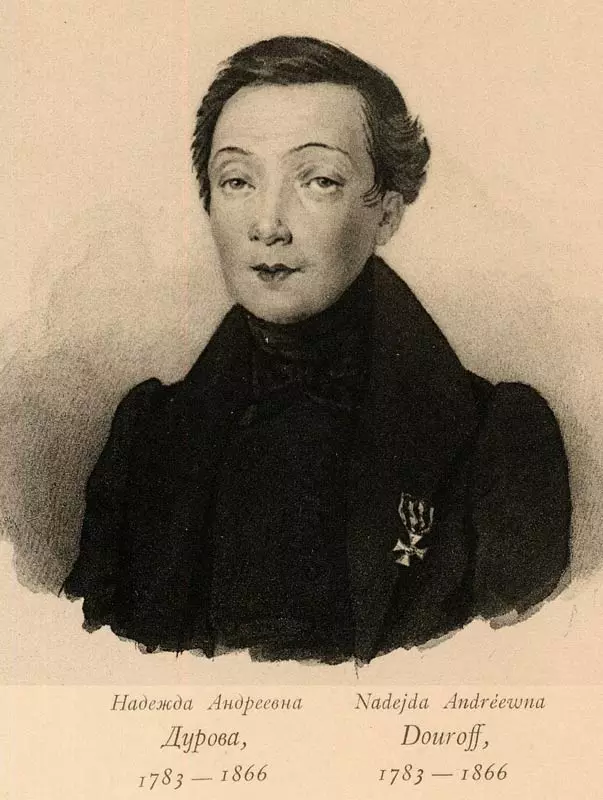
Many, if they did not read the “Notes of the Cavalryman-Devita”, then at least he heard the name of Nadezhda Andreevna Durova (aka Alexander Andreevich Aleksandrov), a cavalryman, officer of the Russian Imperial Army, a participant in the Patriotic War of 1812. Durova is one of the most mythologized female figures in Russian history. Back in the XIX century, a complete identification of the heroine of the “Notes” with their creator occurred, although it should be noted that for a long time they really were almost the only source of information about her biography. For example, Ekaterina Nekrasova, the author of essays about writers of the 19th century, noted that “notes” in the “Notes”. The author mainly told what was with her - this is an excellent autobiography, indicating places, names, events, ”and followed the storyteller. Her biography has become an extremely convenient material for interpretation needs: here is Durova - a patriot, a participant in the Napoleonic Wars; Here is the adventurer who escaped to the army for his lover; Finally, here is Alexander Andreevich Aleksandrov - a transgender, a hostage of his own sex.
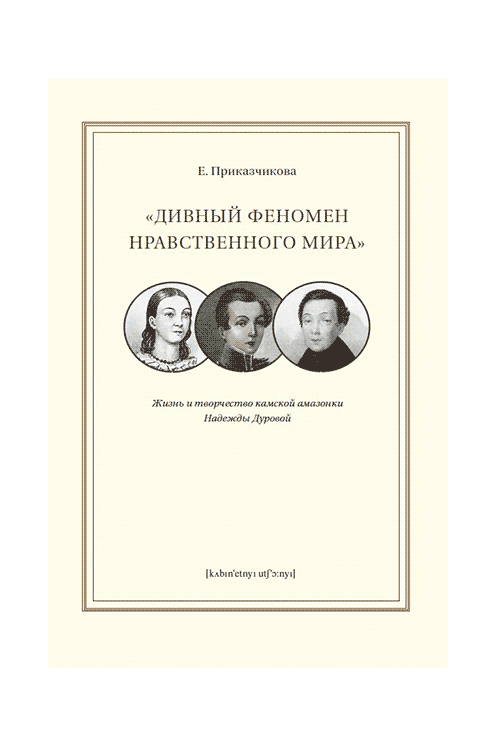 The book of the Doctor of Philological Sciences Elena Kosschikova is almost the first attempt to consider the life and work of Nadezhda Durova as an integral phenomenon, to debunk the mythology that formed around the gentleman-girl. One of the most stable myths created by Durova herself is the alienation and dislike that her mother experienced for her (by the way, in the “Notes” she does not call her name anywhere). “Durova persistently emphasizes the strict, vigilant supervision of her mother, who does not allow her to“ youthful joy ”,” writes Kostrizchikov. The researcher delves into the history of the family and shows that her mother was “a beauty-Malorossian woman, who left a wealth, honor, a calm, secured lifestyle for a poor, insignificant army officer, fled with him at the age of sixteen and very soon disappointed in family life. Moving to Sarapul (after a nomadic military life with her husband), where Durov resigned and became the mayor, frequent diseases, death of children, her husband’s betrayal really fierce her character. From the “Notes” it is known that until six years the young hope was in the arms of his father's orderly Astakhov, who became “uncle” for her. The reason was the episode also described by Durova:
“One day my mother was very bad; I did not let her sleep all night; They went on a hike at the dawn, my mother was settled to fall asleep in the carriage, but I started to cry again, and despite all the efforts of the nanny to console me, I screamed from the hour louder: this overwhelmed the measure of annoyance of my mother; She lost her temper and, grabbing me from the girl’s hands, threw me out the window! The hussars cried out with horror, jumped off the horses and raised me all the bloodied and not giving me any sign of life; They carried me again in the carriage, but the father jumped to them, took me from their hands and, shed tears, put me on his saddle. ”
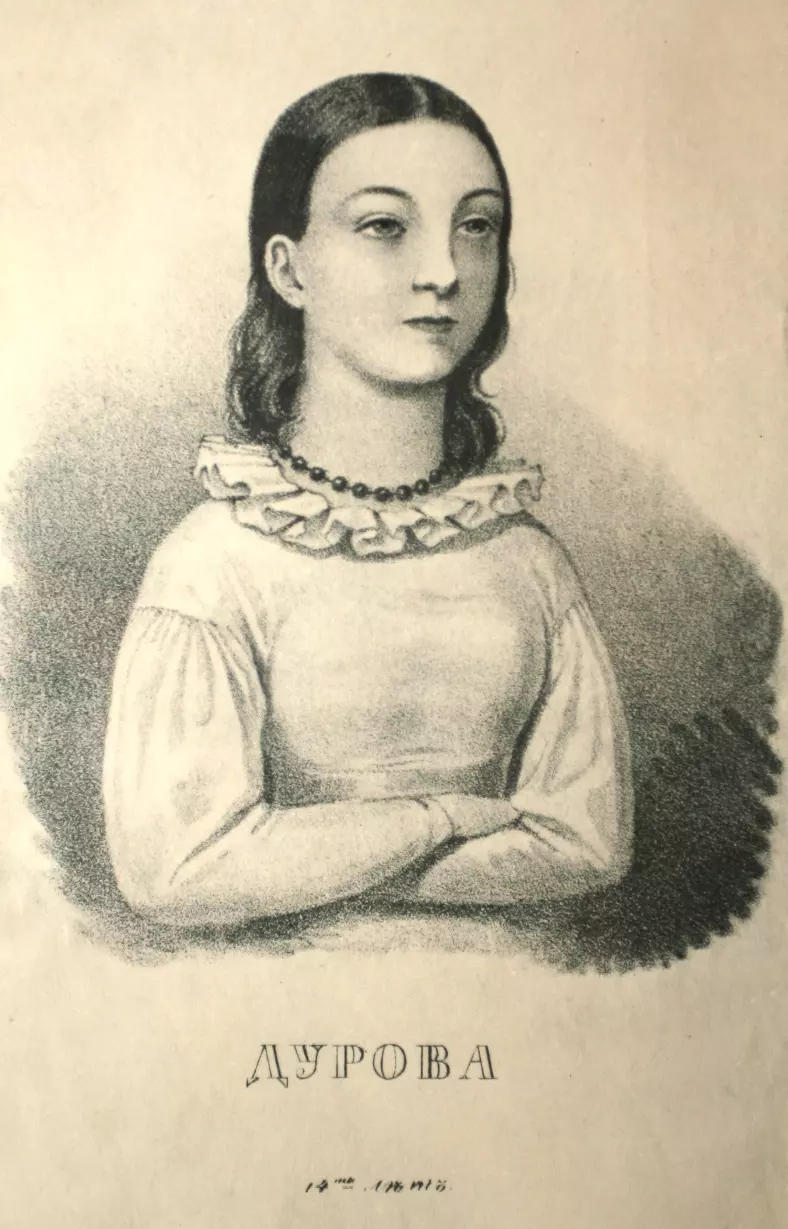 Kostroschikova writes that it was "during this period that young Durova acquired those" hussar "manners that her mother will go so much in the future and will have such a great influence on the subsequent life of the" cavalry-girl "." Analyzing documents related to the early period of Durova’s life, and comparing them with “notes”, the researcher concludes that “in Durova’s memoirs, an insistent desire to subjugate all the facts of her biography of one single goal is felt - to justify the departure into the army. This, without a doubt, is the description of her life in the parental house as a constant chain of suffering from the despotism of the mother. ” The researcher is correctly confirmed by the first lines of the “notes”:
“My mother passionately wanted to have her son and in all the continuation of her pregnancy was engaged in the most seductive dreams; She said: “I will have a son, beautiful, like a Amur! I will give him the name Modest; I will feed it myself, to educate myself, to teach, and my son, my dear modest will be the console of my whole life ...” So my mother dreamed; But the time was approaching <...> Blood was allowed, and shortly after that I came to the world, a poor creature, the appearance of which destroyed all the dreams and overthrew all the hopes of the mother. <...> But alas! This is not a son, beautiful, like a Amur! This is a daughter, and daughter is a hero! I was an extraordinary size, had thick black hair and screamed loudly. Mother pushed me from her knees and turned away to the wall. "
Durova, on the one hand, emphasizes that it was the boy who was desirable, on the other-as a newborn girl she also did not justify hope, was a "god-goddaughter." So the memoirist, as it were, hints that her fate was a foregone conclusion at that moment. Kostrinkova indicates an interesting detail - despite all the above, the mother is also perceived by Durova as a romantic rebel: "The narrative of childhood" begins and ends with the episode of a female rebellion and an escape from the parental house. " In the first case, her mother runs from the house in order to combine her fate with Andrei Durov against her father’s will, in the second case, Nadezhda Andreevna herself runs out of the house to get rid of the usual female fate that has become hated by her. ”
The next myth, which exposes Kostrizchikov, says that Durova escaped into the army after the lover, Esaul of the Cossack regiment. The memoirist writes that she left the house at the age of sixteen, although in fact it is not. At this age, Durov led the girl’s measured life for a giving way, and she does not mention her marriage with the noble assessor of the Sarapul Lower Zemsky Court Vasily Stepanovich Chernov. In 1803, the couple had a son Ivan, but “Durova’s marriage was unsuccessful from the very beginning. Chernov was not at all the person for whom he gave himself to the bride. If in Sarapul he still restrained himself, fearing the wrath of his wife’s father, then, going on a long business trip to Irbit, where Durov went with him, he apparently decided to lead his wife to obedience. Perhaps he even raised his hand to her, as is the case with the heroine of the story “Elena, T-S-beauty”. <...> Durova, apparently, soon began a real war with her husband. " Only after the collapse of hopes associated with the marriage, as Kostroschikov writes, the future cavalry-girl "begins to seriously think about changing her gender status, about the possibility of social change in her gender." On September 17, 1806, on the day of the twenty -three years, Durova was leaving the house of his parents, taking advantage of the presence in the vicinity of Sarapul of the Cossack regiment, sent to fight robber gangs. Realizing that her escape will give rise to a lot of rumors, the girl imitates her own drowning, leaving the dress on the shore of the Kama. The departure with the Cossacks gave the ground for the appearance of various kinds of speculations and romantic versions.
In the mass consciousness, there is also an idea that Durova went into the army exclusively from patriotic feelings. Kostroschikova writes that the main reasons were still love of military service and disappointment in the female fate. Durova was opened by another alternative scenario of female fate. Usually, a girl who did not want to marry, that is, proceeding with her main duties, the fulfillment of which society expects from her, could voluntarily stay in the “old virgins” or decide on a more radical step - to go to the monastery (like Lisa Kalitina from the Turgenevsky “noble nest”). In the preface, Durov sympathetically addresses his readers:
 “To you, my young peers, my admiration is clear to you alone! You can only know the price of my happiness! You, who are every step on the account that cannot be passed two fathoms without supervision and security! Which from the cradle to the grave in eternal dependence and under the eternal protective, God knows from whom and from what! You, I repeat, can only understand how joyful sensation my heart is full of my heart at the sight of vast forests, boundless fields, mountains, valleys, streams, and at the thought that I can walk in all these places, not giving anyone a report and without fear of anyone a prohibition, I jump from joy, imagining that in my whole life I will not hear more words: you, a girl, sit. It is indecent for you to walk alone! "
Even during the life of Durova, the idea took shape that she is the author of only one work-“Notes of a cavalry girl”. Of course, this is the most famous text that came out of the pen of the writer, but not the only one. “Notes” really amaze the unusual events of the described events, and, in addition, Pushkin put his hand in their publication, which provided attention from the reader's audience.
The first work of Durova aroused universal interest, however, criticism, sometimes very zealous, as in the case of Denis Davydov, who, having read the book, "responds about the hope of Andreevna in a very neglecting tone as a woman who dared to invade the purely male military world, moreover, express her, purely feminine, attitude to this world." Kostrizchikova gives several reviews of Davydov - not even about the book, but about the writer herself: “Subsequently [in 1812 - E.P.] I saw her at the front, in the Vedes - in a word, in the whole difficult of that time, I did not do much, it was not before it was to distinguish between male or female to the family.”
The literary career of Durova lasted from 1836 to 1840: “From the first publication of the passage from the notes about 1812 in the“ Contemporary ”by A. S. Pushkin in 1836 (the full name“ Notes of the Kavalerist, published by A. S. Pushkin ”) to the novels“ The treasure ”,“ Yarchuk-the Dog-Duhvoda ”1840, 1840. causing strict criticism of V. G. Belinsky. " Durova also published the works: “A cavalry-girl. The incident in Russia ”(1836),“ Elena, T-Bishop ”(1837),“ Count Mauritius ”(1837),“ The Year of Life in St. Petersburg, or disadvantage of the third visit ”(1838),“ Notes of Alexandrov (Durova). Add to the girl-cavalryman ”(1839),“ Hudieska ”(1839),“ Nurmeka. The incident that happened in the reign of John Vasilievich the Terrible, shortly after the conquest of Kazan ”(1839),“ Sulfur Key (Cheremis Story) ”(1839),“ Pavilion ”(1839),“ Two Words from the everyday dictionary ”(1840),“ The turnover ”(1840). Describing the work of Durova, Kossachikov notes that she “almost always prefers the exceptional, supernatural, rising above the level of everyday life. A terrible and fantastic, often in the spirit of Gothic novels, attracted her to herself with an irresistible force. "