
Translated material
Best country for writers
Interview with the editor and publisher Christian Kelstruper about the Norwegian book market
An ideal country for its writers is not very friendly for strangers: Gorky continues to talk about how book markets are arranged in different countries. Elizaveta Alexandrova-Zorina talked about literary life and publishing in Norway with Christian Kelstruper, editor and publisher, who studied Russian literature and in the nineties walked around Moscow with a metal rod.Christian Kelstrup is famous for his unusual literary projects. For example, he traveled to the northern cities of Norway, knocked on the houses and read the verses of his beloved Portuguese poet Fernando Pessoa. And then for a week he opened in Lillehammer the “Shop of one Book”, where only the book of Pessoa was sold. On the first day, they bought 50 books, in the second, thanks to the visit of the Crown Princesses Mettte Marit, already three hundred, and in just a week 1,600 books took. Now, thanks to this project, Pessoa is known in Norway and his books can be bought in any book.
A few years ago, he came up with a new project - portraits of famous writers, which he makes from different products, playing names. Leo Tolstoy (Leo Toastoy) was laid out of toasts, Fedor Dostoevsky (Pestoevsky) - from pesto, Doris Dressing (Doris Dressing, Dressing - Salad Sauls) - from salad salad, Charles Duckens - from fried ducks, shakespeare (William Shakespear)-from a pear, Agatha Christie (Agatha Lachristie) made of Lacritsa, Summer Sugar (Sukkrates, Sukker-Norwegian sugar). When there were many portraits, Christian (under the pseudonym Christian Ketchup) published a book of the Samizdat method and sold 2,000 copies. In such an extravagant way, he tries to return interest in writers and their works.
How does the state support publishers in Norway?
It redeems 1,000 copies of each book and sends through the libraries of all cities. Or 1,550 copies, if this is a children's book. Therefore, having released the book, writers may not think about how to earn a living and calmly continue to work on new text. At the same time, publishers of non -profit literature are supported. Publishers may not worry that the non -profit novel will not pay off.
Do you have a writer's union?
There is one. To join it, you need to have at least two books and be a non -profit author. Genre writers also want to be his members, but they are not accepted. The Union of Writers and the Union of Publishers are gathering together if you need to discuss some important issues. For example, when electronic books appeared and publishers decided to pay less writers, both of these unions arranged a discussion. As a result, it was decided to pay writers for electronic books as much as for printed ones. We also have literature houses. This idea came to us from Germany, where there are already about twenty such houses. There are readings and meetings for both children and adults, there are rooms for writers where you can work, your restaurant. The largest house of literature is in Oslo. Large not only in square meters, but also in the number of events, about 400 per year. Here were Murakami, Pamuk and other famous authors. It is interesting to come here. Some authors believe that literature should not turn into a show, they want their own, some narrower events, and yet, when they are invited to speak in the house of literature, they, as a rule, do not refuse.
Tell us about the main Norwegian publishers.
We have three largest publishers: Gyldendal, aschehug in which I work and Cappelen Damm. Gyldendal and ASCHEHOG are two main competitors, they are on the same street, opposite each other. Aschehous was founded in 1872, Gyldendal in 1925, and Cappelen in 1829. In these publishers, commercial and non-profit literature, non-fiction, textbooks are published. There is also an interesting Oktober publishing house. It was created in the 1970s of the working communist party. Many writers of that time were left -handed, and this was the left publishing house, and the name, apparently, was connected with Russia, with the revolution. But today they no longer have such a political orientation and publish fiction. Interestingly, 91 % of Oktober shares are now owned by Aschehous. That is, it is now our publishing house. And the TIDEN publishing house created in the 1930s (translated as “time”) now belongs to Gyldendal. These are not imprints, but independent publishers.

Fernando Pessoa, Leo Tolstoy, Tove Jansson and Cortrand Christian Kelstruper from products
Photo: Facebook
Is it typical for Norway when large publishers buy small ones?
We have such a thing as “vertical integration” - this is when the publishing house belongs to the chain of bookstores. In Norway there are, say, one hundred different bookstores, but they are network. And the main ones belong to Gyldendal, Aschehug and Cappelen Damm. It’s like a cold war, arms race: when one publishing house buys a book network, the rest do the same; When one buys a small publishing house, others also buy publishers. Disputes are going on how good it is for literature. For example, in Norway there is a so -called union of competition - the State Institute that follows that the competition is honest in all areas of the market. The Union decided that three leading publishes are so dominated by the book market that it is unfair. Therefore, a little less than a year ago, Gyldendal, Aschehous and Cappelen Damm were forced to pay a relatively large fine to the state. We went to court, tried to challenge this decision and eventually paid a little less. The main argument in his defense, which the publishers nominated, and he is fair that without them there would be no such literature. The population of Norway is relatively small, but Norwegian literature has strong positions abroad. Largely thanks to us.
Only 5 million people live in Norway. Probably, you have small circulations?
Relatively low. But 1,000 copies are a minimum, because they are redeemed by the state for libraries. A book of poems, for example, in addition to these 1,000 copies, another 200-300 people will buy. After all, we have a lot of writers. Each publishing house is looking for debutants, and every year the number of writers increases by a person by 50. Of course, there are many writers, and it is impossible to write about all the books in newspapers and buy all these books. Circulations of Yu Nesbyo are about 100,000 copies, but this is a unique case. There are bestsellers that are sold at 50,000. 5,000 - this is a great success and very rare. And the average circulation, I would say, 1,500–2,000, including those that the state buys.
Throughout the world, they are now talking about the crisis and even the death of literature.
The positions of literature, especially artistic, are very strong in Norway. Maybe not as strong as before - again, people began to watch TV shows and read social networks instead of books. Over the past ten years, many journalists who write about literature have lost their job. Newspapers began to earn less and are forced to adapt to new realities. And long interviews with writers are the first thing that was thrown out of newspapers. But still, the role of literature is great. I would not say that the writer has a prophet, as it was once in Russia. The political role of the writer is limited. But his role as a famous person, expert, is rather big. Those who say that the writer is dead are wrong, because in the media he is very alive.
It is impossible not to say about Karl Uve Knausgor . He is known for his autobiographical book “My Struggle”. It was pretty bold to take the same name as the book of Hitler. But now in Norway no one is associated with “my struggle” with Hitler, but only with Knausgor. [Half a million copies were sold in Norway, that is, every tenth Norwegian bought it. - approx. Ed.]. Knausgor supposedly honestly describes his relationship with his wife, father and other relatives. His family was not very happy about this, and his uncle even wanted to sue, but since the book was named novel, then this is a novel, that is, fiction, so the court refused him a lawsuit. I remembered Knausgor, because interest in the writer as a person, personality, is very large. When The New York Time Magazine wanted to make material about Russia, they invited him as an author. He traveled around the country and wrote several articles about it. But, it seems to me, he did not understand Russia. He did not talk to people, and this is very important when you write about the country.
Do you know Russia well?
In 1994, when I was 20 years old, I came to Russia for an internship for one year. And it was a strange choice for the Norwegian - both then and now. My friends, when they had the opportunity to spend a year abroad, chose the West, the USA. I also studied in Britain, my degree in the Russian language and literature from there. When I went to Russia, for many it was an incomprehensible, strange decision, some even thought that it was dangerous. And I was always fascinated by rich Russian culture, I mean classical culture. I really love Russian classical music and literature. And I am sorry that in Norway, many still do not share culture and politics. Because politics in Russia is dirty, sorry.

Photo: Facebook
Yes, you can't argue here ...
Where is the average Norwegian going for the holidays or vacation? In Barcelona, Paris, London. There are not many those who voluntarily want to spend time in Russia. Someone comes to Moscow to see the Kremlin, but there are few those who go to travel around the country by train to watch different cities. In Norway, the idea of Russia as if it were such a gray, gloomy, dangerous place. To some extent, maybe this is true. But still there is a lot of other things. People, first of all. I had a funny story in Russia. I was practiced in St. Petersburg and went to a friend in Moscow. He said that I, as a foreigner, need to carry weapons with me. I was very surprised, I did not go in a white suit, but in an old coat, was a poor student and rather resembled Raskolnikov than a foreigner. But a friend convinced that it was dangerous to me in Moscow and gave me a metal rod. I hid it under my coat and forgot. And when he came to the Tretyakov Gallery, the metal detector rang, they searched me and found this rod. “Well, man, man,” they told me, “you have problems.” A policeman, a healthy Russian man named Shishkin, came, and we went to the department. I had the worst opinion about the Russian police and thought that now they would demand money from me, send from the country, and I could not return to Russia without paying thousands of dollars. On the way, I tried to talk about the artist Shishkin in order to arrange his namesake to him, but this somehow did not touch the policeman. In the department, no one began to demand money from me, Shishkin simply said that I did stupidity out of ignorance and that I should no longer do that. He had a bottle of Soviet champagne, and we drank it. Until now, somewhere at home I have his business card, on which he wrote by hand: "Christian, if you come to Russia and you will have problems, always turn to Shishkin."
But you traveled not only in Russia?
When you know Spanish, it is easy to travel to Latin America. So I, knowing Russian, could travel to the former Soviet republics. I was in the Baltic states, Ukraine, Belarus, Georgia, Kazakhstan, Uzbekistan, Tajikistan, Kyrgyzstan, Turkmenistan. I even wanted to write a book about traveling in Central Asia, but I have three children, and the book requires a lot of time. And, fortunately (fortunately for readers and unfortunately for me), one of the Norwegian authors several years ago was published by a travel book in Central Asia. It was interesting everywhere, but if I had to choose, then I would choose Georgia. She is very close in spirit, I would say so.
Tell us about Samtiden magazine, in which you work as an editor -in -chief.
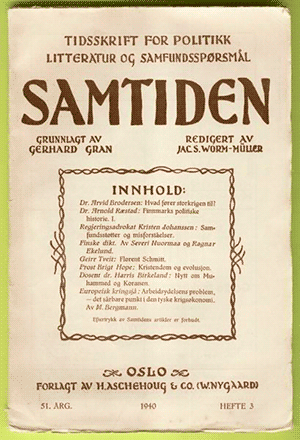 Release of Samtiden magazine, 1940
The magazine was created in 1890, in the same year, when Knut Gamsun wrote “Hunger”, a very important novel for European modernism. By the way, Gamsun wrote articles for Samtiden. Our competitors Gyldendal have their own magazine, Vinduet (“Window”), but this is a purely literary magazine. And Samtiden is a journal about literature, culture, politics, technology. But despite the fact that magazines belong to publishers, they spend small means on them, so the connection between the magazine and the publishing house, I would say, is thin. Decades ago, Samtiden played a more noticeable and important role. When I was a student, Samtiden was read, as they once read “New World” or “Literary Newspaper” in Russia. Now the situation has changed because new media has appeared and, first of all, social networks. Why buy a magazine when you can watch TV shows? And indeed in the information field there is a lot of competition. But despite everything that I said now, I am not a pessimist. I have been working as a Samtiden editor for only a year and a half, and during this time the circulation has increased three times.
What is the circulation of the magazine?
Small compared to newspapers. 1,000 subscribers, and we sell another 3,000 copies.
This is a good circulation for a literary magazine. In Russia, magazines have much less circulations.
From my point of view, such a magazine today can play an even more important role than before, because it is so difficult to understand modernity. Sometimes I walk along the street or sit in a cafe, look at people and think: why don't they read Samtiden?!
If Norway is the best country for Norwegian writers, then for foreign ones it is far from the most successful. The small market and the high cost of translation lead to the fact that there are not so many foreign literature published here. The same Knausgor complained that he had to read in English of many authors, including those who were translated into English from another language. For example, the biography of his beloved poet Artyur Rimbae. Knausgor even founded his own small publishing house exclusively for translated books.
Christian, what Russian writers do they know in Norway?
Norway today is not interested in Russian culture. However, I think, like Russia of Norwegian. Although I know that some Norwegian writers are very popular with you. This, of course, is not quite the correct comparison, after all, Russia is the largest country in the world, and you need to get acquainted with its culture closer. I would like to tell readers and writers of Russia: let's read each other and learn more about each other. 18 years ago I went to Moscow, made programs for Norwegian radio with Russian writers, and Nina Sadur told me: imagine a person who sits in a locked room and plays chess with a giant. He cannot lose, because the bet is his life, but he also cannot win, because otherwise the giant will still kill him. And what happened, Sadur said: the giant died, the door to the outside world opened, but this man was not needed at all. A giant is a Soviet Union, and this man is a writer. I don’t know how correct what she said, but they sunk into the soul of her words very much.
In Norway there is a small circle of people involved in Russian literature. And the publishing house Cappelen Damm even had an imprint that published only Russian books, but it is no more. If you stop a person on the street and ask: who is the largest modern Russian writer, no one will call a single one. But, of course, we know the classics, they love Dostoevsky, Tolstoy, Bulgakov. When I lived in Russia, I noticed that your favorite writer is Pushkin. In Norway, the most beloved Russian writer is Dostoevsky.

On the left: Celserup crosses the road with a tape recorder. Right: Fedor Dostoevsky, painted with pesto sauce
Photo: Facebook