
Translated material
Not a twin brother you are me
Ivan Navparenko - about the book "In Search of True Russia"
The book of the Russianman Lyudmila Parts (USA) is dedicated to the symbolic role of the province in modern Russian culture, or rather in our favorite contrast “West - Russia”. The province can act as a treasury of the spirit or a dead swamp - it all depends on the sympathy of the observer. The scheme of the cultural myth proposed by the author, but needs to be finalized taking into account some current trends, says Ivan Napapenko.Starting from February 24, 2022, we were all in the face of the advancing barbarism, violence and lies. In this situation, it is extremely important to preserve at least the remnants of culture and support the values of humanism - including for the sake of the future of Russia. Therefore, the editorial office of Gorky will continue to talk about books, reminding our readers that the world remains in the world and fiction.
Lyudmila Parts. In search of true Russia. Province in modern nationalist discourse. St. Petersburg: Academic Studies Press / Bibliors, 2022. Translation from English Olga Fields. Content . Fragment
 The story happened. I was looking for an expert to prepare material. He wrote to one candidate, but he said that he could not, and advised the other. I fugitively googled, whom we are talking about - like relevant competencies. We wrote off. After some conversation, the interlocutor sent me the text - in general corresponding to the topic. But at the end of it I read the following:
“Today, NATO countries unleashed a war against Russia and lead it through the Nazi Kyiv regime. They make the main bet and will make to incite Ukrainian revengeism. The deep core of the revanchist syndrome is always a wounded sense of national dignity, which is quickly turning into ethno -nationalist resentification. That is why it is necessary to clearly understand: the goal of denacing will not be achieved if the ethno -nationalist resentment in many circles of Ukrainian society in relation to Russia and Russians will not be identified and adequately understood by the authorities of the Russian Federation. ”
I was impressed: not every day the text demonstrates what you asked to write about, not just content, but your own form (the theme of expert commentary was this: “Restification as an ethical phenomenon”). In an amazing way, this story is directly related to the book of the Russianist Lyudmila Parts - and not only because the resentment occupies one of the central places in its theoretical structure.
Party specializes in Russian literature, post -Soviet culture and cultural representations of nationalism. In her work “In search of true Russia”, all these three interests came together. In the center of the book is the image of the province as a component of a national myth in modern Russian culture. Parts shows that the province as a symbolic topos arises in Russia in the middle of the XIX century and appears under the guise of the space of uncertainty between the exotic periphery like the Caucasus and European St. Petersburg. Most often, this is a space and boredom space, but in crisis moments, Russian intellectuals see the treasures of the spirit in it. For example, it was in the pre-war 1910s, and the same, according to Parts, was observed in the post-Soviet time. It is with the collapse of the USSR that the provincial topos is revealed in culture in all its ambiguity. But no matter what polarity they attribute to him, the province gains meaning in contrast to the symbolic topos of the capital. In other words, if Moscow is not Russia, then non-Moscow is all of Russia.
The main thesis is that the intra -national dichotomy of the “province - capital” has the interethnic twin “Russia - West”, and the relations between the “mythological” elements of these oppositions are symmetrical. This is how their other researcher characterizes that the author quoted:
“The Russian capital, always trying to reach for Europe and imitate it, can be considered as provincial as the province, in relation to the real center, namely to Europe.”
It’s not just about envy: Parts believes that the essence of this symmetry is a resentment. The lack of an understandable explanation of how such a complex ethical phenomenon joins with cultural myths and group behavior is one of the weaknesses of the book. On the other hand, it is difficult to demand a lot from the overview introduction that precedes a small cultural study.
Let me remind you that the resentment, according to Nietzsche, is a state of resentment and anger, in which one who considers himself a victim of injustice and does not have the opportunity to eliminate this injustice. Unlike ordinary resentment and envy, the resentment has a kind of creative force: it creates a system of values, which, on the one hand, substantiate the exclusivity of the sufferer, and on the other, explain his misadventures of intrusive enemies. It is believed that a paradigmatic example of a resentifying hero in Russian literature is Smerdyakov. And although Dostoevsky invested in the mouth of the odious servant Evil invectives about the “Russian people” who “need to flog-s” convicts Fedor Mikhailovich himself in a resentment in relation to the West, since the writer refuses him the slightest moral wealth (resentification as an accusation is generally extremely easy to work in both directions) .
Parts does not write about this, but if you take resentment unprofitably, then it is structurally similar to nationalism - any, not only to the Russians. The similarity lies in the need for a reference point. Nationalism, constructing the community of “we”, needs in comparison with “they”; Tsvetan Todorov, to whom the researcher refers, calls this "proper treatment with another . "
It can also be assumed that not any resentment is equal to the stinkingish region: injustice and oppression can be quite objective. But the pathological form of resentification arises when it gains paranoid features, that is, when “they” begin to allegedly attacked “us”, and already on this attacency aggressive fantasms grow that have nothing to do with reality. When the affect of the clogging develops into the delirium of its own power. And even when a sense of its own inferiority begins to be compensated through the diverse “but” (“But we have the greatest literature”, etc.).
Somewhat mechanically linening resentification and social behavior, Parts addresses the theory of social identity that psychologist Henry Tajfel invented in the 1970s. According to her, groups with a low perception of their own status can cope with frustration in three ways. The first - go to a group with higher status (mobility); The second is to change the relative status of the group (competition); The third is to transform the criteria for assessing the status so that the group can claim superiority (creativity). From this we can conclude that the Russian Westerners of the 19th century chose competition, and the Slavophiles preferred creativity. In modern postmodern and cynical departments, such creativity acquires the extremely specific nature of mechanical turning: if the West has succeeded in rationalism and progress, then the power of Russia should consist in spirituality, fidelity to traditions, etc.
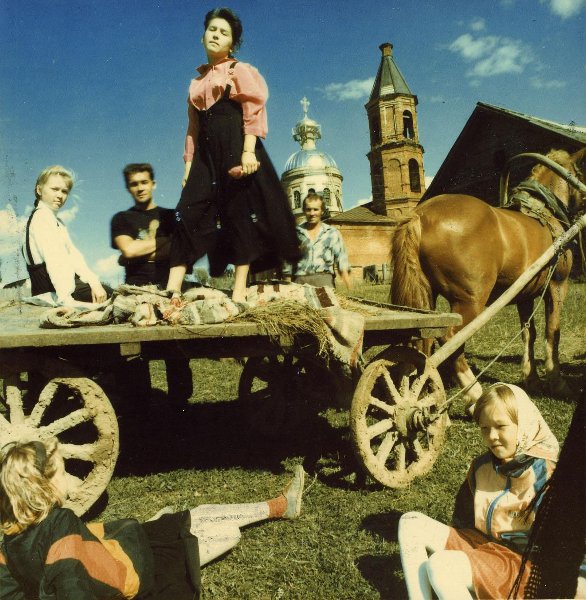 Sergey Chilikov / Mamm / MDF / History of Russia in photographs
Given the fact that the poles can change places, the Trinity structure of the cultural myth “West/Capital/Province” acquires a special coloring: the province becomes a symbolic reservoir where the carrier of truly Russian properties live under the canopy of ringing birches and cedars, that is, a certain people (purely abstract), and its “appropriate” others, with which it will be compared, will be compared, will be compared. The coder West, which, I recall, has an internal twin - a soulless capital. Parts wittily illustrates this twinings of surveys, according to which the Russians do not trust either foreigners or metropolitan residents.
It is important that such a symbolic structure retains stability, even if the coloring of its components changes. So, for example, the province can act with equal success as the black swamp, the West is a hail on the hill, and the capital is the refuge of the only Europeans. The nationalist myth of a change in the scheme does not imply - and therefore, the author is sure, is at a standstill.
Nevertheless, this scheme itself seems to be built into the mechanism of catharsis. The fact is that the West will always remain different, but between the capital and the province, reconciliation is possible; It is impossible to remove the antagonism “we” , but in the relationship “we - we” options are possible. In other words, the “capital” becomes the subject of the bargain: it can be inclined to the side of the province or prefer the West. I will assume that the very possibility of reconciliation is ensured by the fact that it is not so simple to reduce relations between the “Russians” and “Muscovites” to a paranoid resentment - they are too often tested by reality, although the diverse discussions about “cattle” and “creas” do their job.
The variability of relations between the capital, the province and the West is considered by Parts with examples from post -Soviet journalism, literature and cinema. For the most part, her observation is accurate, although it is sometimes obvious that the researcher squeezes the works into her conceptual scheme not without difficulty. For example, in the case of Sankya’s novels, Zakhara Prilepin and the “lines of fate” Mark Kharitonov Topos “Moscow” rather read the works than is really present in them.
However, in the chapter on the cinema there is a curious failure, in the light of which the abundant references of the researchers to the classics of post -colonial thought acquire a special charm. Parts analyzes the plot about the provincial Cinderella, who came to the cruel capital in search of simple human happiness. Many films have been shot according to this scheme - from arthouse to commercial, but a special place in their row, according to the author, is occupied by Anna Gres “Doyark from Hatsapetovka” (2006).
In this series, all elements of the myth are brought to the limit. Patient beauty Katya is a noble orientalist savage. Demonstrates moral purity, drinks tea from a saucer and promotes the spiritual degeneration of his Moscow groom-playboy. Parts believes that the inevitable happy end confirms her thesis about the catharsical removal of the symbolic confrontation of the “province” and “capital”:
“In the“ milkmaid from Hatsapovka ”and many other similar films, the Center simultaneously studies and civilizes the object of its interest, while“ wild ”the girl brings“ true ”civilization to the center, shares with him her purity and moral strength. A few minutes spent in Katin's world awaken in Dima the desire to become a man worthy of Katya love. Diametrically opposite at the beginning of the film, at the end of their worlds are happily reconciled. Katya learned to dress, speak and is like a Muscovite, and Dima - what it means to be responsible, adult and a good person. Compared to the West, other provincial discourse is more familiar, and more control, so it is not difficult to reconcile the opposites. ”
But there is a nuance that the researcher does not mention. Gres is a Ukrainian director, members of the film crew are Ukrainians, and Hatsapetovka is the Ukrainian city of Uglegorsk, which has been controlled by the self -proclaimed Donetsk People’s Republic since 2015.
Perhaps if the party, whose book was published in 2018, paid more attention to these facts, then the Trinity scheme would have acquired a different type. Let's try to assume how she would look in this case.
It is very likely that the topos of the province in the nationalist mythology of the late Putinism would then begin to double in a strange way. True Russia would have a twin brother - Ukraine, where Yesenin’s poems are being read, professing a deep truth that “respect is labor, valor and honor” (quote from the series). This twin must be Siamese, but he separated him and made the outer the West with his intrigues. The topos of the fallen capital would also have changed-most likely, it would have dissolved at all and acquired the features of the cross-border network of the Nazis and the National Representatives. And of course, this network would prevent the merger of the “Russian people” with the “twin-fraternal” Ukraine. Nationalist love is an absorption, so the Siamese union between the “we and we are also we” would seem to be national oriented intellectuals with a kind of magical injection of completeness and fullness, which is necessary to triumph over others, that is, the West. In other words, the scheme would have acquired the following view: “West/Ukraine/Province (Russia)”, where the average element would become the subject of bargaining.
No matter how sarcastically it sounds, but in this form the scheme allows you to see that the fact of aggression is masked by the cultural myth, the cultural myth modified by propaganda. The collision of “we - they” is rewritten as the merger of “we are us” . This disguise and caused by her blindness are strengthened by paranoid transfer, which promotes the logic of resentment built into the myth. By paranoid transfer, I understand here the attribution of one’s own motives to another, which serves as a justification for the attack. Recall the quote with which I started the text. “These are not we are revanchists, it’s them ,” the author says. “And in general, we came to our home for Catharsis,” adds the logic of the myth.
But there will be no catharsis.