
Translated material
Timothy Parshchikov
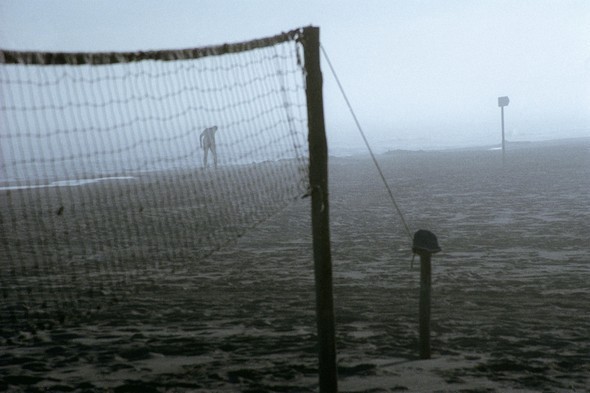 In June, the photographer and film operator Timofei Parshchikov opened the exhibition “Suspense” at the Museum of Contemporary Art on Petrovka, 25 . A few days before the opening, we talked about his diploma cinema, Noir films and a sense of anxiety for old Europe.
- How did your searches in the visual area begin?
I was fond of photography since childhood, and after school I began to engage in more seriously and entered the VGIK at the faculty, and for a while I began to engage in cinema.
- And what can you learn at VGIK?
As in any creative university: what you want, you yourself will learn.
- What did the diploma cinema shoot?
I took off my diploma and still did not defend it, but I will defend it in the near future - there is such a parable about people who stuck in the train forever.
- Are there two trains stuck? It seems to me that one friend from St. Petersburg told me about this film.
You see, the number of people already knows about him indecent for short cinema. This, partly, is due to the fact that the shooting ended almost two years ago, and the process is going on. At some point, we ran out of money for post-production, but now everything has somehow moved.
- And when will the film be released?
I'm already afraid to guess - by the end of summer, probably.
- And what is the name?
You know, before we found the money, the only thing we did is changed the working name once a month. I don’t even remember what we ended in the end.
-Still, what is primary for you: photography or cinema?
They are equivalent, but this is a convenient position: to engage in cinema and photography, because you are very well resting from one, doing the other. Cinema is such a tremendous collective work, and at the end of the filming, I am very tired precisely from communication with a huge group, and after that to leave for photography in complete solitude - rest. And when you get tired of loneliness, absolute rest is to return to such great communication.
- And how is the “first cinema” association and what projects are you working on now?
I know the “first movie” well, we studied together, but I myself have not done anything for them for a long time. The last month I am busy with a photo exhibition and preparing the book for it. In the fall there will be an exhibition in France.
- In your last book there were poems and photographs, but there will be no poems in this. Are they temporarily left?
I don't know, this is such a thing. I do not force myself. Periodically I write something, but quite rarely.
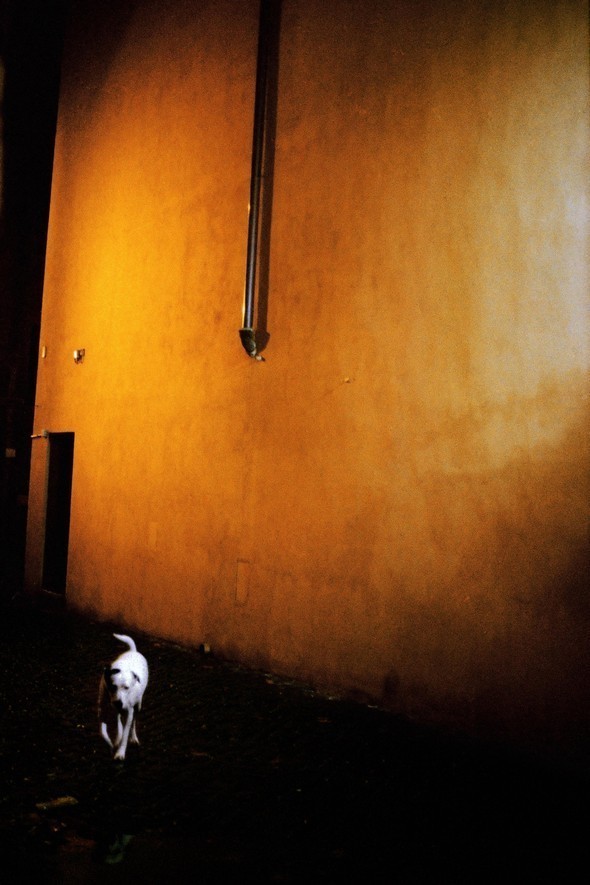 - Let's talk about your Moscow exhibition, which will open soon. How are photographs from the Suspense project related to Noir films?
From childhood, I loved these films - with a boar, for example. But when he studied at VGIK, he began to seriously review them from an operator point of view, from the point of view of building light in them. It was a revolutionary direction, whose origins are in German expressionism. Actually, a large number of German directors moved to America at the end of the thirties, and the genre canvas appeared, of course, just in Hollywood cinema. And these were incredibly bold solutions: very contrasting lighting, personnel, which kept only on one silhouette - in general, for the first time, the viewer in the cinema was forced to think out what was happening. And somehow it was always close to me, I tried to take this experience in the cinema and in photography. And in painting I was attracted by contrasting images, when something is hiding, not talking-such a severe caravagism. This does not mean that I will take off my whole life like this, but this particular project - “Suspense” - thought with an eye on this kind ofKyaroskurovsky lighting.
“ But Nuars are a twilight movie.” Here Borges said that Europeans are generally not very comfortable in the culture of the night.
Yes, but there is another turn: the crisis of the good old Europe, which, on the one hand, has long begun, and on the other, it stifies so slowly that it is almost not noticed. In fact, all these photos were shot in Europe. And if earlier the Europeans had goals to somehow expand, to conquer something, now the main thing is to maintain this world amazing, created for centuries, which, of course, is destroyed, and the fear of the unknown future of the old world is also to some extent connected with the concept of Suspense.
- Do you say goodbye to Europe with this exhibition?
No, she is still worried. But at least I wanted to show that this tension in Europe exists, and maybe it is even better visible from the outside.
- And in Russia what is interesting for you to shoot?
Moogoroda - cities with city -forming enterprises that are tied entirely on one industry.
- For example?
Recently I was in Magnitogorsk, although this is a huge city - almost half a million inhabitants - but it, of course, is completely dependent on the Magnitogorsk metal plant. This topic was always interested in me, because there is also a shaky balance: people understand that if something happens to the enterprise, it is death, degradation and disaster for the city.
-Tell us more about some of your projects?
I continue to remove “peripheral vision” - in the sleeping areas of Moscow in winter, but now, of course, a pause. 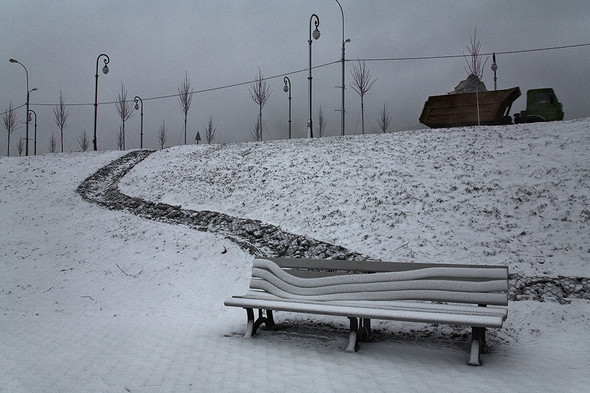
- And what is the most missing in Russia at all?
It’s hard for me to say, because I spend quite a lot of time outside, and something is blocked, but here, of course, it is difficult to relax, because Russia is an aggressive country. Although I am a very urban person and I love the urban environment and urban communication, but here everything is accumulating and you need to leave for nature.
- There is still a question about the photograph - do you feel its frightening nature? Maybe when you are removed?
Well, yes, what can cause more horror than to see a photograph of herself in one year unexpectedly in the album? Of course, the photograph has something mystical, and it will always be interesting in that it is not only an object of art, but also a document. And any photograph, like wine (sorry this terrifying comparison), over the years it becomes only more interesting.
-Do you have any advice for young photographers? And how do you cope with tons of images piled on us today?
I once conceived a project-a dialogue with the film by Dzigi Vertov “A Man with a Cinema”, because for me this is not only a film about how Moscow has changed and not only a creative search in installation, but also an incredible evidence of what the image was for people in the 30s, and who the operator was-the god who creates in the magic box. Compare with the attitude to the image today - when billions of pictures are taken and almost everyone has a camera on a mobile phone. It turns out that today a good or completely brilliant picture can take anyone, even a car, but to imagine a story or just make a visual series that would be held together-this is not available to everyone, and this is precisely Challenge.