
Translated material
The State Duma is not afraid of new sanctions that can introduce the West for the poisoning of Alexei Navalny
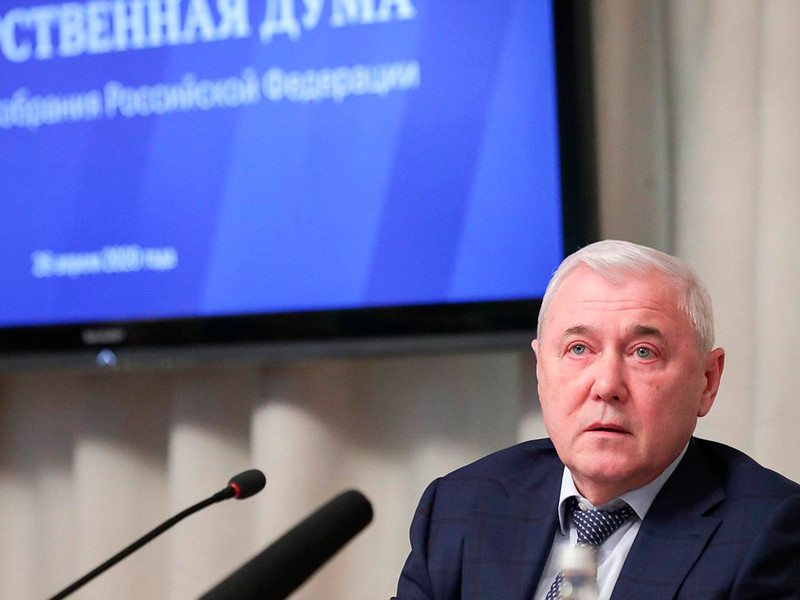
Anatoly Aksakov, the head of the State Duma Committee on the Financial Market, believes that Russia is not afraid of new sanctions, the threat of introducing which has loosened against the backdrop of the success of the German investigation, which was started in connection with the alleged poisoning of the leader of the opposition, Alexei Navalny. On Wednesday, Berlin announced that Navalny was poisoned by the nerve-paralytic poison of Novice, which Russian special services were suspected of repeatedly.
In connection with the poisoning of the opposition, fears are expressed that, within the framework of new sanctions, Russia can be disconnected from the International Interbank System for Transfer of Information and making SWIFT payments. They began to talk about such a development of events back in 2014, after the accession of the Ukrainian Crimea to Russia, but so far the matter has not gone further than threats. Anatoly Aksakov believes that Western countries will not dare to disconnect the Russian Federation from the payment system. Interfax quotes his words.
“I don’t think that they will turn off SWIFT, because then it will immediately be clear that this is a politically motivated solution that is“ wy with white threads. ”And most importantly, that it will not lead to European countries or the United States to anything good. Although America is probably a lesser extent, with which we have a fairly large trade, a fairly large volume of operations passes through the SWIFT system, and this solution will be seriously affected. It will hit our partners, ”said the head of the Duma committee.
Speaking of other possible economic measures, the deputy noted that Russia will withstand any sanctions. “We are no longer afraid of anything, we adapted, took countermeasures from the point of view of the economy. I admit that the decisions will be made against some political persons, and purely economic measures, now everyone has been convinced that they are not working. The main losses are image, which affects the attracting loans and expanding trade, and from the point of view of undermining the Western decisions are overcome,” he emphasized.
The parliamentarian added that the very idea of poisoning the leader of the opposition Alexei Navalny is supposedly so stupid that only the opponents of the Russian government could occur. It is so stupid, primitive, if it requires, of course, there is still a check, but if so, this is a frank provocation that is specifically against the Russian authorities. I can not explain it to the “poisoning“ newcomer ”.
Earlier on Wednesday, the official representative of the Cabinet of Ministers of Germany Steffen Zaybert said that the Bundeswehr laboratory found the Russian opposition to the poison from the Novice group in the body of the Russian opposition. At the same time, Zaybert said that Navalny’s neuro-paralytic substance was poisoned in the Russian Federation.
In the context of the strengthening of geopolitical risks due to the poisoning of the opposition policy, the dollar and euros significantly accelerated growth on the Moscow Exchange on Wednesday evening: the US dollar amounted to 75.34 rubles. at 19:00, which is 1.76 rubles higher than the closing level of previous bidding. The euro cost 89.19 rubles., Planting by 1.53 rubles. The cost of the bivalyut basket ($ 0.55 and EUR0.45) increased by 1.65 rubles to 81.57 rubles.
The Russian stock market also fell, demonstrating the vulnerability of the Russian economy not even before sanctions, but just before the public accusations of the Russian Federation in the actions for which these sanctions may follow.
Berlin expects explanations from Moscow on the situation, the Government of the Russian Federation may and should answer questions, the German Chancellor Angela Merkel said on Wednesday. In turn, the Foreign Minister Haiko Maas said that Berlin will discuss with the EU partners a reaction to the situation with the Russian opposition to the coming days. And in the USA they threatened the introduction of personal sanctions for Navalny's poisoning.
SWIFT (Society for Worldwide Interbank Financial Telecommunication) - International Interbank Communication System. More than 11 thousand financial institutions in more than 200 countries of the world are connected to it. In Russia, the community has more than 600 participants, including the Bank of Russia and the largest banks. The operator of the system is registered in Belgium.
The possibility of disconnecting Russia from SWIFT has been discussed since 2014, when the first anti -Russian sanctions were introduced in connection with the accession of Crimea and the support of pro -Russian armed groups operating in Ukraine under the flags of the DPR and the LPR. Then the European Parliament adopted a resolution in which, in particular, he urged Russia to exclude Russia from the SWIFT international calculations. However, in SWIFT, such recommendations considered violating the rights and inflicting the company.
As an alternative channel of interbank interaction in Russia, a system of transmitting financial messages (SPFS) was created. The Central Bank reported that some foreign participants in the financial market have already joined the system. When connecting to the SPFs, foreign counterparties will be able to interact with Russian companies under sanctions, the creators of this financial system say.
In February 2018, Arkady Dvorkovich, who then held the post of First Deputy Prime Minister, reported on the readiness of Russian banks to turn off SWIFT. “Of course, this is unpleasant, because it will complicate the work of companies, banks, will slow down this work, will make it necessary to apply outdated technologies for transmitting information and calculations,” said Dvorkovich. “Nevertheless, due to the fact that this threat has been voiced more than once, our financial institutions and companies are morally and technologically ready for this.”
According to Deputy Prime Minister, any problem, including disconnection from the global financial system, are ready to "meet with dignity" in the government.
Dvorkovich emphasized that such measures in the framework of tightening sanctions against Russia will harm not only the Russian economy, but also companies in Europe and the USA. Therefore, he called the shutdown from Swift with a crazy act by partners.
In 2019, as part of the International Economic Forum in Davos, Dvorkovich assured that "you can work without Swift." At the same time, he emphasized, the government hopes that there will still be no disconnection from SWIFT, since this is "completely aggression." If this nevertheless happens, Russia, according to Dvorkovich, "has possible retaliatory steps."
Later, the First Deputy Prime Minister, Minister of Finance of the Russian Federation Anton Siluanov, admitted that "it is hardly possible to create a full-fledged replacement for SWIFT today."