
Translated material
Mother of atomic tears
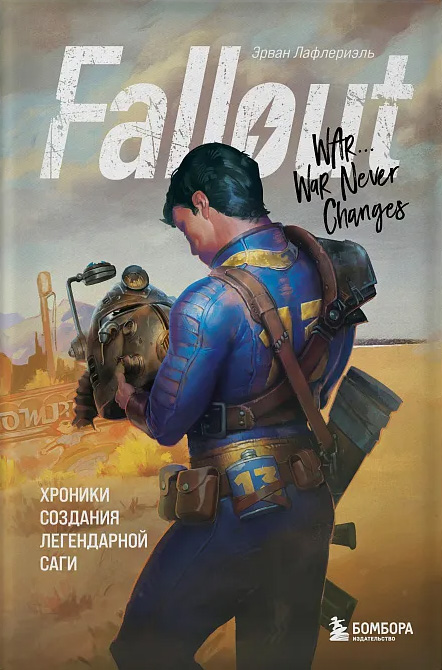
About the book "Fallout. Chronicle of the creation of the legendary saga "
The game universe Fallout has existed for a quarter of a century and will probably live the same if the forecasts of its creators about the future of mankind do not come true. The book of the Gam-journalist Ervan Lafleriel is dedicated to the way the post-core world is arranged in this game, the Russian-speaking edition of which was studied by Eduard Lukoyanov.Starting from February 24, 2022, we were all in the face of the advancing barbarism, violence and lies. In this situation, it is extremely important to preserve at least the remnants of culture and support the values of humanism - including for the sake of the future of Russia. Therefore, the editorial office of Gorky will continue to talk about books, reminding our readers that the world remains in the world and fiction.
Ervan Lafleriel. Fallout. Chronicle of the creation of the legendary saga. M.: Bombor, 2023. Translation from French Daria Mayorova. Content
 In the fall of 1997, discs with an impressive cover appeared on the shelves of specialized stores: a humanoid pile of metal looks somewhere past the viewer, while the ruins of the metropolis were darkening behind her in the black and red haze. And the inscription - Fallout: A Post Nuclear Role Playing Game.
When the buyer inserted the disk into the drive and launched the game, the first that he saw was an introductory video . A sentimental hat from 1940 sounds - the Maybe song performed by The Ink Spots , the cartoon hero waves his hand and calls to call right now and book a place in the “refuge of the future”. For clarity, we are shown an idyllic picture: immensely happy inhabitants head to a new city built in the rocks, while nuclear mushrooms unobtrusively grow on the horizon.
The news of the news begins. On a black background are credits: "Our selfless boys support the world in recently annexed Canada." We are shown a report: two people in armor like those that we saw on the cover are executed by a person whose hands are tied behind. After two shots, the “selfless boys” are fervently laughing and wave their hand into the camera.
“News” ended, on the screen a new advertising block: buy military bonds, buy a new car model, a completely analog system, no computers, only 199 999 dollars and 99 cents. However, there is no one to buy bonds and cars, the camera is going smoothly, and we find that the TV that we just watched is in the destroyed high -rise building in the middle of the destroyed city. The narrator (his voice belongs to Ron Perlman) pronounces the classic monologue that "the war is never changing."
As befits a truly great game universe, the entire Fallout setting is set out in the first minutes, after which the action occurs. In the second half of the 1990s, role-playing games confidently won the mass market, ceasing to be the lot of relatively small enthusiasts. The post-core apocalypse also did not seem new: the Cold War ended, but the mass culture continued to release scripts of the end of the world for every taste-from the uncomplicated trash explorer Albert Pun to more sophisticated projects like the “12 monkeys” of Terry Gilliam.
But the Fallout universe had what allocated it as much as possible in a diverse market for popular eschatology. This is an expertly verified balance between the tragedy and the comedy that sends the player to emotional American slides, and a tough, periodically rough, but without fail working political satire, and a radical graphic violence at that time (in the original, not distinguished version you can kill even children). However, nothing of this would have worked if not one decisive factor: the world created by the InterPlay studio did not seem fantastic. The theater of cruelty Fallout is not scared by mutants and rivers of blood, but by the fact that the total violence and the depreciation of human life in this universe easily and naturally became completely ordinary-it turned out to be no more difficult to erase the border between civilization and barbar than to switch the channel with news to the channel with advertising of cars.
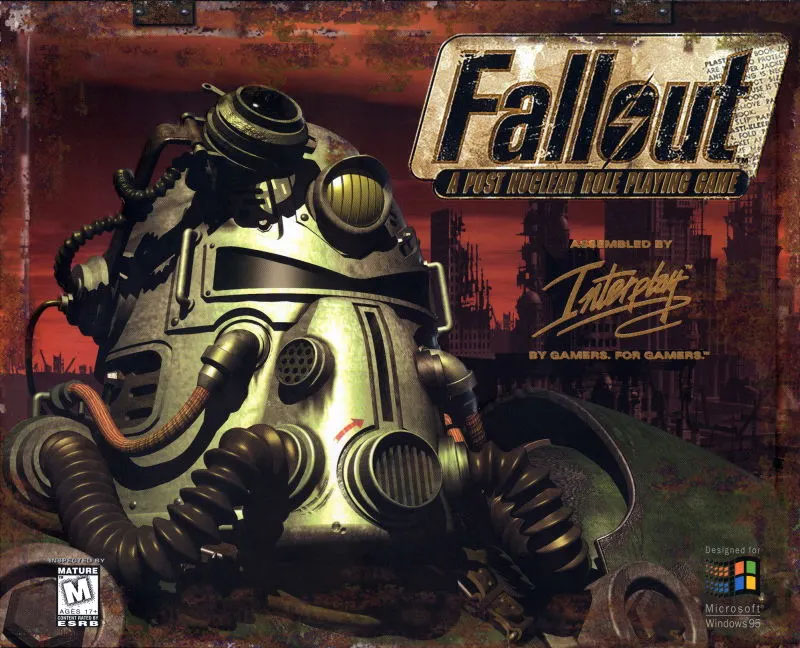 Fallout game cover, 1997
It is not surprising that the Fallout franchise has existed for a quarter of a century and does not show signs of aging - contrary to all economic and creative crises that stably pursued its creators and distributors. During this time, her universe has overgrown with countless details, sometimes paradoxical, and sometimes completely mutually exclusive.
The Russian title of the book of Gam-journalist Ervan Lafleriel “Fallout. Chronicles of the creation of the legendary saga ”can mislead the reader: the history of the development of“ decline ”(as the name once creatively translated all amateur localizers) is dedicated to only the first of the eight and a half chapters. For comparison - the French original is called La Saga Fallout: Histoire d'Une Mutation (“Saga Fallout : History of mutation”), and the English translation is entitled to Fallout: A Tale of Mutation . However, I will not dwell on the ethics and success of such marketing decisions that we have long been accustomed to. In my opinion, in reality, Ervan Lafleriel’s work does not belong to the objective “chronicles”, but to the ambiguous, but at times an interesting genre “Fan, conducts the subjective revision of the object of worship”.
As I said, the Fallout setting , which, if we are alive, will turn 26 in the fall, over the years has been replenished with many plots and details that need to be generalized and reflected. It may seem to an outside observer that Ervan Lafleriel simply systematized the leadership to different parts of the game, building them into a kind of unity. The work is perhaps meaningless, if we recall the existence of a whole Fallout Wiki , containing detailed information about almost every little-old object and character of post-core wasteland.
But this work is still meaningful and reflected by Erwan Lafleriel himself. The fact is that how many fans have , so many opinions on any question, and the author of Fallout: Histoire d'Une Mutation took the courage to speak for each of them in order to bring the chaos of discussions in a kind of order. Give a support point for future conversations about all your beloved Universe, which would be more productive than deliberately meaningless disputes between Olds, recognizing Fallout only in the form of a step -by -step RPG, and “Newfags”, which ended up in the wasteland when it has already become a background for a three -dimensional shooter.
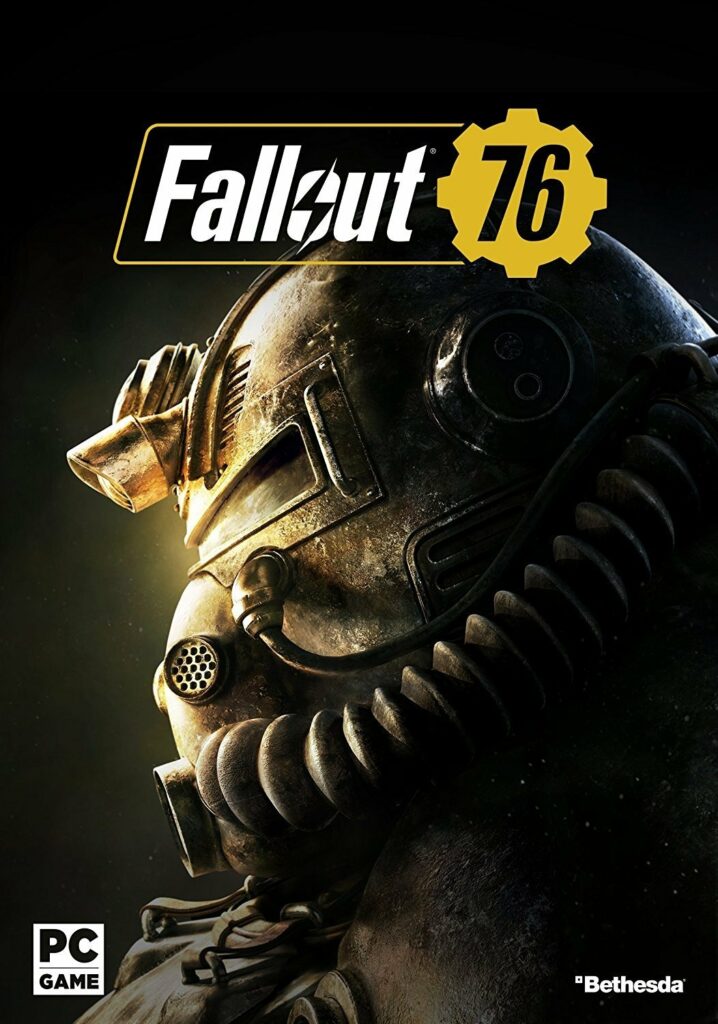 The cover of the game Fallout 76, 2018
Speaking about the gameplay of the four main parts of Fallout , Ervan Lafleriel tries to take a position as if a detached observer, who knows that everything is always “not so clear”. If the fans of the first two parts, seeing the third, ultimatively reported: “This is not Fallout , but Oblivion with guns”, then Ervan Lafleriel reasonably remarks: “What is bad in Oblivion with guns?” And he meticulously answers his own question, sometimes even overgrown with meticulousness - for example, when he complains about the insufficient species diversity of the Fallout world and stops a step away from accusing the creators of cultural normalization of ecocide.
At the same time, having occupied the superposition of the “flight over the fight”, the author of the book still involuntarily reproduces the stereotypes, which promotes one of the parties to the “conflict” between visited players and beginners. So, the main problem of Fallout 4 Ervan Lafleriel believes that it is too easy for passing. And this is a fact. As well as the fact that by the time the fourth part was released, the audience had already begun to get tired of turning video games into interactive cinema.
But by the time of turning into a trilogy, and then into the Fallout tetralogy (and in the Bethesda studio, this was perfectly understood in the line of the Bethesda studio ) became something more than a role-playing game about utilanka survival in the conditions of post-apocalypse. The low entrance threshold to the gameplay directly opens up for the extremely wide audience what the creators of the very first, “hardcore” part of the series wanted to inform. Ervan Lafleriel himself cites the words of the leader of the developer team Brian Fargo, who explained so why the cheerful volt-bo , the cartoon Mascot Fallout , never discourages: “He gives a nuclear disaster to triviality, emphasizing the whole absurdity of our attitude to this potentially possible scenario.”
Erwan Lafleriel seemed to not have enough effort to finally understand the nature of a strange clash of realities in the retro -futuristic setting of Fallout . The nuclear war that destroyed the whole world occurred in 2077, but its townsfolk live in the entourage of the 1950s-an era, which in the United States now idealize as a “golden”, quiet, peaceful, fed, when every honest white citizen could afford a lawn house, a fresh car, a TV and a her wife, a housewife, which had come off with pinaps. The peaceful areas of one-story America, listening to a gramplast with a vintage pop music and polishing mint, “corveeh”, contrasts sharply with power armor that protect the peacekeepers in Canada and the research laboratories of the Institute that produces synths, indistinguishable from people.
This eclecticism has an artistic task is much more important than just the creation of expressive contrast. The developers of the recent hit of Atomic Heart reproduced the formal side of the Follautian setting, transferring an action from America to the Soviet Union, playing with a retro -futuristic understanding of VDNH, machine guns and other phantom memories of the brightest past - but only formally. The essence of this technique performed by the author of Fallout was not in juggling with nostalgic notes, but to demonstrate the fragile world, on the basis of which consumerism, hedonism, civil investments in military bonds and other joys of life with the confidence that the war never changes and always somewhere far away.
Otherwise, Ervan Lafleriel gives a detailed and at the same time concise analysis of intricacies, cultural and household details, of which our not so distant future, which the creators of Fallout see it, is woven .
Be vigilant.