
Translated material
The art of being strangers
About the book of Clifford Trini “Past Factum. Two countries, four decades, one anthropologist "
The book of the famous American anthropologist Clifford Girtz “Post -Factum. Two countries, four decades, one anthropologist ”, published in the original quarter a century ago, became the result of his many years of work-from the late 1950s to the early 1990s-in the rapidly changing Indonesia and Morocco. This collection of notes, rethought by scientists on the threshold of its seventy years, gives several chronological sections and shows how the global changes in the second half of the 20th century influenced the development of not only recent colonies, but also anthropology itself. For our joint project with the “Enlightener”, Nadezhda Protsenko tells about the book of Girtz.Clifford GIRC. Post -factual. Two countries, four decades, one anthropologist. M.: New Literary Review, 2020. Translation from English Andrei Korbut
GIRC describes his forty years of experience in the Marrokan city of Sephre and the Indonesian pair not from the point of view of politics, economics, traditions or religion, although the names of six chapters - “city”, “country”, “culture”, “hegemony”, “disciplines” and “modernity” - as if suggest that the book is divided into relevant topics. GIRTS is well aware that the political situation in the country's study and a particular city has changed in the same way, say, the anthropology itself changed, and with it an anthropologist, which belongs to a certain culture.
GIRC uses in the book his famous method of “saturated narrative”, which involves a description of particular cases and practices placed in a wide social context, and an increase in them in different years, so that the post -facts interpret their relationship. The author writes a lot about how different social layers were transformed politically, economically, religiously and socially, which led to the transition of Indonesia and Morocco on colonial dependence to what they are now - not the most comfortable, but not the most backward countries, typical middle peasants on the world scale of development. At the same time, it is noteworthy that the GIRTS is not trying to hang a convenient label and name these societies, for example, post -colonial or semi -peripheral.
“To explain the changes that occurred in my cities, in my profession, in my world and in myself, I do not need a plot narrative, measurement, recalling or structural progression and definitely do not need graphs - although all this can be used (along with models and theories) to outline the framework and determine the subject of discussion. It is necessary to show how specific events and unique cases (a meeting here, circumstance there) can be associated with many facts and a battery of interpretations in order to make it possible and, probably, will be about. It seems that Northrop Fry said that the myth describes not what happened, but what happens. Such is in many ways science (at least social science), except that its descriptions claim to be more firm grounds and sound judgments and from time to time - for some impartiality, ”the author explains his method.
In one of the most interesting chapters of the book-hegemony-GIRC describes the process of finding his place in the world of two states that have gained independence in the 1950s. Then, in the post-war years, the understanding of what anthropology is and how an anthropologist should work: there is no longer the type of researcher working in a cork helmet somewhere far from civilization with “his” people (those that he studies). Now, in the most deaf corners of the Earth, there are its researchers, and the very studied society is inevitably inscribed in the global context-similar intuitions appeared at the same time at the pensioner of the plan, the young Africanist Immanuel Vallestain, who will later develop his famous world-system analysis on their basis. GIRTS is sure that “the movement of anthropologists in society, much more affecting the flow of world history, and migration into this stream of more peripheral societies, on which Western researchers used to concentrate“ in search of primitive ” - both of them occurred as a result of political regrouping after the Second World War - changed not only what we study, or even how we study it. They changed the environment in which we exist. ”
 The chapter on hegemony begins with a description of the Trigent’s conversation with the inhabitants of Bali in 1957 that the USSR launched the first satellite of the Earth: “Expressing reverence with gesture, he says so quietly that I barely hear him:“ Please forgive us, father [I am thirty-one, he is somewhere from fifty to eighty], but we have a question that we want to ask. [State Radio] says that the Russians sent the moon to heaven. But Er-Er-I is governed by the government, so we are not sure. This is true?" I say (my source is the BBC World Service, the trust in which I have absolute: I expect that it will tell me when it will be necessary to run): "Yes, they did it. She is there now, rotates around the earth." After that, different people nod each other and say: “If an American confirms that the Russians have done this, then it is.”
To this story, GIRC gives a very short comment: “Empirism in action. Professionally carried out intercultural communication. Cold war in real time. " It is worth recalling what 1957 in the history of Indonesia was: it was this year that President Sukarno finished the games in democracy and declared martial law in the country, after which his relations with the West began to deteriorate, and friendship with the Soviet Union, on the contrary, was strengthened - the launch of the Soviet satellite coincided with a fracture in the trajectory along which Indonesia was moving in the Cold War.
Further, GIRTS talks about his meeting with Pasha Ksar-El-Kubir in Morocco, near Tanger, which happened in 1964. This man named Hassan was the main mediator between the Moroccan monarchy and the Americans, when they settled in Por-liote/Keniter in 1942. Hassan told the anthropologist a completely household story about his American wife, which he repelled with an American lieutenant who served in the Lote Navy, which the French did not like very much (Morocco was still under the French protectorate).
What did the scientist see in this story? “This cultural echo-camera, where Vieux Maroc [Old Morocco] (Spanish, French, English and En Passant [by the way] American imperialism, struggle for independence, nationalism) and Jeune) [Young Morocco] (social and sexual cosmopolitanism, religious and political closeness, male narcissism of the Middle Eastern style, female adventurism of the Euro-American style) gather in history with a weak story and even weaker morality, leaves at least I have a feeling that they told me a lot of extremely important, but without any certainty, but without any confidence in what is going on Speech and why this is now you need to tell me - an accidentally looking motorist, it is not clear why it is here. The past and the present. East and West. Me and the other. Desire and dominance. According to Hoffmannstal, how much we say, saying “evening”. ”
The same chapter gives many other, completely different stories, meetings and jokes that the author participated or in different years participated for decades. Of course, when reading the book of Treez, other European anthropologists and sociologists who worked at the same time in the same regions will be recalled. For example, Benedict Anderson, who wrote his “imaginary communities” mainly on the Indonesian material, and Pierre Burdieo, who burst into French science with works on the traditional societies of Maghreb - there are plenty of wide contexts at the Girz book. What conclusions did he draw from all this exotic material?
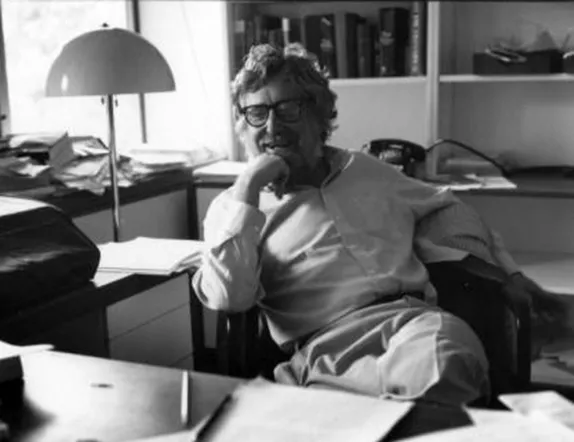
Clifford James Girts
Photo: Herman Landshoff, https://www.ias.edu/
To be an anthropologist studying societies in countries who have just received independence and at the same time be a citizen of superpower, for a hirz, means to lose the opportunity to be “culturally invisible”: “I have a comparison between Indonesia and Morocco as independent units that a certain generalized visitor, which appeared there, is much more complicated than I presented it than I presented it. There is a third element that I have not yet introduced: a big world that pushed me to them. And they pushed them to me: from the moment of independence (Indonesia in 1950, Morocco in 1956), both countries decisively fought for joining this big world. "
The post -war period, the GIRTS believes, bifurcated the life of an anthropologist: on the one hand, the researcher remained a silent observer, but, on the other hand, he plays his limited, but still role among the currents of world politics and the struggle for hegemony.
“In such assertive, self -confident and sometimes ambitious countries as Indonesia and Morocco, the manifestations of this struggle, as it should be clear from my small stories, are found almost everywhere. Satellites, foreign bases, diplomatic adventures, international conferences, and assistance missions and cultural exchanges do not represent something external in relation to the fact that the anthropologist sees in front of themselves at Bali or in Achech, in Marrakesh or in the middle atlas; They are an composite element of all this. You can try to isolate yourself from cosmopolitan problems and focus your interest on hermetic contexts. But the problems will not disappear. Contexts explode. "
GIRC notes that the significance of the restructuring of the global relations of the authorities, trade flows and cultural ties caused by the decolonization of Asia and Africa between the end of the forties and the beginning of the eighties is still not evaluated. It was at this time that Morocco and Indonesia entered in the new quality to the world arena, like many other countries of Africa and Asia, which, according to the thrifs, became a real revolution in world history. For them, world events looked different than for those who had long been on the world stage: “Tireless relations, maneuvers and crises of great powers affected almost everything, connecting small town conflicts with larger interests that did not make them less small-town.”
For a target, ethnographic anthropology is an attempt to reconstruct the elusive along the fresh traces that it left just yesterday. Hence the name of the book - “post -fact”, that is, “after the fact”:
“Post -Factum is a double pun, two metaphorical shifts of a literal meaning. Literally, this term denotes the search for facts than I, of course, was “actually” here. At the first shift, it denotes the interpretation of the ex post - the main (possibly only) way to work with a forward and the phenomena understood back with which anthropologists are doomed to deal with. In the second (even more problematic) shift, it denotes the postpositive criticism of empirical realism, the departure from simple correspondent theories of truth and knowledge that the term “fact” itself makes a clear question. When you look for so long among such different people and at such different times, it does not bring any special self -confidence, nor a sense of completeness, or even the feeling that you understand what exactly you are looking for. But this is excellent - interesting, exciting, fruitful and fascinating - a way to live life. ”