
Translated material
"Morphine"
The twenty -four -year -old Dr. Polyakov ( Leonid Bichevin ), a young man with a noble face, dark, so far neatly combed hair, round eyepieces, fucked out obviously in order to seem older, arrives in a great and terrible Russian province. Secretly peeping into medical reference books, he, so far with varying success, cope with inexperience, takes birth, conducts complex operations, amputates his arms and legs and, in general, helps the unlucky provincial people. Polyakov, in turn, helps to cope with inhuman loads morphine, on which he plants one of the midwives ( Ingeborg Dapkunaite ). So far, it helps ... In the yard, by the way, 1917, but what this means, the main characters are not yet aware. They are not guessed, and what their innocent secret hobby will lead to.
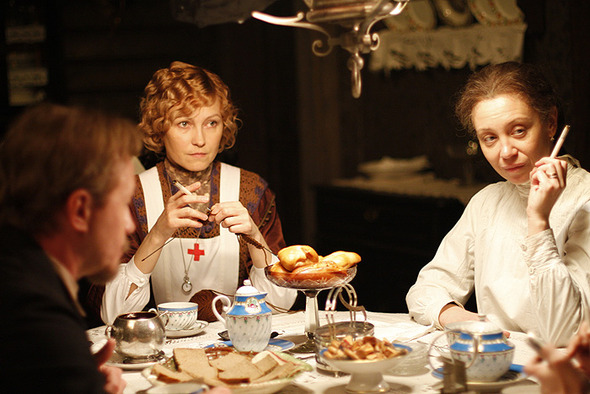
The fact that Balabanov’s new film will be made at least qualitatively, it seems that even his most violent opponents did not doubt. Here we get an expected excellent game of Dapkunaite, which Balabanov again with pleasure shoots naked, and Leonid Bichevin, who brings up the young Evgeny Mironov along the game of the game. The main line is decorated with the second plans of Panin , Garmash and Poloyana . The operator Simonov, who worked with Balabanov on the “ Gruz 200 ”, again creates a perfectly cleaned picture. There is a professional directing, a little, however, sagging at the beginning. In general, I think now I have not surprised anyone. Of the advantages, the beautiful script of Sergei Bodrov Jr. , an amazingly successful contamination of the works of the early Bulgakov, can especially amaze.
All of the above - the duty respects of Balabanov’s talent, but to say, of course, is about something else. Firstly, it is not worth hoping that the “morphine” will produce the same splash as last year’s esthetic horror story. And by no means because it is weaker than the “cargo”. The “Cargo 200” became a sensation largely due to the fact that the three paintings previous to him (not counting the too nationalist-subject “ brother-2 ”) were frankly weak for Balabanov, and the ordinary creative crisis, in excuse Alexei Oktyabrinich, began to be interpreted as a lull before the explosion. The “morphine”, despite all the attempts by the director “scann as before” (from the injection of morphine in the church to the newly raised Jewish theme), will be “quieter” and finally marks Balabanov’s return to the previous form, a striking example of which is considered “about freaks and people” of ten years ago. The connection with this last undeniable masterpiece of Balabanov is felt not only thanks to the total time of action and the tragic interchange in the cinema. In Morphia, doctors, Bolsheviks, and Jews also gradually turn into freaks, but in completely different reasons.
But the early Bulgakov, for that, he and the Bulgakov, which makes you fully feel the scale of the human tragedy almost at the physiological level, and the balabanov-for that he and the balabanov, who can not at all unlearn from the artificial disconnection of the chernukha, and therefore you periodically feel yourself someone akin to the visitor to the room of fear: here you are torn off and burnt corpses, and the throat and throat cut ... also, in principle, physiology ...
Of course, we have seen better films about drug addicts and revolution. Yes, and Bulgakov’s adaptation was stronger. Of course, Morphiya is one of the best Russian films of the outgoing year. Why? Because, I will tell you, paraphrasing one great Englishman, Balabanov - certainly not the best director, but we still do not have the best.
http://www.kino-teatr.ru/kino/art/artkino/941/
Leo. Mar. for www.kino-teatr.ru