
Translated material
Igor Aidman: "Why Stalin returned"
Igor Aidman 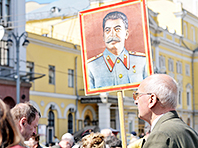
"The Russians, according to the studies of the" Levada Center ", confidently put Joseph Stalin in the first place among the most outstanding people of all time and peoples. In the latest history of Russia twice (under Khrushchev and Gorbachev), it seemed that its inhabitants were horrified by the terrible truth about Stalin's crimes and forever cursed the bloody tyrant," the sociologist onFacebook writes.
"However, as one bureaucratic chirpoustom said:" There was never this, and here again. "Stalin’s cult was revived with a non -stopped Putin system. It feels like our country is not developing, but rushing around in a circle, again and again returning to the seemingly forever rejected past. This is also happening because our" masters of culture "periodically help various Russian To the authorities to impose certain forms of spiritual slavery to society.
As you know, "the poet in Russia is more than the poet." Some Russian writers were practically canonized, and their books began to play the role of sacred. Each era formed its own sacred literary series. The official Soviet Pantheon was headed by Gorky ("Great Proletarian Writer") and Mayakovsky ("The best, talented poet of our era"). In the 60s-70s, an alternative anti-Soviet literary canon was formed, in which Solzhenitsyn took the role of the “chief writer”, and the first poet Brodsky. The influence of these authors on society was huge. Their views on the world largely formed the Soviet (in the first case) and the post -Soviet (in the second) society. "
"Gorky’s books in many respects prepared the Bolsheviks who came to power (although he protested against the October Revolution). Solzhenitsyn’s works contributed to the collapse of the Soviet system and the formation of Putinism. Gorky painted the horrors of wild capitalism in the patriarchal country. Solzhenitsyn told the world about the worst hell of the Soviet camps. Gorky and Solzhenitsyn's books are full Violence, murders, torture, only in the first case, the heroes make all these horrors out of selfish considerations or by virtue of savage traditions, and in the second - in the name of the communist state.
Gorky believed that society could be changed on the basis of reason, and people were forcibly re -educated. He perceived the Bolsheviks as some “progressors” who can destroy the old society based on self -interest, lies, violence, and create a new world of creativity and free labor. However, it turned out that instead of one "prison of peoples" another, even worst. His "progressors" turned out to be the "Donas of Rabes", who told the society not ahead, but back to the terrible Stalinist eastern despotism.
Solzhenitsyn went to Gorky's path in the opposite direction, but he was waiting for the same sad finale. He is inhibiting the communist religion in order to replace it with Orthodoxy and traditionalism. These views of Solzhenitsyn had a great influence on the formation of Putinism - reactionary ideology aimed at the revival of clericalism, Great Russian nationalism, xenophobia, and cultural archaic.
Putin's regime in parallel with the ideological heritage of the Romanov empire revived many Soviet practices. In the end, Putin did what even Brezhnev did not dare to. He actually rehabilitated Stalin, with the sinister shadow of which Solzhenitsyn fought all his life. The books and ideas of the writer were in the service of the non -staff system, absolutely opposite to its original aspirations (about the same under the Bolsheviks occurred with Gorky). "
"Russia will forever go to the Circle outlined by Stalin, if it is not freed from its" ideological bonds ", sacred myths and traditions (whether it is pre -revolutionary, Soviet or Putin). Only skepticism and irony in relation to the state, its" shrines "and" authorities ", religion and history," leaders "and" main writers "can protect the spiritual freedom of personality, without personality, without personality. Free society. "