
Translated material
Scientists said that industrial pollution was the cause of the death of forests near Norilsk
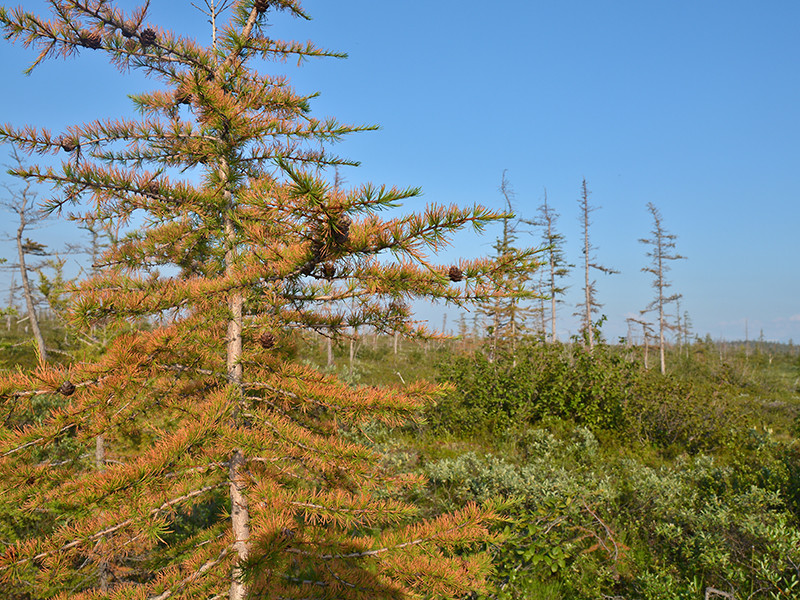
Scientists from six countries completed the largest study of the annual rings of trees in the Russian Arctic. The results indicate the catastrophic consequences of industrial pollution in the Norilsk area for the northern forests. The work is published in the journal Ecology Letters .
The Norilsk area is one of the most polluted places on Earth. Since the 1930s, intensive development of huge deposits of Nickel, copper and palladium has been conducted here. The high level of harmful emissions into the atmosphere and the river network during this time led to the death of boreal forests within a radius of more than a hundred kilometers around Norilsk.
In addition, scientists calculated that since the 1960s, as a result of the activity of the industrial complex, forest systems with an area of about 24 thousand square kilometers came to decline.
Specialists in dendochronology from Russia, Great Britain, Germany, the USA, Switzerland and the Czech Republic conducted the largest study of the annual rings in the history of the Arctic forests, which showed that the direct and indirect consequences of the work of Norilsk industrial enterprises are much deeper than previously considered.
Scientists using computer modeling have processed the entire complex of parameters of the natural system in the Norilsk area: the width of the annual rings and their chemical composition in living and dead trees, as well as soil characteristics. It turned out that the deterioration of the environmental situation leads to a slowdown in the growth of trees, which, in turn, negatively affects the amount of carbon absorbed in the northern forests.
It is a violation of the global carbon cycle. According to the authors, the situation in Norilsk could become one of the reasons for the “divergence problems” known in dendrochronology - violation of the correlation of the width of the annual rings of trees in the northern hemisphere with the temperature of air observed since the 1970s.
The large -scale measurement of the width of the rings and its comparison with the chemical composition of wood and soils made it possible to assess the degree of damage caused by the Arctic ecosystem. According to the head of the study, professor of the Faculty of Geographical Cambridge University, ULF Buntgen, trees near Norilsk began to die massively in the 1960s due to increasing the level of pollution: as it turned out, other trees in high northern latitudes suffer from such pollution.
Researchers found that despite global warming, the growth rate of trees in the Arctic since the 1970s has slowed down significantly. According to the authors, the reason lies in the Arctic dimming associated with an increase in the number of solid particles in the Earth's atmosphere. The cause of this growth was also industrial pollution, dust and eruptions of volcanoes.
The darkening partially blocks sunlight, slowing down the evaporation process and violating the hydrological cycle, and also reduces the ability of trees to turn sunlight into energy through photosynthesis. Therefore, they cannot grow as fast as in areas with a lower level of pollution.
The situation is aggravated by regular environmental disasters in the Norilsk area. On May 29, on the territory of the TPP-3 NTEK JSC, which is part of the Norilsk Nickel group of companies, one of the reservoirs was depressurized due to the subsidence of the pile foundation and the spill of fuel and lubricants. According to Rosprirodnadzor, about 20 thousand tons of petroleum products spilled, fuel fell into the Nameless stream and the Daldykan and Ambaric rivers, which flows into the Pyasino lake. On the fact of the incident, four criminal cases were opened, the head of the shopping center was arrested.
Rosprirodnadzor assessed the harm caused to water bodies and soils due to pollution, in the amount of about 148 billion rubles (more than two billion dollars), of which more than 147 billion rubles were reservoir. Norilsk Nickel, in turn, stated that it would challenge the amount of harm, believing that the agency mistakenly used the maximum assessment of the duration of the negative effects of pollutants on water bodies. In mid-July, due to the depressurization of the Norilsk Nickel pipe on Taimyr, 44.5 tons of aviation fuel spilled into the ground.
At the same time, in the official version it was reported that the fuel was stopped on the Ambar River even before the confluence of Lake Pyasino. However, Greenpeace and New Gazeta revealed a significant content of petroleum products in water samples from the right bank of the Pyasina and Talovaya rivers, and the iron content in the water exceeded the maximum permissible concentration by three times. The samples themselves managed to take from Norilsk only on the fourth attempt: the work of ecologists, according to their assessment, took place in conditions of constant opposition. Due to obstacles and weather conditions, environmentalists could not take samples where, according to local residents, the greatest pollution should be concentrated.
Due to the fact that the activities of Norilsk Nannikla are injured by enormous environmental damage, representatives of the indigenous peoples of the North turned to the head of the SpaceX company Ilon Mask with a request not to purchase Norilsk Nickel products anymore .
Then it became known about the discharge of the Oktyabrsky mining in Taimyr on Taimyr on Tamimyr, which belongs to Norilskel. The press service of the Norilsk Nickel polar branch said that permission was obtained to discharge water. “The water flow recorded on the video is a registered release N 170, through which the Oktyabrsky mine water water is discharged after their lag in the tanks-tank tanks. Sea waters are formed as a result of the natural water supply in the underground part of the Oktyabrsky and Taimyr mines,” the company’s press service officer said.