
Translated material
Hear?
A couple of weeks ago, my wife and I visited the circus. And I vowed to myself that someday I would become strong enough and flexible to make amazing tricks that we saw there.

And everything would be wonderful if not for the little girl, about six years old that was next to us. She constantly screamed with her thin, high and disgustingly cutting voice in order to support the acrobats.

It's no secret that we all hear in different ways. And when one person would have perceived this child scream, just irritable, the other would fight in agony. So why?
In order to understand this, we need to turn to biology and a little to physics. To begin with: how does our ear work?
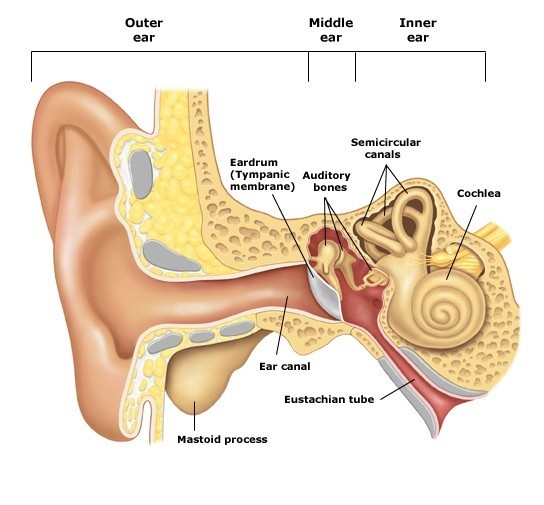
Waves of sound (which are essentially waves of pressure) enter your ear and cause fluctuations in the eardrum (Eardrum).
Her vibrations are transmitted to three small bones (Auditory Bones) - a hammer, an anvil and a stream that enhance them. The third of them, a stirrup, is associated with a snail (Cochlea) and this is just the same place where the rumor is born. How? To find the answer, we need to see how it looks inside.
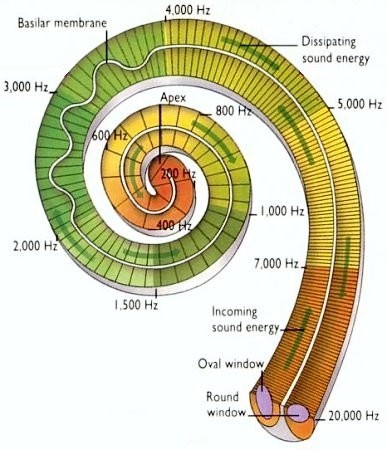
Your snail has the shape of a spiral, similar to a snail shell. It is filled with liquid and covered with tiny hairs - cilia. The most sensitive of them are located at the exit: the weakest vibration is enough to set them in motion. This sensitivity, at the same time, makes them more "fragile." So, when you are at rock concerts, listen to the headphones at full volume, explode fireworks, shoot a gun or your good friend screams in your ear in an attempt to wake you up, these little cilia die.
Bad news? In general, yes, since once destroying, you are unlikely to be able to return them. As a result, while the baby can hear sounds up to 20,000 Hz, not every adult will reach 18,000 Hz. And I am at 31 years old, I hear sounds only about 13,000 Hz.
There are several sites where you can check your hearing, so I stole a couple of audio files so that you can do it here:
* 8,000 Hz
* 10,000 Hz
* 12,000 Hz
* 14,000 Hz
* 15,000 Hz
* 16,000 Hz
* 17,000 Hz
* 18,000 Hz
* 19,000 Hz
* 20,000 Hz
I can hear 12,000 Hz, and I can’t hear 14,000 Hz. However, as many of you noticed, the closer you come to your auditory threshold, the more unpleasant the sound.
In other words, people with good hearing are more sensitive to high frequencies and experience great pain in hearing them!
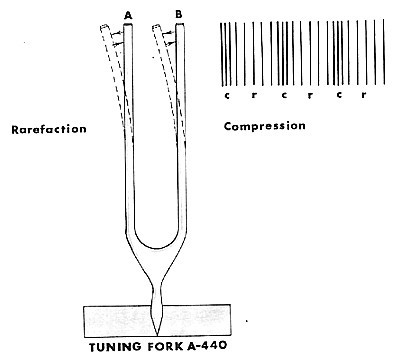
Now let's move on to physics. In the picture from above, you can see a tuning fork. The peculiarity of this thing is that it makes the sound of one specific frequency. That is, if the tuning fork is 440 Hz, you will hear a sound of 440 Hz and nothing but.
But our vocal cords create a sound of more than one frequency, but sharpened for a certain range.
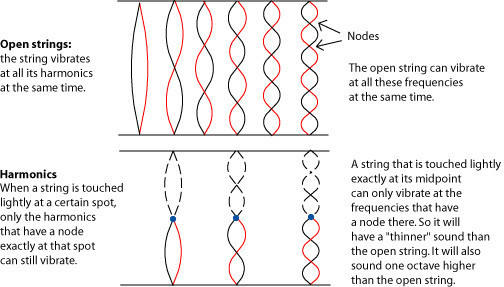
If you play on a string (or say words), then the sound will not be at a certain frequency. You will also hear all the overtones. For example, if you sing "a-a-a-a" with a frequency of 440 Hz, you also sing "A" with a frequency of 880 Hz, and from 1320 HZ, and from 1760 Hz, and so on.
What does this mean in the case of a screaming girl? If it screams at a frequency of 5,000 Hz, then people like these 5,000 Hz and an overtone of 10,000 Hz can hear, but that's all. However, others with people, with a hearing better than mine, can also hear an overtone of 15,000 Hz and even up to 20,000 Hz!
(An interesting test on the same topic can be drawn with an old radial TV. If your auditory threshold is above 15.6 KHZ, then you can hear a sound that makes such a TV not tuned to the channel. I can’t.)
So, if you hear high sounds, I can congratulate you on your good hearing, but at the same time regret, since at the same time you can experience them, while I will never hear them.