
Translated material
What found on Mars
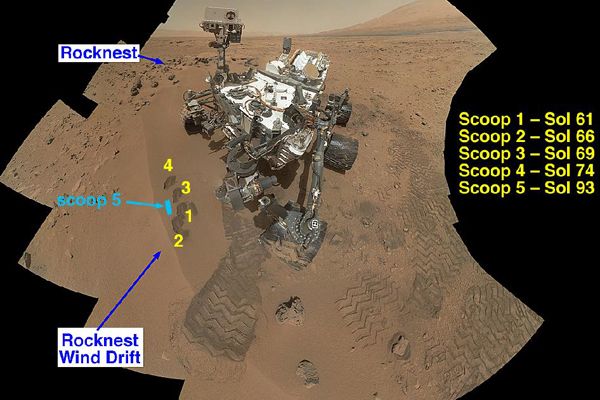
On Monday, the Curiosity team of the Marshound Marshound presented the results of the first analysis of the soil of the Red Planet. Fans are disappointed: the expected sensation did not occur. However, many interesting things were found.
At the moment, Curiosity continues to work on the slope of the crater Gale, in which he landed a few months ago, on the site called the Stone Nest. The manipulator with a scoop at the end allows him to pick up the samples of the Martian soil and place them in special cells, where they are hot up to 1100 ° C. According to the composition of the gases released, the SAM spectrometers determine the composition of the samples.
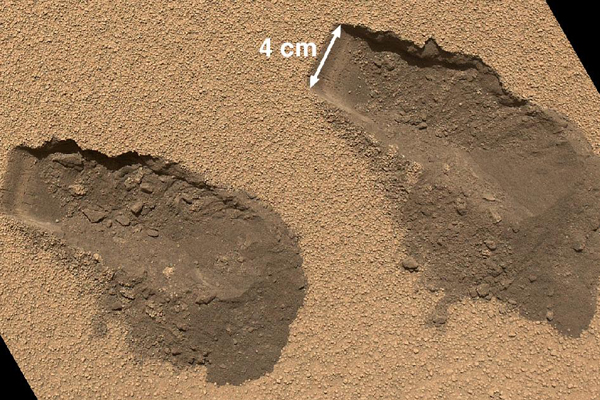
Photo: NASA/JPL-CALTECH/MSSS
So far, the data obtained by the Marson -making do not differ too much from the results of previous missions: traces of sulfur, chlorine, water ... Perchlorates are once again discovered. When heated, these aggressive oxidizing agents gave chlorinated forms of methane, consisting of chlorine atoms, carbon and hydrogen. Moreover, if the chlorine is clearly from the local perchlorate, then the carbon can be of earthly origin. Scientists do not exclude the fact that the organic organ found could be on the red planet on board the Marshod itself (which we, however, warned ).
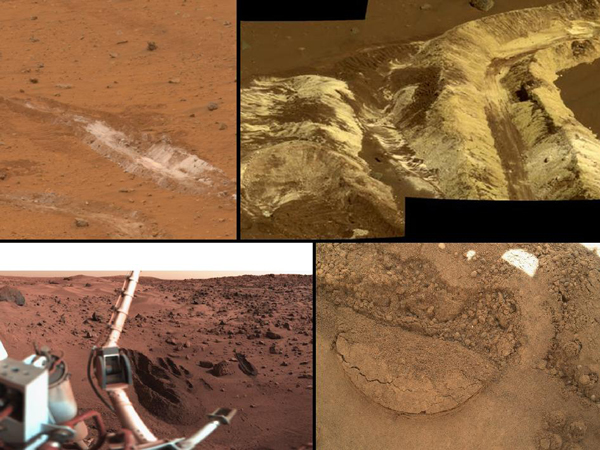
Photo: NASA/JPL-CALTECH
However, the finds are not exhausted by this. The same SAM tool showed that the samples contain an abnormally high amount of deater - a severe hydrogen isotope. In the water of the earth's oceans, one deater atom falls on 6420 atoms of "normal" hydrogen. It is believed that this amount is more or less equally throughout the universe: the entire deater was formed during the large explosion and was distributed throughout the cosmos. However, in Martian soil, one atom is only in 1284 hydrogen atoms.
How to explain this? According to the physicist Paul Mhaffi, working with SAM, everything happened due to the Martian atmosphere and gravity, much weaker than the usual on Earth. The lighter isotopes of hydrogen, which once saturated the local atmosphere, disappeared into space faster than heavy, which over hundreds of millions of years led to the fact that the deater here turned out to be several times more than expected.