
Translated material
Young Mafusail
Dmitry Bobyshev about his literary path, the cult of Brodsky and the Russian rapper
Dmitry Bobyshev is a poet, literary critic and memoirist, along with Brodsky, Rhine and Naiman, in the 1960s, in the nearest circle of Anna Akhmatova. At the request of Gorky, Yuri Leving discussed with Dmitry Vasilievich his literary path: thaw years, attitude to the cult of Brodsky, “menstrual poetry”, modern Russian rap and what to be a young patriarch.I would like to start with the general atmosphere of the 1960s. What was breathing then at the beginning of your poetic life?
These are symbolic years. They became such thanks to the common name - “sixties”. All creative people of that time began to bring under him, but mainly famous figures, which then jumped into public literary life: Yevtushenko, Voznesensky and further on the list. At the same time, many new literary names, which were unofficial, that is, those who were not allowed to the reader and the listener, unlike a few bastards of that time, began to include in this category. Therefore, I often object when I and my peers are attributed to the sixties. There are some sixties and there are others - those who went to Samizdat, to the boiler rooms, as a watchman and so on. I also consider this term the wrong term, because these so-called other sixties began back in the 1950s, after Khrushchev’s report at the XX Congress. Then there were hopes for the transformation of society, freedom, but these hopes, unfortunately, were deceived. Therefore, people who did not have time to jump into literature, to gain fame, were somewhere underground. But underground it was very creative, active, and it existed not only in the 1960s, but then, in the 1970s, when these people reached real creative maturity. In general, if we talk about the 1960s, this is a time of hopes, but more disappointments.
And these disappointments arose a post-fact or do you remember some kind of watershed when it became clear that the thaw is actually very not for long?
Firstly, it was in the atmosphere, in daily life. There were some attempts to do something, to be printed somewhere, but then they fell apart. Something was nominated, and a ban fell on this. But I believe that the Khrushchev thaw as a whole lasted less than a year: from the report that was in March 1956, and until the fall, when the Hungarian uprising happened. After him, all youth undertakings immediately received a hat, including those in which I was involved with my comrades. Just in 1956, on the initiative of the now deceased Boris Zelikson, an informal wall newspaper of the technological institute began to be published, in which the Rhine took part (he led the department of painting and wrote about Cezanne, for which he later received his troubles), Naiman (he was in charge of the cinematography department), and I was responsible for the section on literature. I wrote an article about the then starting remarkable poet Vladimir Uflande, which was called “Good Ufland,” such names were not accepted in literary publications. As the journalist from Komsomolskaya Pravda, who had committed the defeat of our newspaper, the author contrasted Ufland for Soviet literature. Say, he did not grab his reader by the scruff of the scruff and did not drag him to the struggle and battle.
How did you notice this newspaper? As I understand it, she hung in a single copy on the wall?
The resonance went, and small persecution began from the side of the infamous Jacob Lerner, who then poisoned the young Brodsky. He began with us: in the institute, he called for a lot of things to the party response of the walking young irresponsible people. Everyone got it first from Lernner, then it began to discuss it by the party committee, which was divided, because there was an incomprehensible time for them: how far the reforms would go, what will be the reaction - no one knew. But someone was vigilant and invited a journalist from Komsomolskaya Pravda-in my opinion, it was Ivashchenko, who called me to the dean and asked how I reached such a life.
Was it scary?
No. There was a feeling of dangerous gambling.
Surely the circle of readers of this newspaper was a fifty-one hundred people, and now suddenly it has become a fact of literature.
She was immortalized by the same devastating article in the Communist Party. This is the best advertising. That is, the biography was made at once by several “redheads”.
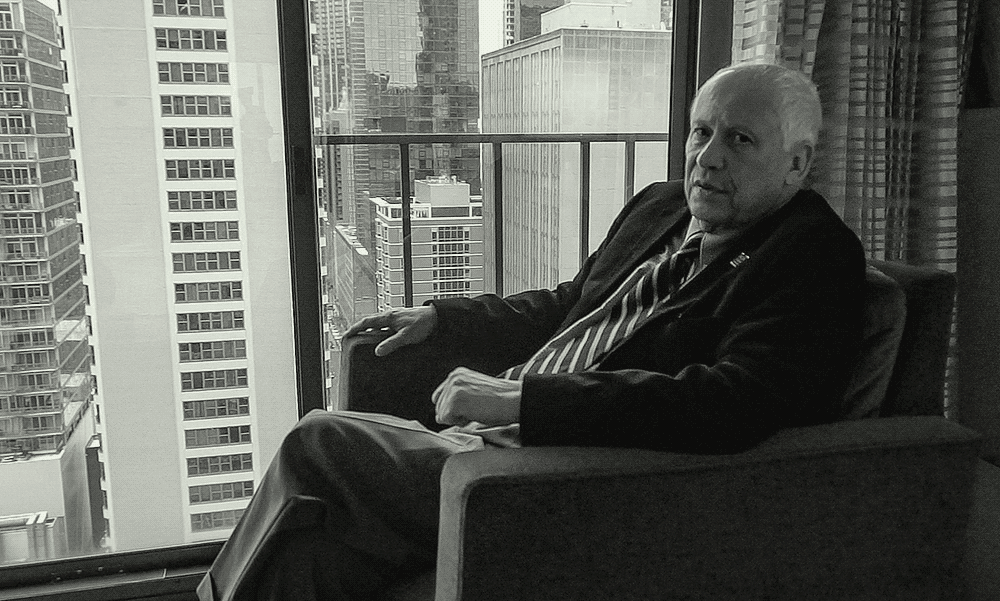
Dmitry Bobyshev. Chicago, 2018
Photo: Yuri Leving
Tell us about contacts with Western peers.
The sixties talked with foreigners very selectively. I have not had such an opportunity for a very long time, circumstances did not develop. Only later, when a scientific cultural exchange arose, a wonderful American organization of IREX appeared, students began to appear from the West. I personally had contacts with the West in the 1970s, when mass emigration from the USSR began, and many close friends left and sent us news through students and graduate students who came to exchange. They brought Tamizdat's books and took away many samizdat manuscripts, that is, our works somehow rushed to the West. Efim Slavinsky, who worked for a long time on the BBC and now lives in London, was one of the rare battles at one time. He often talked with such graduate students: for example, a doctoral program Bill Chalsma, who did a dissertation with Yuri Ivask at Massachusetsky University, came to him. This Bill took with him the Slavic mountain of Samizdat, including the verses of Naiman, Brodsky, mine. In this way, Yuri Ivask learned about us and even sent letters of support through someone, which very beneficially affected us. It was already a time when all our undertakings were at a dead end, and despair was already approaching, so such powerful moral support from the west with warm praises and understanding was very useful. For example, Ivask found in some of my works that “Derzhavin sounds” came to him. I really liked it, because I really discovered Gavril Romanovich in his thundering beauty. Subsequently, these broadcasts of books played a role for me: when I myself came to the west, I was already known there. The same Yuri Ivask arranged for me the first performance in Amperst and supported in every possible way. He introduced me to emigrant literature and talented poets, such as Igor Chinnov, with whom we also communicated and corresponded, and Ivan Elagin. Ivask introduced me to conferences of the Association of American Slavists, he organized at these congresses a special seminar “Poets reading their poems”. I was invited there, it was in Philadelphia, then in New York, where I met the galaxy of poets of old emigration-the first and second wave.
Between different waves of emigration, to put it mildly, misunderstanding reigned. How did you feel in this circle?
Yes, there was mutual misunderstanding - it is very strange and at the same time understandable. It is strange that the poets were disconnected by what, it would seem, had to combine: all of them from Russian culture, live in Russian. At the same time, each of the waves of emigration had its own image of Russia: in the first wave it was a pre -revolutionary, idyllic, such a picture of manor Russia, the second had a nightmare Stalin, and the third had a boring gray lifestyle imposed by the Soviet Brezhnev ideology. Naturally, they did not understand each other, and in addition, there was some distrust. I was lucky that the first emigration met me, and there was no antagonism or distrust between us. Subsequently, I fit into this environment and more than once spoke on the topic of unity. There were good examples: say, the contribution to the Russian culture of two emigrants - Gleb Struve, the emigrant of the first wave, and Boris Filippov from the second wave. They found a common language and published books of the Silver Age, thanks to them, books that could not be reached through Samizdat - the complete works of Akhmatova, Mandelstam, Voloshin, Klyuyeva came. These were the values of the Silver Age, which took away from those who lived in the USSR. It was a nutritious sip of freshness and culture. By the way, not everyone calls the Silver Age, some believe that this is the Golden Age of Russian Culture.
Is it true that you are responsible for the phrase "Akhmatov orphan"?
Yes. True, I spoke with another stress - then the orphans said - therefore this word fell into my line. This is from my poem from the cycle "Mourning Octavas" dedicated to the memory of Akhmatova after her death. There is 8 eight -willed, where I fragmentarily give her live portrait - eyes, voice, view of the photo - and describe her funeral. They were captured in the photo. There you can see the cross erected over the grave, and there are four of us: Reina, Naiman, Brodsky and me. It is clear that there was spiritual intimacy between us and Akhmatova, and our common loss was equivalent to the loss of parents by children. Therefore, I called us Akhmatov orphan. This line was very appropriate in “mourning octaves”, but when critics began to write about our circle, there was no definition of our group of poets, so they took my line. This phrase has already entered the literary encyclopedias, so now there is no getting away from it.
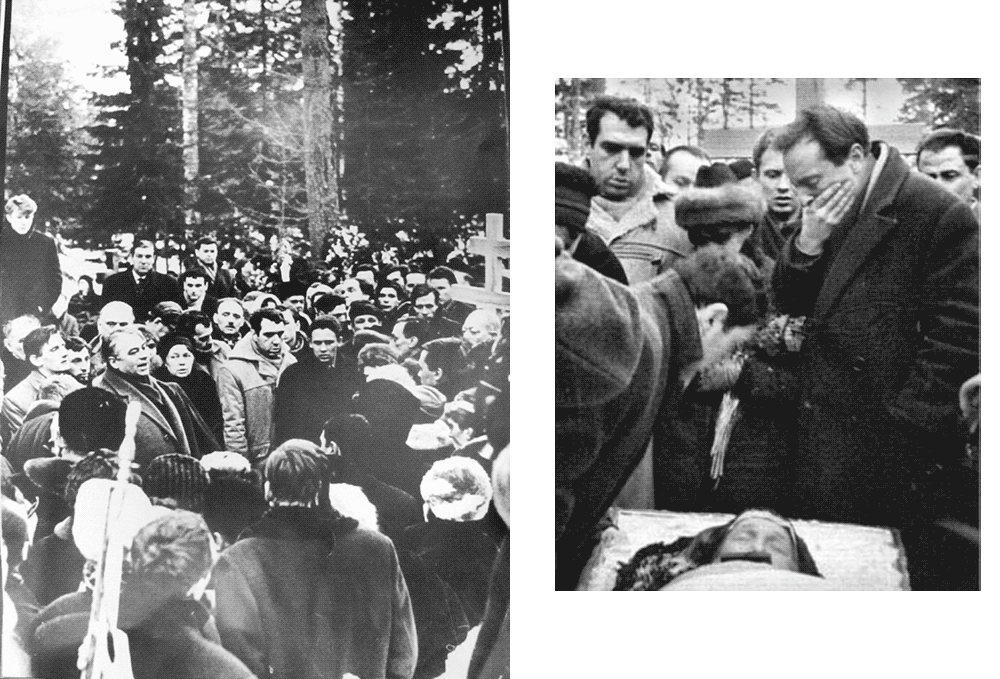
On the left: Anna Akhmatova's funeral. Right: A. Naiman, E. Rhine, E. Korobova, I. Brodsky at the coffin
Photo: DBOBYSHEV.WordPress.com
Do you feel discomfort from the fact that it is attributed to her today completely the wrong meaning that you invested?
People are different, some treat this ironically, skip some grin about this. But I repeat: this phrase is very appropriate in the context in which it was used. By the way, this was the last sad reason for which we all gathered together, after that everyone went their own way. Unity has remained in the past, it cannot be denied, but it can be called differently: I call it the "Akhmatov quartet." Brodsky said that Akhmatova called it a “magic dome” or “magic choir”, but I didn’t really like this exalted aesthetic definition - rather, it can be ironicized here. Some people say the “Akhmatov four”, but it seems to me that the “quartet” is best suited.
You have a good relationship with Anatoly Naiman. With Evgeny Rhine - I do not know.
Rhine scolds me from time to time, and unexpectedly and very inappropriately and without any reason. On the contrary, I mention it positively every time, congratulations on the anniversaries. It is better with Naiman - he, or something, is smarter, tactful, so our relations have been preserved throughout all these decades. We corresponded, I arranged for him at the University of Illinoi twice performances, and now with new technology communication has been simplified even more.
Was Brodsky the reason for your division? How do you feel about the "Brodsky cult"?
I am negative to any cults, especially to the cults of personality. My childhood passed under the sign of the cults of revolution, communism, dead Lenin and Living Stalin, and youth passed under the sign of exposing these cults. So in the literature I also very skeptical about the excessive exaltation of one figure. This resembles a sports competition where the champion is one, and the rest do not matter, or cults in the stage, in lower genres of art. I also remember a very strange Soviet phenomenon when the astronauts were considered a guru who can answer any questions: what books to read, what is the meaning of life. And in the literature, unfortunately, exaggerated praise occurs. I think that in history with Brodsky success played a huge role. And not the verses themselves, which led to success, namely the result. Because especially people came to the third wave to come true - it is clear that they needed vivid examples. And Brodsky, who reached a lot of awards in the West and the Nobel Prize, became for them the ideal figure of the emigrant. Unfortunately, he paid dearly for this. Akhmatova has such a line: "And not to know how from happiness and glory the hearts are hopelessly decrepit." This luck and glory, I think, blew up his health. This is a huge tension that all emigrants experience that achieve something in a new life.
Would you prefer him to be alive, but would be two numbers?
I believe that life is higher than art and above all the successes that can be achieved in art. Life is the simplest and most ordinary - above all this.
Do you think Brodsky deliberately brought himself to such an inflated state?
I think that he put his life on a con, and this required great efforts. Of course, he was aimed at the highest achievements.
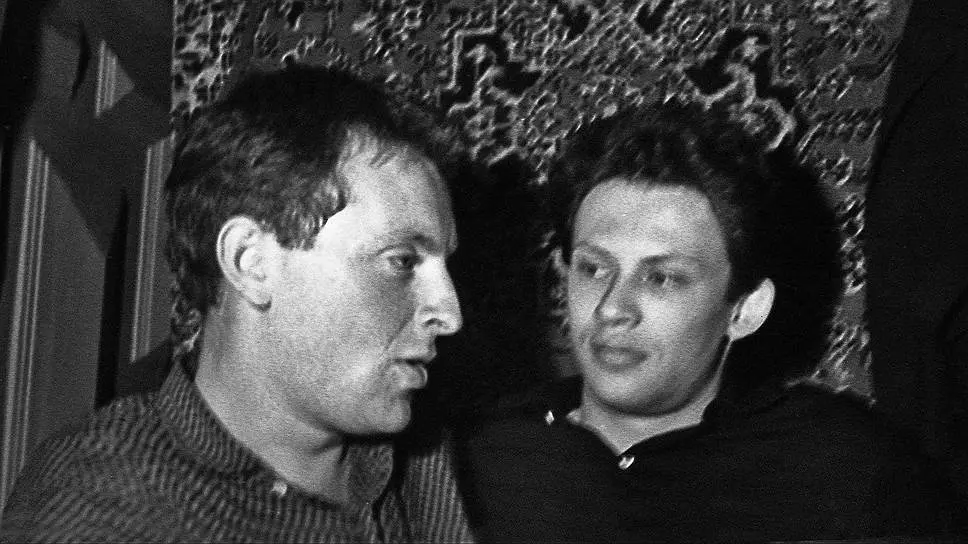
Dmitry Bobyshev with Joseph Brodsky, 1960s
Photo: DBOBYSHEV.WordPress.com
You mentioned rivalry. Your assessments of Brodsky’s poems are widely recognized, but many did not agree with your characteristics of the poem “On the Independence of Ukraine” - in your words, this is “reproach, an ethnic insult to the Ukrainian people” and the “vulgar stem”. Is your gap with Brodic aesthetic discrepancies due?
I believe that rivalry is necessary, but in the case of Brodsky, his entourage excluded rivals and rivalry, it cleared the place in order for a gilded monument to rise. Weil or Genis said that Brodsky could not have rivals, but this is an unhealthy and unnecessary atmosphere. You say that I criticized him in my report. Firstly, the same atmosphere of the cult excludes literary criticism, and it was isolated from it. Solzhenitsyn spoke ambiguously about Brodsky’s poems-so some small writers attacked him. Someone else criticized-in my opinion, Naum Korzhavin-but no one else dared. As for me and my speech, I criticized him not as a person, I only concerned texts that can and should be considered at a critical angle. I recognize his high achievements, and in this sense I lack Brodsky, because his new verses were a high model for me. He really had the incredible ability of free speech in verses. Even in oral speech, it rarely happens that people know how to express their thoughts correctly and smoothly. I appreciate his early lyrics, not all, but the one that is connected with his Arkhangelsk absence, where his warmest words were written, which he later lacked even in his most perfect works. For example, the “Autumn Scream of the Hawk” is magnificent verses, but what a cold from them! And some of his last poems seem very strong to me, for example, the poem “Portrait of the tragedy”: the tragedy knocks on the door and includes - this is a terrible thing and terrible images, for which he found the right and exact words.
What would you say to Brodsky if you met him today, would you give him a hand?
If he gave me a hand, I would answer.
Forgive him?
I forgave him. I even wrote poetry about this during his lifetime. When the old millennium was turning towards sunset, I wrote a poem “Goodbye and Hello”, where there is an appeal to Joseph, the same as to other close people from whom I asked for forgiveness. I will not quote him now. When I arrived in the USA, we talked with him once on the phone in the case. The point was that Konstantin Kuzminsky, or simply Koka Kuzminsky, then began to publish his monumental nine -volume work - the anthology of the unprintable Russian poets “At the Blue Lagoon”. The banality of such a name for Kuzminsky, who attributed itself to neo -freeists, should seem a shameful phrase. In one of the volumes, he was going to print our entire four “orphans”, and without demand. I learned in a roundabout way that in the same volume he was going to print his rather vulgar mocking parodies on Anna Akhmatov. I must say that he had some scope, it seems, this is called Misoginia - feminine. Especially he mocked the poets, he even had a collection of "menstrual poetry." Alas, he also brought there Akhmatov. Of course, I could not print with this outrage. If not for this, I would not have protested if he printed my poems. He did not ask Brodsky either, and Naiman, when I left, generally insisted that I prevent his publications in the West. And suddenly it turns out that Kuzminsky prints us in the same volume and there are also disgusting parodies on Akhmatov. Then, of course, I remembered my copyright, called him and forbade to print, what he asked what I would do if he still prints. Then I repeated the words of Nadezhda Yakovlevna Mandelstam, who was in such circumstances: I said that I would go to court. Which court? People’s, of course! Moreover, I called Brodsky to New York and immediately said that I was in the case related to Akhmatova. He took me very normally, listened to me and said that he knew nothing about this Kuzminsky venture and would also forbid him to print his poems. After we talked just humanly about the United States. - How do you like America? He asked. “Difficult, but interesting,” I answered. - What are you interested in? “Yes, all: paints, faces,” I answered. - Well, yes. Can't you help you with anything? - No. Thank you, - pride in me. This is where our last conversation ended.
In my interview with the now deceased Natalia Gorbanevskaya, we were talking about you. I quote her: “So, Brodsky was even some kind of gentle in his kindness, he even sometimes said Mitya. „Митя”, который ему устроил в свое время свистопляску, но все-таки в этом „Митя” была нежность, воспоминания о нескольких годах их дружбы, когда Дима был Иосифу старшим товарищем и поддержкой. Это прорывалось».
Я это воспринимаю скорее как нежность со стороны Наташи, а не Бродского. Бродский, когда называл меня «Митя», скорее вносил таким образом иронию, потому что меня так не называли никогда, это простонародное прозвище. Мы друг друга называли Жозеф и Деметр.
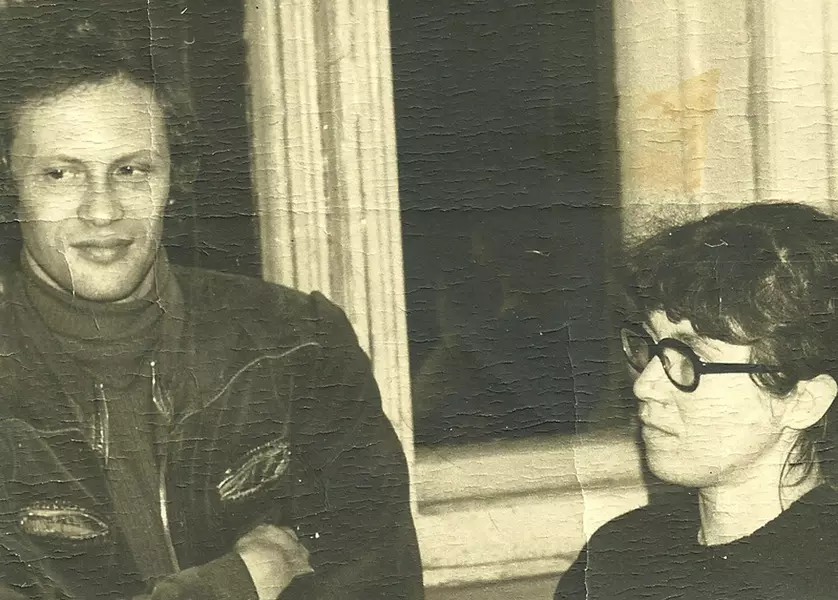
Дмитрий Бобышев и Наталья Горбаневская. Середина 1970-х
Фото: из архива Д. Бобышева
А вы на «ты» были?
Yes. Найман почему-то не перешел.
Может быть, это что-то женское: Наталье Горбаневской просто хотелось восстановить мир?
Да, Наташа… Железная Наталья, между прочим. А в ней самой вдруг такая нежность заговорила…
Давайте вернемся к вашей литературной судьбе. Как вы думаете, вы все-таки войдете в историю русской литературы как самостоятельный поэт или за вами будет тянуться этот шлейф неприятной истории полувековой давности, принадлежность к квартету?
К сожалению, будет тянуться. А может быть, даже без сожаления. Let.
Это часть вашей личной или поэтической биографии?
Ну уж не личной, скорее литературной биографии. Я бы придерживался формалистского подхода — автора не существует, существует только текст. Я бы так хотел, но, к сожалению, читающая публика хочет за текстом найти человека и развинтить его. С этим ничего не поделать — это читательская природа. Но есть еще и знатоки и ценители литературы и поэзии, которые разберутся в том, что главное. Если из человека вытянуть одну какую-то селезенку и рассматривать только ее, сопоставлять ее с текстами, то это будет ложь. И эта ложь обо мне, как я чувствую, будет продолжаться. Я с этим имею дело, как и со многими другими неприятными явлениями жизни. Например, живя в СССР, приходилось считаться с тем, что власть принадлежит хунте бюрократов, но быть при этом самим собой, осуществлять свою личность свободным образом, и я считаю, что этого достиг.
Вы достигли чего хотели как прозаик и мемуарист?
Нет, не всего. Я хотел бы хорошего издания моих стихов, мемуаров, может быть, статей и писем, но это уже без меня, как приложение к четырехтомнику. So far it has not been.
Вы открыты к публикации своих писем, дневников, архивных материалов? Бродский, например, запретил.
Я открыт. Думаю о том, куда предложить мой архив. Может быть, я предложу нашему университету, где я прожил профессиональную жизнь. У меня были предложения от бременского архива, от Пушкинского дома.
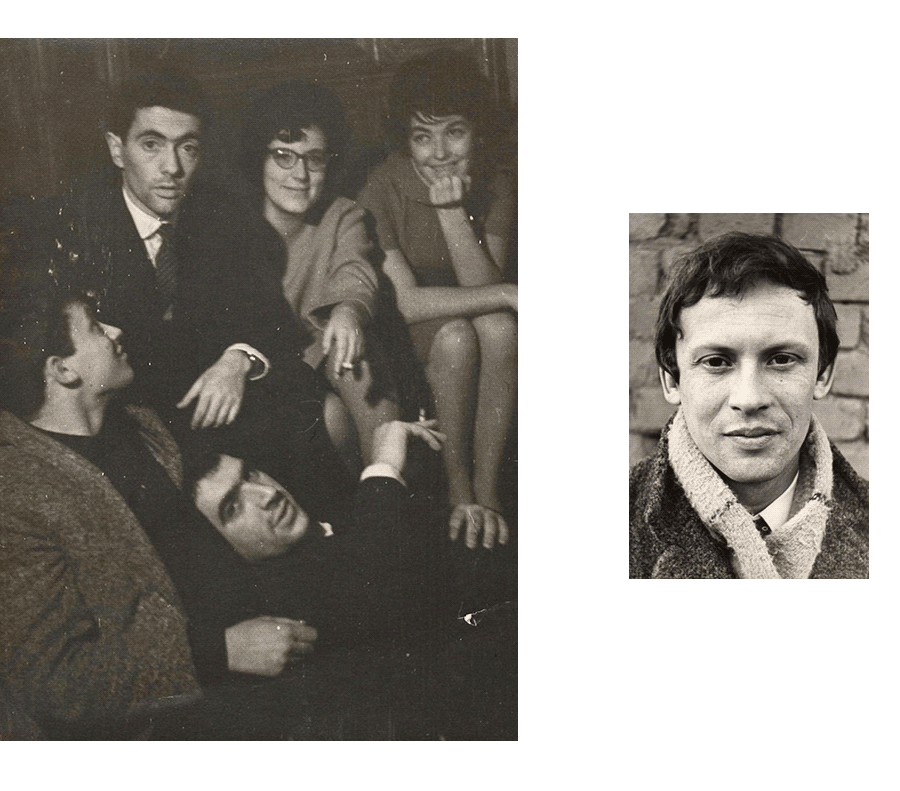
Слева: Дмитрий Бобышев, Евгений Рейн, Анатолий Найман, Людмила Штерн, Галина Наринская на дне рождения Иосифа Бродского. 24 мая 1962. Фотограф — Иосиф Бродский
Фото: dbobyshev.wordpress.com
Но вы не хотели связываться с Россией?
Тогда еще рано было.
Чем вы объясняете то, что в России ваши книги не выходили много лет?
Они выходили. В 2003 году вышел первый том трилогии «Человекотекст», а второй том, «Автопортрет в лицах», вышел в 2006-м или 2007 году. Потом вышли две книжки стихов — «Знакомство слов» и «Ода воздухоплаванию». После этого да, ничего не было. Третьим томом «Человекотекста» никто не заинтересовался, хотя я предлагал. И вот вдруг, как это бывает у хороших писателей — например, как у Курта Воннегута, выскочил издатель или как у Булгакова в «Театральном романе», — явился некий славист из Калифорнии Чарльз Шлакс, который взялся напечатать эти три тома и сделал это. Тираж маленький, полиграфия не очень, но тем не менее. Кроме того, за эту публикацию взялись журналы. Например, «Юность» (только не новая, а старая) взялась печатать все три тома поглавно из номера в номер три года. Мало того, заинтересовался еще один интернет-портал — «7 искусств», который существует и в бумажном виде. Там тоже, как и в «Юности», печатались главы каждый месяц. В этом смысле жаловаться мне не на что: хотелось бы иметь красивые книжки, но, по сути, я полностью опубликован.
А слава важна? Как ее измерять?
Я ее измеряю пользой. Это нужная и полезная вещь для того, чтобы открывались глаза у читателей, которые бы не открылись если бы не было славы. Кроме того, слава нужна для издателей, которым нужно имя. Слава, как мы знаем, тоже имеет опасные стороны, которых следует остерегаться.
У вас есть аккаунт в Facebook, персональный сайт. Это вам нужно как еще один канал связи с читателем, или просто нравятся новые технологии?
И то и другое, но главным образом, конечно, как окно к людям. Такое социальное окно, выход, который раньше был фантастическим, а теперь стал реальным.
За кем вы сами следите?
Я читаю сейчас в основном мемуары, книги по истории литературы, интервью, если они сделаны не на живую нитку. Читаю писателей и литераторов моих лет, мне интересны их мнения и реакции на те события, которые я пережил.
Вы интересуетесь современной русской поэзией? Сейчас, например, очень модны русские рэперы.
Этот жанр мне чужд. Смесь литературы и реслинга меня отталкивает. Я смотрел видео Oxxxymiron * Мирон Федоров признан в России иностранным агентом , Гнойного, но тут сами названия говорят о том, что это что-то отталкивающее. Я вообще к антиэстетике отношусь антиэстетически.
Все-таки футуризм наследовал символизму, а социальная языковая агрессия были и у Маяковского, и у Хлебникова… По поводу Гнойного я совершенно с вами согласен, но нельзя не отметить, что тут есть какая-то свежесть по части работы с языком, — как-то вдруг он деавтоматизируется, по Шкловскому, да?
Что-то, наверное, есть, но в целом… Сама по себе агрессия тоже бывает хороша, свежа, но без хамства и безобразий. Мне кажется, что можно обходиться без языковых безобразий, того, что мягко называется нестандартной лексикой. Может быть, кто-то в каком-то мужском клубе может специально порезвиться, но для широкой публики это не годится, это шокирует. Меня, например, шокирует не только нецензурщина, но и красивость и другие штампы, стереотипы не меньшим образом. Я эту антиэстетику отношу к той же нежелательной категории.
Есть ли для вас сейчас в русской литературе поэт номер один?
Я против номеров.
В каждом десятилетии кто-то есть, но сейчас даже Нобелевская премия в литературе уже вызывает споры.
Я иронически отозвался о Константине Кузьминском, но он сделал замечательную вещь (хотя сделал плохо и хаотично) — антологию непечатаемых поэтов. И он сказал одну верную вещь о читателях: читателям слишком много даже одного писателя и одного поэта — им с головой хватило Солженицына и Бродского, не горько ли это? I agree with this.
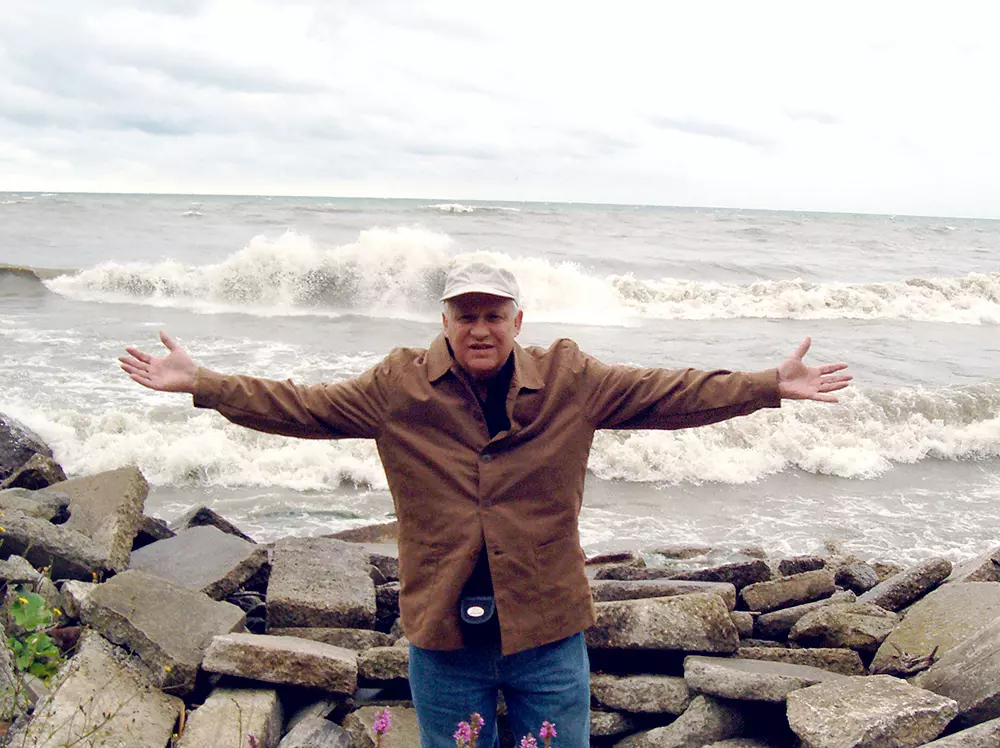
Дмитрий Бобышев на озере Онтарио
Photo: Personal page on Facebook
Не грустно ли вам, патриарху русской поэзии, сейчас взирать на эту ситуацию?
Кого вы относите к патриархам? (смеется) Видите, у меня на лацкане значок, который выдавался на юбилей Иллинойского университета, где я преподавал полный срок? Так вот, когда я ехал поездом в Чикаго и снял пиджак, одна спутница меня весело спросила: это кому 150 лет, не вам ли? На это я ответил ей, что для своих 150 я выгляжу слишком молодо. Пусть мне 150, пусть я патриарх, даже Мафусаил, но тогда я молодой Мафусаил — он жил 600 лет, а мне всего еще 150.
Ваша душа молода?
Не знаю, увидим, когда предстанем перед Судом. Молодая душа катается на старом велосипеде… Когда мне позвонили из Нью-Йорка и сообщили о смерти Бродского, я был очень опечален, это был шок, что он умер в таком молодом возрасте, а он был самый молодой из нас. Я написал некролог о нем, который назвал «Вдогон уходящему», его напечатал «Новый журнал». Но, что интересно, очень таинственно и даже немного страшновато, на сороковую ночь он приснился мне как в яви, молодым, в вельветовом пиджаке. Он очень радушно приблизился ко мне и что-то хорошее пытался мне сказать, но не смог, а потом исчез. Я понял, что это не просто сон: это его душа пришла со мной проститься и простить. Я написал по этому поводу стихотворение «Гость», в котором в точности все описал, только в стихах, с недоумением, что он — посол чужого языка, который на своем не смог высказать что-то важное для нас двоих. Но я прощаю его, потому что я сам потом это узнаю.