
Translated material
Hero Stephen
Alexey Polyarinov for the anniversary of the author of the "Dark Tower"
Today marks the 70th anniversary of the birth of Stephen King - one of the most popular modern writers. Especially for Gorky, Alexei Polyarinov talks about how King himself understands his writing skills and what he can teach novice writers.Almost all books about writing are useless. Their authors will tell you the “parable of the soliter” (literary work devours the life of the writer like a huge parasite), advise “walking more”, and if they are very lucky, they will tell about the three -shaking structure of the work and teach to place the commas. Not a single book about writing teaches the main thing - to cope with refusals.
As a child, Stephen King began to send his stories to fiction magazines. They were invariably returned, and the forms with refusals, he strung a nail driven into the wall. When there were too many forms, King replaced a nail with a carpentry crutch. He did not despair: "When you are still too young to shave, optimism is a completely natural reaction to failure."
It seems to me that it is this detail that is the most important in its memoirs, which are called the “Book of Craft”, and in the original “On Writing”. There is something from the parable in it, like that old joke about Diogenes, who asked for alms from the statue, and to the question of passers-by what he was doing, answered: “I teach myself to refusals.”
King writes about this in his autobiography. The fact that every young author at the very beginning of the path fights not so much with words as with doubts; The fact that writing is a voluntary Robinsonade, and if you have not dropped your hands even after a dozen failures, at some point you still feel this emptiness-like an astronaut that you forgot on Mars. Of the tools you have only tape and potatoes - try to collect a novel from them, wise guy. In this sense, King's memoirs are extremely useful, even soulful, they look like a sudden radio signal from the cosmos, reminding you that you, young-coming-giving-out-prose, are not lonely. Is it a joke, the author of the novels “it” and “confrontation” himself comes to you, claps on the shoulder and says: “Everything is fine, guy, and it is necessary. We all went through it. Every day to hear “no” is an important part of the initiation rite. To get the first “yes” from the publisher/reader/critic, you first need to collect the whole collection “No”. You will collect two hundred “no” - this will be your pass into literature. ”
And then the second part of the book begins, in fact, about the craft. Stephen King, as it were, looks at your instruments, tape and potatoes, and says: “Wait a minute, what do you want to collect a novel from this? Well, no, buddy, it won’t work. Romanes are collected from completely other materials, ”and explains how the language works, what the plot is and how to make your characters look like people, and not the potatoes, glued with adhesive tape. And the most important thing - in his advice there is not a drop of condescension.
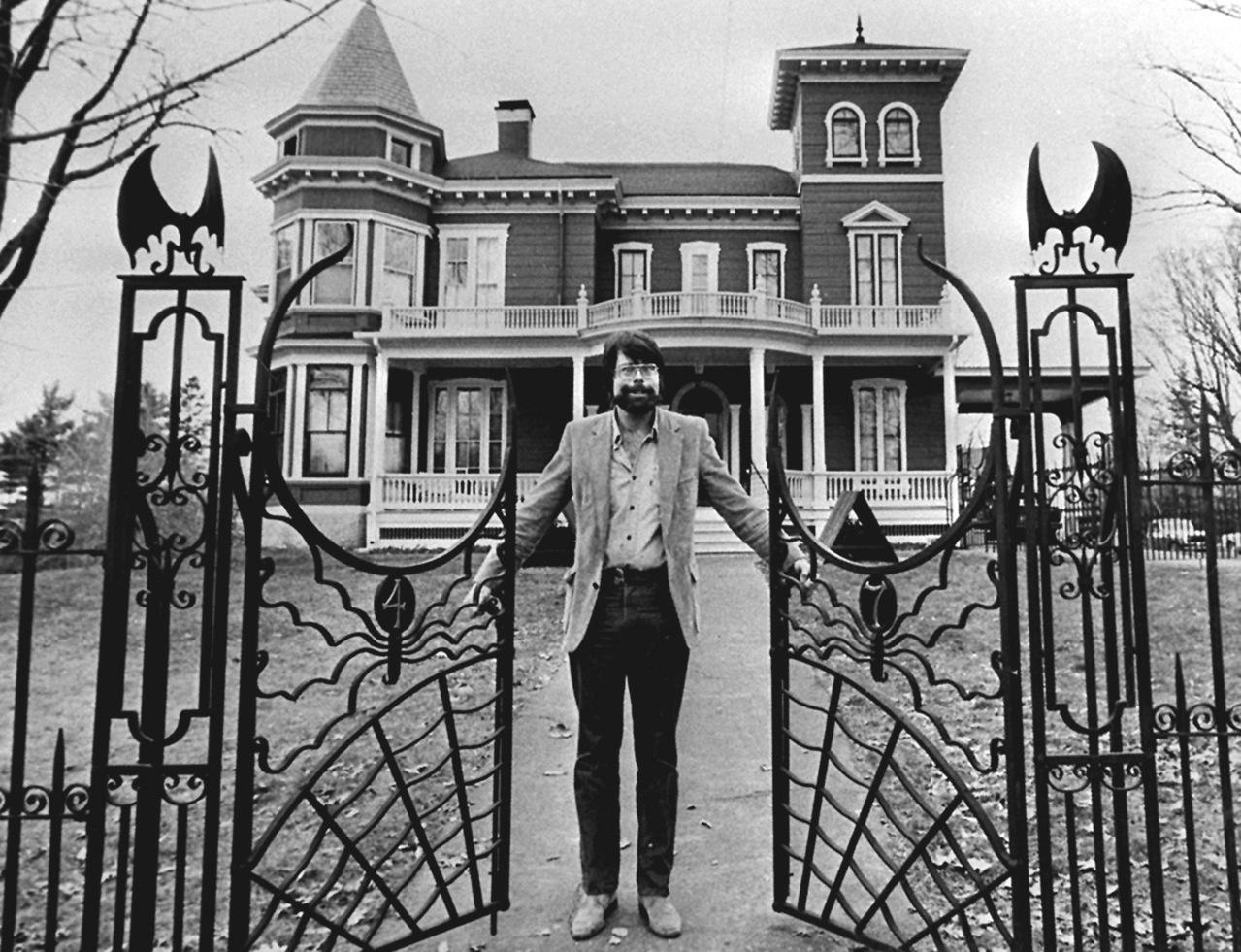
Stephen King at the gates of his home in Bangor, Maine
Photo: Themanyrlesoffilmclub.com
This is the difference between King and the rest. Writing memoirs are most often so tightly stuffed with narcissism that for their eternal self, I, I, I, I, almost nothing to see - only the figure of the author, smoke and mirrors. Salman Rushdi, for example, or, say, Nabokov, they are usually so passionate about their own sensations, style, syllable, complex fate that in their memoirs (“Joseph Anton” and “Memory, Speak”, respectively), the reader is needed solely in order to witness their exclusivity. And King is another, he has the opposite, he seems to be the only writer who did not lie when he gave his text subtitle “memoirs about the craft”. Perhaps this distinguishes “how to write books” from others: it is not at all about success, she is not even about the author, she is about the image of thinking. She is about a man who just likes to tell stories who, in childhood, was read out by Edgar in PO and Howard Lovecraft, wrote stories about monsters and dreamed of seeing them printed. King is not trying to build a book as “History of Success” or “Overcoming”, in the style of the film “Rocky”-so I suffered, suffered, was an underdog, and then won everyone, on the contrary: his attention was concentrated on the reader, his goal is to cheer up the young, to inspire them that they are not alone. And this is worth a lot.
Even the autobiographical chapters are not so much about him as about people who were always nearby and dragged him through his life for his life: he writes with tenderness about his mother, with admiration - about his brother, with humor - about friends who have found, working in the weaving factory and in the laundry room; What is there! Even the story of the first novel sold here is Oda to his wife, Tabita.
It is difficult to say whether this technique is intentional or not, but it works: King seems to be herself from his own story and directs Sofites to his favorite (and not so) people.
When I read the “Dark Tower” in my youth, I was sure that this whole story was with Roland Dissein through the world, with his attempt to protect rays - one large metaphor for writing, things that cannot be abandoned, which must be completed at all costs, otherwise the world would fall apart, collapse. Another important lesson from the author of 55 novels and one seven -volume epic is always to complete everything.
How was it?
I do not kill with a weapon.
Those who kill with a weapon forgot his father's face.
I kill with my heart.
And I write too.
Happy birthday, Stephen King.