
Translated material
"You have a dog, sorry, goodbye." Where in Moscow you can get with the animal and what to do if you are not allowed?
According to the Yandex.Market and Mars Petcare survey , 74% of dog owners consider them family members. About 50% of the owners would like to visit shops with a pet, and about 20% - cafes. It is unsafe to leave the dog on a leash, and the animal experiences stress, being alone. Assaries often install prohibitions and glued a sticker with a crossed out dog on the door .
Activist and initiator of the project #Subakamomnovnov store Katya Bro helped “such matters” on the example of Moscow to figure out where to come with a pet and what to do if the dog is not allowed somewhere.
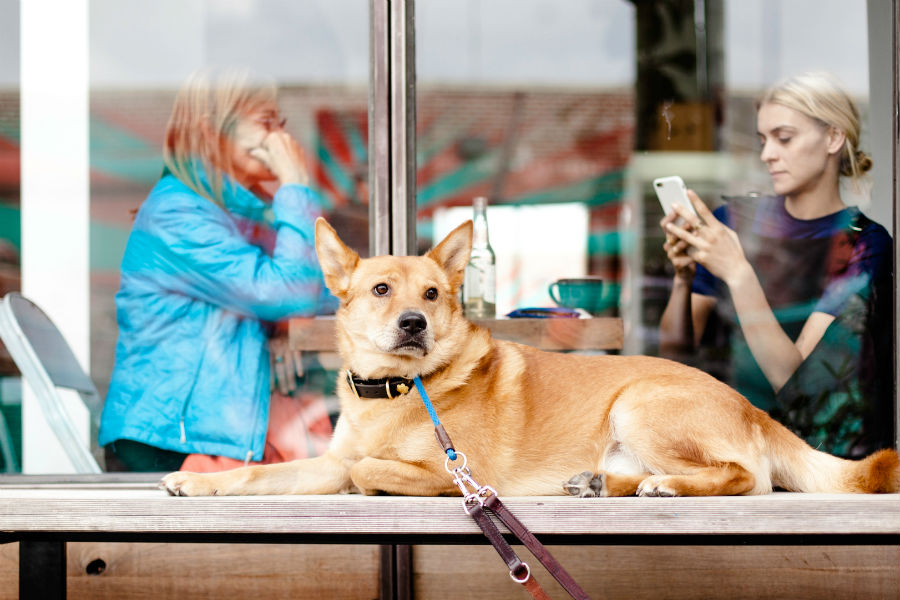 Photo: Unsplash.com
Where is the dog allowed to walk?
The dog, by law, can go to the toilet only on the territory of special “places for walking”. In Moscow, a regulation has been approved, which determines how places for walking and training should look like and where they can be. For example, the site should have lighting in the evening and a fence of one and a half meters high. The pedestrian availability of these places from the house should not exceed 400-600 meters. If the place does not meet the criteria, you can contact the district council and the Moscow government.
If the dog goes to the toilet in the territory that does not belong to the places for walking, and the owner does not remove it, then he can be held accountable for the Code of Moscow on administrative offenses . “Such cases” did not find court decisions under this article.
How is walking different from a walk?
In the rules of parks, hospitals and schools, one can often find the wording of “dog walking is prohibited”, but there is no such term in the legislation. In the main document on animals - the frail law " On responsible treatment of animals" - the walking is not regulated.
The concept of “walking” is explained only at the disposal of the Department of Housing and Communal Services and the improvement of Moscow (but in this case it applies to volunteers and shelters), as well as in the modeling law “On B handling” , which is advisory in nature, developed by international organizations.
 Katya Bro. Photo: From the Personal Archive
The first document says that walking is “ the temporary finding of dogs outdoors outside the places of their constant content in the presence of an employee of a shelter or volunteer in order to satisfy their physiological needs and harmonious development”.
“[Walking] is not just the appearance with the dog somewhere. Walking is, roughly speaking, that which leaves some kind of trace in nature, ”adds activist Katya Bro. She believes that organizations can prohibit precisely dog walking, but not a regular walk.
Once Katya, together with the dog, was not allowed into the territory of VDNH. Then she studied the rules of the park and saw that it was forbidden to walk dogs in the territory. “When we pointed out the administrations of the park to this, they realized that they contradict themselves: you can be with a dog, you can’t walk. The ban on the entrance with the dog was ultimately canceled, ”says the activist.
What laws and norms concern dogs and their owners?
There are several such documents:
Can I get to the store with the dog?
“When my husband and I passed by some of the institutions where there are standard stickers: crossed ice cream, videos, dog, I wondered how legal it is. We began to dig all this up, and it turned out that there was no legal basis for a person to come on rollers, there is no dog and ice cream with ice cream, ”Katya recalls.
The Civil Code of the Russian Federation states that the seller does not have the right to provide preference to one person to another and must equally serve customers. Katya Bro clarifies that issues of visiting public places with animals are regulated not only by federal legislation, but also by regional - almost every municipality has a legislative act on visiting public places. And if there is no direct ban on finding a dog in a public place, then “the principle acts: which is not prohibited, then permitted,” the activist claims. The rules can be sought on the website of the city or region administration.
In Moscow, there are temporary rules for the maintenance of dogs and cats , in which it is spelled out whether the owner can visit the store or not. Until 2008, the document said: “ In the absence of prohibiting inscriptions, it is not prohibited from the appearance of the owner with a dog on a short leash in a muzzle in institutions, non -food stores, at the mail.” In 2008, the normative act was updated by removing the words about "prohibiting inscriptions." Nevertheless, most stores still glue stickers with a crossed dog.
Now in Moscow with a dog you can get to “Shop, institutions, playgrounds, markets, beaches and transport” if it is on a leash and in a muzzle . The rules also say that “ dog walking in the territories of healthcare institutions, kindergartens, schools, other educational institutions and institutions working with minors” is prohibited. Nevertheless, the rules do not prohibit that the dog owner is in these places with his pet.
“12 years ago, these stickers were quite within the framework of the law, but now not,” says Katya. - There are few people who start dogs begin to study regulatory acts related to them. And therefore it is so convenient for everyone. It is convenient for stores - "We hung stickers, and you believe them." But this is the same as writing something on the fence. ”
Is it possible to go with a dog in a cafe or restaurant?
According to the Decree of the Government of the Russian Federation “On the approval of the Rules for the provision of catering services”, the catering establishments can independently prescribe their own rules of visit, if they do not contradict the law. The activist emphasizes that the norms of Sanpin are also not violated when visiting gastronomic institutions with a dog - this is not even mentioned .
“I understand that there are people with allergies or phobia,” says the activist. -But, roughly speaking, we do not force us to cut down trees on the street because of allergies or do not force people not to use perfumes? I am an asthmatic and carry medicines with me. My husband is allergic and he carries a pill with him. This is a human responsibility zone . ”
There are Dog-Friendly cafe that are happy to visitors with dogs. However, in them, the activist faced the so -called bridism - discrimination or a biased attitude to the animal in connection with his breed, size and degree of fluffiness.
“Roughly speaking, if I come with a small dog, they let me in. A man with a large dog stands behind me - they refuse him a visit, because a large dog. This is illegal , ”the activist explains. “Either they let everyone , or no one.”
What to do if the rights of the dog owner are violated?
In such cases, the activist advises writing complaints and proposals in the book, which should be in any store. It should briefly describe the problem and leave your contact phone number. You can also contact the Rospotrebnadzor and the prosecutor's office.
“It seems to me that the more such complaints will be, the easier it will be to achieve a change in the situation,” Katya is sure. -It will be clear that people have already begun to understand their rights a little, they can refer to something. The main thing here is to explain that you acted according to the law, the dog was in a muzzle and on a leash, and you were refused a purchase. ”
Katya also draws attention to the fact that a citizen can call the police due to a violation of his rights. She herself never used this opportunity: “I do not advise calling the police, because not all police are familiar with such details. They will need to explain something, prove, spend a lot of time, make the dog be nervous. In addition, there are more serious offenses that the police need to pay more attention. ”
The activist advises to talk about the situation publicly - to post information about the store in which the conflict occurred on social networks.
Does this scheme work?
In February, Katya, together with lawyers, sent a collective appeal from 30 people to the Moscow prosecutor’s office in “the fact of violation of the law and the infringement of consumers' rights by the Tville store chain”.
“At Vastiville, sellers and other employees, in principle, refuse customers to make a transaction. This must be assembled a full basket, approach the cashier and they will tell you: “You have a dog, sorry, goodbye.” Or, when you go to the store with the dog, they say: “You can't with the dog.” As far as the employees themselves say, they have such an installation - they will be fined, ”says Katya.
 Photo: Anastasia Zhvik
In May, she received a letter from the prosecutor’s office that the appeal was redirected to Rospotrebnadzor, who replied that the sanitary rules would not regulate this issue. Then in June, activists sent a second letter to the prosecutor’s office with a demand to answer the question on the merits.
“We will follow what will happen next. While this is not moving, there is no answer, because it is easier for instances to throw appeals to each other than solving problems. In my plans, so that the “Tasteville” removes these stickers that do not comply with the law, ”says Katya.
According to her, in addition to the Tasteville, in Moscow there are other stores where she cannot get with the dog. But for starters, the activist wants to create a precedent and after fighting other institutions.
The press service of "Tasteville" "to such cases" said that they initially let the dogs into stores, but stopped doing this because of complaints from other buyers. “ We placed in many stores a friendly sticker“ The Master, I will wait for you here ”and made pens to envelop the dog, and many liked this idea. They conducted an experiment with the installation of booths, but the dogs themselves did not like it. Apparently, they are uncomfortable in the booths, where there are smells of other pets, and we did not develop the idea with public booths, ”the store said in the answer of the store.
The Tasteville lawyer said that in Moscow there are temporary rules for keeping dogs and cats that forbid dogs to be in a store without a leash and a muzzle, but did not explain why even animals on a leash and a muzzle were not allowed into stores.
In the press service of Vastiville, the TD correspondent commented that the store asks buyers to “treat with understanding” to the request not to go to the store with a dog. “Many buyers react very painfully to the appearance with animals in the store. We have both sides: those who are for animals, and there are those who are categorically against it. ” The spokeswoman noted that “every case is unique” and that she cannot say that “Tasteville” “categorically is not allowed with dogs”: “I know that there are such cases when the dog does not bother anyone and there are no questions for the owners.” The request to clarify whether the buyer can refuse to buy if he enters the dog on a leash and in the muzzle, the store representative said that "she would not specify."
Alena Borisova lawyer, lawyer of the Human Rights Rights, says that there is no unconditional legislative ban on visiting shops with dogs in Moscow. “The refusal to serve the buyer with the dog at the muzzle and on the leash in the absence of a legislative ban on visiting stores with such dogs in Moscow by all signs looks like an unreasonable refusal to conclude a public agreement (sale and sale),” the lawyer says. “Even with the internal rules of the store, because the question arises of how legal they are.” She also notes that in case of violation of the right, you can file a complaint with Rospotrebnadzor.
“Such cases” sent a request to the Moscow prosecutor’s office with a request to comment on at what stage of consideration there is a complaint of the activist to “Tasteville”, but did not receive a response at the time of publication.
Is it really uncomfortable for other people if a person goes to a store or a cafe with a dog?
“Such things” were asked by the psychologist why people could be uncomfortable if there is a dog in the store. Olga Primakhova, a psychotherapist, co -founder of the “Psychology for Human Rights” movement, believes that the main problem is not in dogs, but in panic disorders and phobias that people have.
“They are built on a certain amount of cognitive errors and/or negative experience. A person can once survive the experience of a clash with a dog who scared or bit him, and in this connection make some generalization that all the dogs are like that. Accordingly, any clash with an animal will scare a person, ”Olga notes.
The expert indicates: a person lives in a public space in which dogs exist - you can encounter them on the street or in the entrance. “In this sense, I do not see the difference between a store or any other public space. It seems to me that you need to change culture soon, ”she suggests.
Olga herself advocates that there are more Dog-Friendly places in society. This, in her opinion, will help people with the phobia fight the problem - so they can see that not all dogs are dangerous, and the alarm will decline. In her opinion, one should fight the phobia itself and the reasons that cause it, and not triggers (that is, in this case with dogs) that actualize it.
“Applying such a ban policy, we do not change the essence of reality. In any case, a person will have a clash with animals, he cannot completely protect himself from something. Thus, we stimulate the avoidance of a collision with an object of fear. This is the most dysfunctional model for working with panic, avoidance always only increases the level of anxiety and fear. The more we integrate the subject of fear in our environment, the less avoid it, the more we develop psychological stability and flexibility. Thus, we get a new positive experience in interaction with what causes us an alarm. With the help of new experience, we are reduced anxiety and subsequently leaves as a whole, ”the therapist is sure.