Translated material
Media art
Media art, or Media Art, uses modern communication technologies as an art field - such as the Internet, telephone communication, any other type and signal transmission format. The latest telecommunication spaces and familiar gadgets are used by media artists in an unusual way - they have the main role in creating a work of art or action. What excites modern Russian artists and how, using modern technologies, they convey their thoughts to the viewer, read in our post.
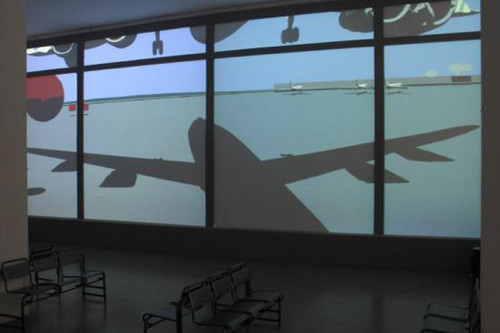
Maxim Svishchev "Waiting Hall"
Over the past two years, Maxim Svishchev has been creating large -scale and high -tech video installations, in which the effect of a complete immersion of the viewer into the work is achieved, the border between art and reality is erased.
In the work “Waiting Hall” on an equal footing, complementing and supporting each other, three components operate - a video made using animation, electronic music and the space itself in which the work is exhibited. Artistic reality is built on the basis of clip thinking - perception of life and events, as a series of clear, understandable, rapidly changing pictures. It was such a way of thought at the beginning of the 21st century that became inherent in most people who look at the world through TV screens and videos posted on the Internet.
Turning to the topic of aerophobia - fears before the flight in the air that passengers on Earth are born - the artist deprives them of the real basis, translating fantasy into a plane. The plane, as the main source of danger, beat, drill, deform, twist. The situation looks emphasized by artificial and safe, similar to the game, and not a real catastrophe on the runway.
Veronika Rudiev-Ryazantseva "Hive"
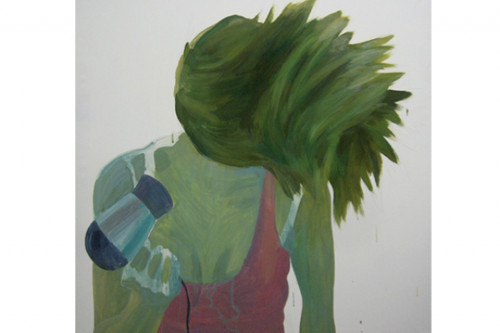
Drying hair with a hairdryer is an ordinary business for most people, and for Veronika Rudieva-Ryazantseva is a fresh idea for an art project.
The project includes showing videos and photos. In non-stop mode, 22 videos spin on the screens, in which girls dry their hair, at the same time the same process is recorded in picturesque work.
- The sound of working hairdries is similar to the buzz of the hive. Models are enclosed in the framework of TVs, as in cells, in structures. And in life we are all buzzing in our own way. From this, the name of the project “Hive” was born, ”said the artist. - A beauty with long hair is an advertising image, but it was interesting for me to transform it. First, my friends participated in the project, then I was looking for the owners of beautiful long hair with the help of photographer Alexander Lavrentiev. These are basically not professional models, and for the video they did not do anything on purpose. I asked them to just dry their hair.
The banal action - drying of the hair with a hairdryer, being removed from the logical row of a commercial, turns into a bewitching and at the same time frightening ritual. You can verify this in the Gallery of Modern Art of Erart until July 2 .
Aristarchus Chernyshev and Vladislav Efimov "Electricbutik"
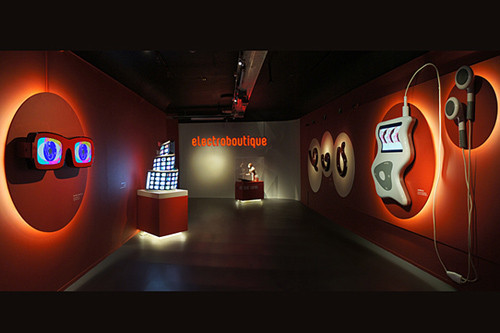
“We can say that in the era of informational, creative capitalism, art loses its previously inherent functions - such as identifying and discussing social, political and environmental problems, a protest action, not to mention experiments in the field of aesthetics. All these functions have passed into the field of marketing strategies of corporations, the design of information and consumer products, and, finally, in the sphere of responsibility of power structures. Moreover, the image of the artist is no longer the bearer of the idea of absolute freedom - freedom now embodies through the commercial image of an extreme athlete. Responding to the challenges of modernity, we in electric busics, offer and develop new strategies for artistic activity, ”say artists.
The installation is a giant IPhone 3G, twisted in the manner of the Tatlinsky “Monument to the Third International” or the Babylonian Tower. Isiphone is the embodiment of Babylon today. This is a mixture of languages, it is instant access to all the information of the world, it is a universe in a pocket. Like no other product, the iPhone creates in an individual-consumer the illusion of omnipotence, turning around by Babylonian puffs in his individual, head. The work of Tatlin is a recognized avant -garde icon, while the iPhone is a bright techno -consumer icon of today. In the 20s of the last century, avant-garde artists invented design as a way to affirm art in the houses of ordinary people. For decades, designers used the ideas of artists and introduced them into the design of consumer goods. Today, many companies say that their products are in themselves works of art; Art again has to rethink your place in society.
Elena Gubanova and Ivan Govorkov "Filtering of white noise"
Elena Gubanova and Ivan Govorkov use the video not as a finished image, but as an artistic material. In the "Filtration of White Noise" the image is interactive with the movement of the viewer. Entering the hall, a person is inside a video of a projection filling three opposite walls. The image of “white noise”, which flickers in constant mode, is combined in three interconnected projections. The viewer, as it were, envelops the vibrating space of white and black.
In the center of the hall, on the floor is the Mini -Stepper simulator. This is a metaphor for the stairs, ascent. The viewer is invited to begin movements on the simulator, as if to start “entering the installation”, which symbolizes the beginning of his life path. When making an effort when walking, the viewer becomes an active participant or creator of the image in space. Each tense step on the simulator changes the image on the projections. As the viewer is moving, the space is filled with luminous in the dark with flying white images, as a metaphor for the passions of a person, which, under the clapping of wings and screams, are carried through the entire space of the hall. This restless movement of black and white lasts some time and, in the end, the birds turn into white atoms and “spray” back into the “white noise” chaos. Everything returns to its circles.
This video installation can be called "parables", but you can live a metaphor for life. The main thing for the artists was to convey the feeling of the secret and involvement of the viewer to create an image.
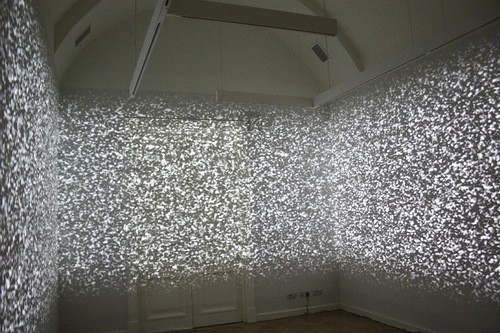
Creative Association “Where are the Dogs” (Alexey Korzukhin, Vladislav Bulatov, Natalia Grekhova, Olga Inozemtseva) “Sediment”
On May 8, the results of the international contest "Prix Ars Electronica 2012" were announced in Linz (Austria). Honorary mention in the “Interactive Art” nomination was awarded to the Russian art group “Where do dogs run” for the work “Sedding”. Of the 550 applicants, artists entered the short list of the 15 best applicants for victory in their nomination.
The “sediment” is a projection with a flow of slowly falling potatoes. Depending on the location of the viewer in space, the installation interacts with him in different ways - a device that recognizes the body movement, and the program specially written for him creates an unusual effect.
Art critic Marina Sokolovskaya: “Fantastic and strange phenomena are easily attributed to the fraud of vision or present as played with different technical means. Imagination allows you to meticulously consider reality and find an ally of man in it. Various kinds of technological tricks create fascinating and harmonious paintings: all unusual phenomena in them are fleeting, barely noticeable to the eye and amazing, like the most innocent focus. ”