
Translated material
New books on Soviet history
Menshevik about red terror, Left Socialist -Revolutionary Office of Revolutionary Violence
A review of historical literature from Dmitry Stakhov: the memoirs of the Bundian and the thoughts of the People's Commissar of Justice of the RSFSR about the October Revolution. 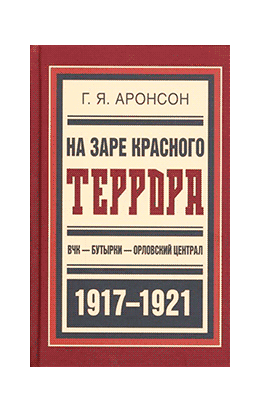 Grigory Aronson. At the dawn of red terror. VChK - Butyrki - Orovsky Central. M.: Kuchkovo Field, 2017
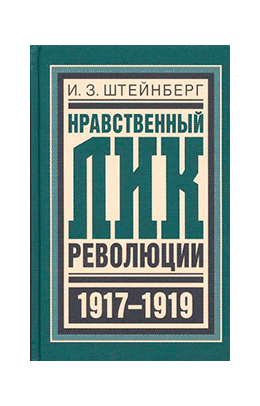
Isaac Steinberg. Moral face of the revolution. M.: Kuchkovo Field, 2017
The memoirs of Grigory Aronson are devoted to the formation of the repressive machine of the Soviet regime, about which the author, the active Menshevik and at the same time the leader of the right wing of the Bund, knew firsthand. Almost four years of Aronson were kept in the basements of Lubyanka, and in Butyrskaya prison, and in the Oryol Central. In December 1921, they were going to send him to Turkestan (Aronson himself admitted that Dota would not reach and the convoy would be scorched along the road), but then the Bolsheviks decided to get rid of him: not shot, in January 1922, he got through Riga in Germany. He died in his bed in New York in 1968.
In his bed-also in New York, only eleven years earlier-the third people's commissar of justice of the RSFSR Isaac Steinberg died. The First People's Commissar, George Oppokov, expectedly shot in 1938. The second People's Commissar of Justice, Peter Stuchk (who returned to the post after Steinberg left the Council of People's Commissars in protest against the conclusion of the Brest Peace), managed to die before the beginning of a large terror, in 1932. Steinberg, unlike Social Democrat of Aronson, was the left Socialist-Revolutionary Socialist Revolutionary. And his book is not memoirs, but a description of the two faces of the revolution: the false Bolshevik (in his opinion) and genuine, growing from the ideals of the left Socialist -Revolutionaries. “Now in the Russian arena the dispute of the two principles is embodied in the struggle between Marxism and LEVONOGRY. But this dispute has a world-historical meaning, because in one form or another it will be repeated everywhere. Whether to be a man and the initiator of history or only her idol, only a prisoner of its laws - this dilemma is more acute and tactively known in the issue of violence, ”he wrote.
After the first publication of the book, Steinberg (like Aronson’s book in 1929, it was published in Berlin, but earlier, in 1923), they reproached: how is it that you are a member of the party that resorted to political terror, and now you condemn the Red Terror. Steinberg politely asked to read his book again to understand the argument. But in addition to his long, at times pathos and romantic reasoning, there were simpler answers. One gave in 1919 in Kyiv a militant and maximal Socialist-Revolutionary, Nikolai Vyvkin, when Yakov Blumkin, who was moving to the Bolsheviks, asked him dynamite. With the help of this dynamite, Blumkin was going to blow up the Kiev Opera Theater at the time of the presence of General Denikin in it. Nikolai Ivanovich said: “We, unlike your new comrades, revolutionaries, not butcher. We threw bombs and throw at the exact address. ” By the way, at the same time, Blumkin was sentenced by the maximalists to death for treason, accidentally warned by Rosa Landau (the bride of the maximalist-explosor Stanislav Taukin), realized what the Kiev air smells of, and flew out of Kyiv.
In addition to death in his beds, Aronson and Steinberg united the traditional Jewish education, previously received secular. Steinberg studied at Moscow University, but was expelled for revolutionary activities and received a master's degree in Germany. Roman Gul testified that Steinberg, who wrote literary works in Yiddish, was an orthodox Jew, who observed all the rites. This did not prevent him from resorting to images doubtful for Orthodox in the descriptions of the meaning of socialism: "A single thread leads from Galilean fishermen before our time." Steinberg is an amazing idealist and romantic of the revolution. Aronson was apparently thinner and smarter. Social Democrat, in a word.
 Aronon was very dangerous for the Bolsheviks. Not by virtue of the "Menshevik-Bundov" ideology. His views are a bizarre mixture of social democracy and the principles of the Bund: socialism, secularism, Yiddishism (worldwide development of culture in the Yiddish), the principle of “dokayt” (committed to the place of residence expressed in the Bundist slogan “where we live, there is our country”). The danger was in his trade union activity, far beyond the "national" boundaries. And it increased after the introduction of the NEP, the Kronstadt uprising and twisting the horn of all the trade unions of the new Russia in Barani. The Bolsheviks perfectly understood that trade unions could only be a "school of communism." In the early 1920s, where trade unions could act as defenders of the genuine rights of workers (not only “pure” proletarians, industrial workers), they saw the most important internal threat. It is not surprising that Aronson had been picked up by Bolshevik prisons for so long. It is amazing that he was not shot when he was shot at one stroke of the pen, and more often without it.
But still, the main value of the book is not in the author’s position and the described ideological disputes, but in the conveyed sensation of the Chekist boot, which was held on all dissenters. First of all, according to the recent allies of the Bolsheviks. Aronson surprisingly accurately describes both the Chekists themselves and the jailers, among whom they came across in prisons at the “damned tsarism”. A comparison of sadists and psychopaths, intoxicated by the authorities, and the old servants made by the author, makes us think about the question, which, apparently, is not: from what abysses, from which swamps these creatures appeared with cold hearts?
Like Aronson, Steinberg is a convinced opponent of the Communist Party and its methods. He writes his book in the third year of the revolution, noting: “The people, the labor people felt evil in the revolution. And from this feeling of evil, his spiritual confusion was born first, and then indifference to the revolution. " Trying to understand where this “feeling of evil” came from, Steinberg comes to the conclusion that “it was born from that rampant violence, from the system of mass terror that entered the use of the revolution that have been legalized, covered, elevated to the pedestal since that time.” And he continues: "This feeling was born, of course, from the centralism of the Communist Party, the displacement of the masses from the disposal of their fate, which organizationally kills the revolution." The terror of the Bolsheviks, he writes, “both as a cause and as a result” is closely connected with centralism. In a word, the Left Socialist -Revolutionary, and even condemned the Bolshevik coup.
Steinberg tries to represent the moral face of the revolution through an assessment of terror, separating it from revolutionary violence. Yes, and he divides the terror into the “red” (merciless and massive, including the executions of hostages, Bolshevik) and “heroic” (Socialist -Revolutionary, possible only as individual). Steinberg believes that terror should be evaluated "not from its impact on our subjective" I ", but from the side of its objective correspondence of the highest senior moral goal." A moral assessment of terror for him is possible from two points of view: as one of the methods to achieve a high goal (“all roads lead to Rome, it means that all the roads are holy”) and by evaluating “Rome” itself, one of the ways to which is terror. Considering the results of “red terror”, Steinberg concludes that “Bolshevik Rome” does not withstand any moral assessment. The Bolsheviks substantiated their terror with threats from the “internal enemy”, but the “concept of“ internal enemy ”expanded so comprehensive, expanded almost to the concept of a nation so much that the protection of the revolution is increasingly concentrating at the threshold of a small group of ruling people, and as a result, the protection of the revolution turns from the protection of the people into self -preservation of power.” For Steinberg, the justification by the Bolsheviks of terror is the most dangerous deception, and one of the consequences of terror is the Soviet bureaucracy, which makes the deceived dictatorship of the proletariat, which is actually the dictatorship of the bureaucracy. Moreover, in the “red terror” he sees the “nursery of the villains”, carrying him out in the “state of permanent panic <...> That's why there is a terrorist dictatorship to a certain extent there is also a dictatorship of panic.”
Steinberg considers violence as a defense: “It meets only emergency, it sets in, only because it is necessary to reflect or breaking the old world, it, in a word, is essentially defensive.” It differs from terror with an internal aspiration: “violence is, first of all, violence against ourselves”; "If violence is a barricade, then terror is a dash." The subjective concept of revolutionary violence (he recognizes the deprivation of electoral rights, imprisonment, boycott and expulsion, but not the activity of the “revolutionary executioner” of the Cheka) becomes a system with Steinberg, in which only an addition to morality, which is surprising for a lawyer, especially one of the ministers of justice. However, there is an explanation for this: moral consciousness, attitude to extra -legal justice (chimera of “social justice”, real Russian Moloch), supposedly above politics and law, to this day is one of the properties of Russian mentality.
 "Moral face of the revolution" 2/4
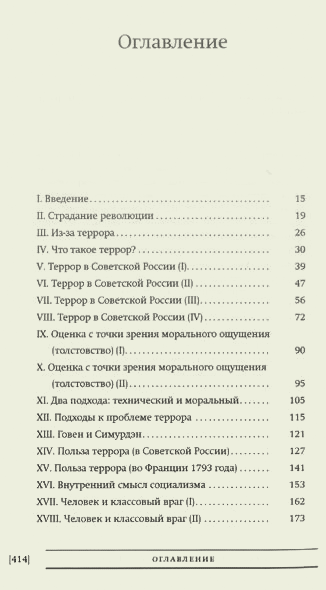
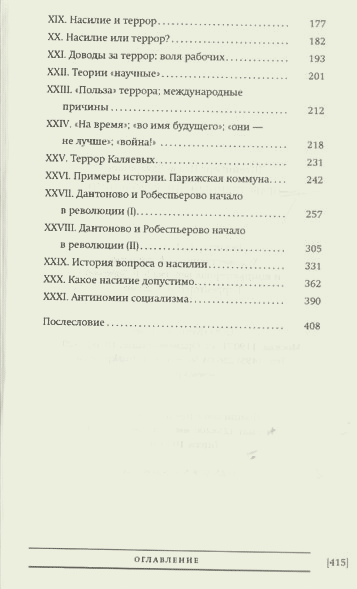 The table of contents of the book “Moral Feature of the Revolution” Table of Table of Table of Revolution of Revolution 3/4
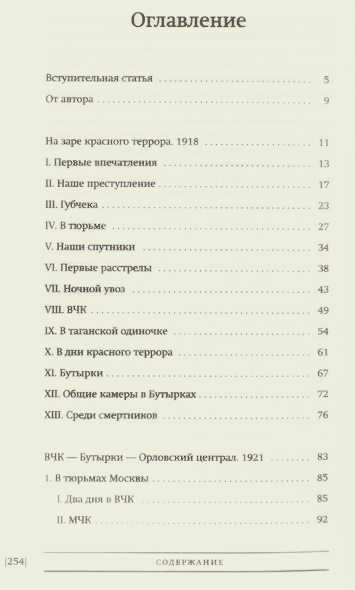 The table of contents of the book “At the Dawn of Red Terror. VChK - Butyrki - Orovsky Central ”4/4
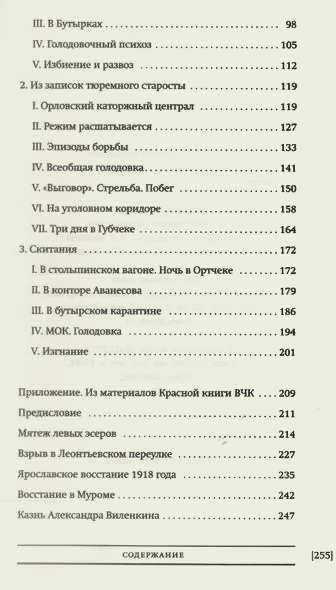 The table of contents of the book “At the Dawn of Red Terror. VChK - Butyrki - Orovsky Central "