
Translated material
They did not understand humor
Five examples of the ban on humorous works
The media and social networks continue to discuss the ban on the rental of the comedy “Death of Stalin” . Gorky decided to recall how different governments at different times tried to ban humorous works.George Orwell "Castard" (1945)
The fairy tale about the animals that the farmer drove out began to build their bestial republic, and as a result, they rolled down to the dictatorship of pigs, led by Bogar Napoleon. To a certain extent, it is a brief retelling of the history of the revolution in Russia and the subsequent struggle for power between Stalin (the aforementioned Napoleon) and Trotsky (other respected boorish, snowball). But at the same time, it is universal and describes almost any revolution.
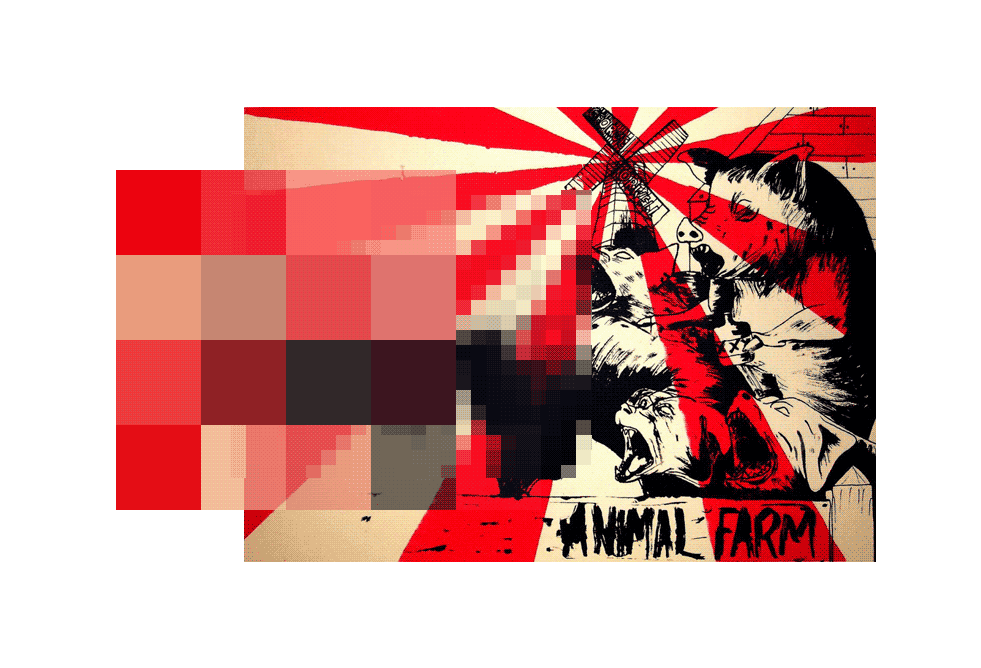
The cover of George Orwell’s book “Cross Courtyard”, artist Adam d'Kosta
Photo: cargoCollective.com/adamdcosta
The censorship of the short book is extensive and fascinating. To begin with, the “farm yard”, written in 1944, refused to print the English publishers, referring to the order of the British Ministry of Information: Stalin at that moment was a valuable ally - it is not good to angry him. And on pigs it will be especially offended, since the "Russians are imaginary." After the war, the Union of Stalin and the UK broke up, the book was published. In the USSR, it was not published until the beginning of perestroika, and the domestic censorship Orwell has been in bad account since the 1930s, as he fought in Spain and sympathized with the Trotskyists. But the "Castard" had problems with censorship in other countries. In France, the book was not forbidden, but in the first translations the chief boar was called not Napoleon (the French, it turns out, are also suspicious), but Caesar. But the book was not printed in North Korea and Vietnam (for political reasons), in the Emirates (because of pigs, because they are unclean animals), in various American states (because Orwell was “a communist” and because various difficult issues are raised in the book).
Joseph Heller "Potion-22" (1961)
The Second World War, the Italian Front, a regiment of American bombers, absurdity and complete inefficiency of a bulky military machine. The protagonist tries to survive and not go crazy, for this, for this he is trying to impersonate a madman. They tried to ban the book several times in separate American school districts, but, to the honor of censors, it is worth noting that the author of patriotism was excited, but completely different. They did not like what women are called "whores."
Korney Chukovsky "Crocodile" (1916–1917)
The African crocodile Krocodilovich, the townspeople in a panic, is attacking Petrograd, but young Vanya Vasilchikov saves everyone. Then the animals again attack Petrograd to free their brothers from the zoo. Moreover, they abduct the girl Lyalya. And again the world is restored thanks to the courage and diplomatic gift of Vani. The fairy tale was very popular in children, but closer to the end of the 1920s, problems began with it. Then it was believed that the fairy tale should educate a new person for a new country. And then who is raising whom and why?
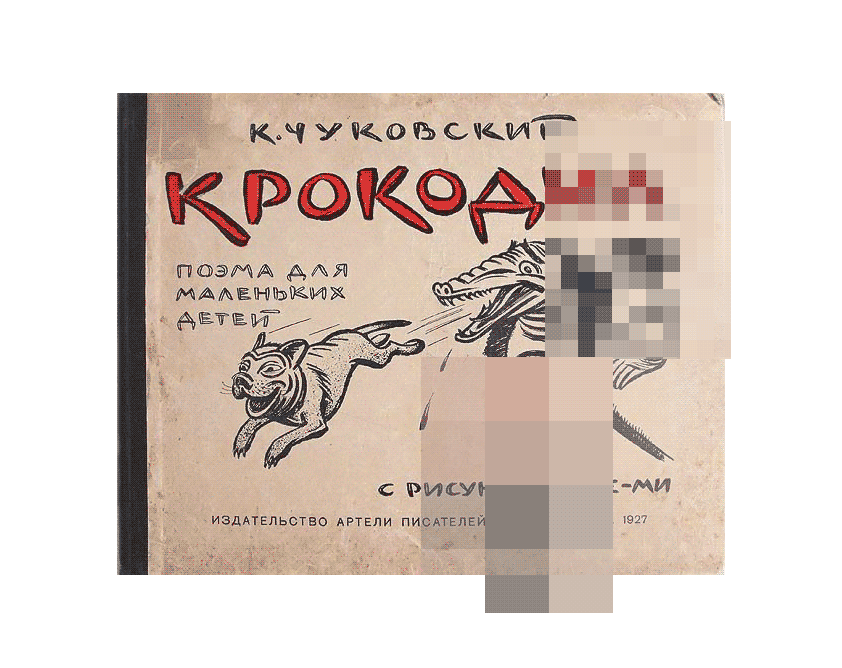
The cover of Chukovsky’s book “Crocodile: a poem for young children”. Publishing House of Artel of Writers "Circle", 1927
Photo: kultura174.ru
Especially Krupskaya disliked the fairy tale. “What does all this nonsense mean? - Krupskaya is worried. - What political meaning does it have? Some clearly has. But he is so carefully disguised that it is quite difficult to guess him. Or is it a simple set of words? However, a set of words is not so innocent. The hero giving freedom to the people to redeem Lyalya is such a bourgeois smear that will not pass without a trace for the child ... <...> I think the children do not need to give “crocodiles”, not because it is a fairy tale, but because it is a bourgeois damp. ” “Crocodile” began to be prohibited for printing, new circulations made their way to readers with great difficulty, and Chukovsky himself was forced to publicly repent. The Crocodile Crocodilovich was completely rehabilitated only in the 1960s.
Ivan Ershov "Horse-Humpbacked" (1834)
The third stupid son of the peasant, together with the third ugly son of the horse, after a series of adventures, comes to success: the fool becomes the king and marries the king-girl. In pre -revolutionary Russia, everything that could be interpreted as disrespect for the king and the church was removed from the book. After the revolution, on the contrary, they threw out what could be interpreted as the glorification of tsarist power. Tatyana Goryaeva in her famous work “Political Censorship in the USSR” (M., 2002) gives a review of the censor of Zhmudsky: “The plot is Orthodox (this is allocated everywhere by the author) Ivan-Durak contrary to his smart brothers becomes the best as possible satire for pre-revolutionary Russia-but the childhood is that the authorized nationalist hates Basurman and dreams of about the Basurman and dreams of about the Basurman and dreams of “The Holy Cross” even on the moon (of course, in the form of fabulous achievements), deeply believes in the star of Ivan-Durak. Without an example of Pushkin’s fairy tales, the fairy tale Ershov is only a popular caricature on them - in terms of educational for children in it, everything from reactionary and antipedagogical. <...> On the basis of all the above, I consider the “humpbacked horse” to release it is very undesirable, if not unacceptable. ”
Pierre de Bomarsha "Mad Day, or the Marriage of Figaro" (1784)
The cunning valet (and right hand) of a large nobleman is going to marry the maid of the wife of the nobleman. But he suspects that the owner will collect the right of the first wedding night. In the struggle of intelligence and feudalism, intelligence defeats, and simultaneously the author makes fun of - to the joy of the third estate - the stupidity and hypocrisy of the nobles and churchmen. It all started with self -censorship: the action of the Bomarche play unfolds not in France, but in Spain. It did not help: King Louis XVI read it and supposedly issued his own, which became legendary, the verdict: “To be consistent, then in order to allow the production of this play, it is necessary to destroy the bastion. This person is mocking everything that should respect in the state. ” But the French Absolute Monarchy was already in those years in no in the best form and was forced to listen to public opinion. In 1784, they set up a play, and after another five years, the people nevertheless destroyed the country's main political prison-Bastille. And after a couple of years he executed the king himself.