
Translated material
Reader Trotsky
Book regiment Leo Trotsky
Gorky continues the story about the circle of reading famous historical personalities. This time we will talk about Leo Trotsky. We have already studied books about Trotsky , and now let's talk about what he loved to read."Power of darkness", Lev Nikolaevich Tolstoy
Trotsky (in those years he was still Leo Bronstein) loved to read since childhood. In the native village of Yanovka, the choice of books was still quite scarce, so the main reading began after moving to Odessa to study. There, Trotsky lived in the house with his relatives - journalist Moses Filippovich Spenzer and his wife Fanny Solomonovna. By the way, about a year after Trotsky moved to them in the family, a daughter was born - the future famous poetess Vera Inber.
Spenters had a rich library, and the eleven -year -old Leo actively mastered it. About the books that made the greatest impression on him, he later told in his memoirs. One of them was Tolstoy’s play “The Power of Darkness”. In those years, she was prohibited from staging in Russian theaters: Emperor Alexander III really liked the play, but Pobedonostsev did not at all attract, who was able to convince the emperor to ban the work that had already prepared for production.
Relatives did not really want to give a lion a play with a gloomy and harsh plot. Then the lion waited for the moment when the adults were not at home, and read the book without demand. Nothing terrible happened - a much deeper impression was made on him read shortly after that a court report on the case of the murder and rape of the girl. As he himself wrote later, “he read a book, sprinkled with medical and legal details, in a state of anxiety, just at night he hit the forest, where I run into the Nolo -beveraged by the moon ghostly trees and find no way out. But very soon this impression was dispersed. ”
"Historical letters", Peter Lavrovich Lavrov
In 1896, Lev Trotsky moved to Nikolaev, where he entered the real school there. It itself was a worse class of Odessa - simpler, more provincial; The main thing in the Nikolaev experience of Trotsky was the acquaintances with a radical youth. These new friends not only opened a window into the world of an underground revolutionary struggle, but also introduced books that, perhaps, did not turn over, but quite strongly influenced Trotsky’s inner world, on his outlook on life and politics.
Lavrov's “Historical Letters” were just one of these books. In those years, Lavrov’s work was considered if not as significant for revolutionary youth as “what to do?” Chernyshevsky, then at least comparable value. Peter Lavrov (1821–1901), one of the apologists of populism, looked around and saw everywhere only a defeat: the hopes that the abolition of serfdom would be supplemented by approaching democracy and freedom were not justified; nihilists were discredited by the process of Nechaev; Pisarev completely urged to wait a decade, or even more. Lavrov urged revolutionaries to rely on the people in their activities, look for support and support in them - and this thought was at one time appropriate and popular. But Trotsky read “Historical Letters” almost 30 years later - and doubted. A little later, in prison, Trotsky will read the work of Antonio Labiola and will consider Lavrov irrevocably outdated.
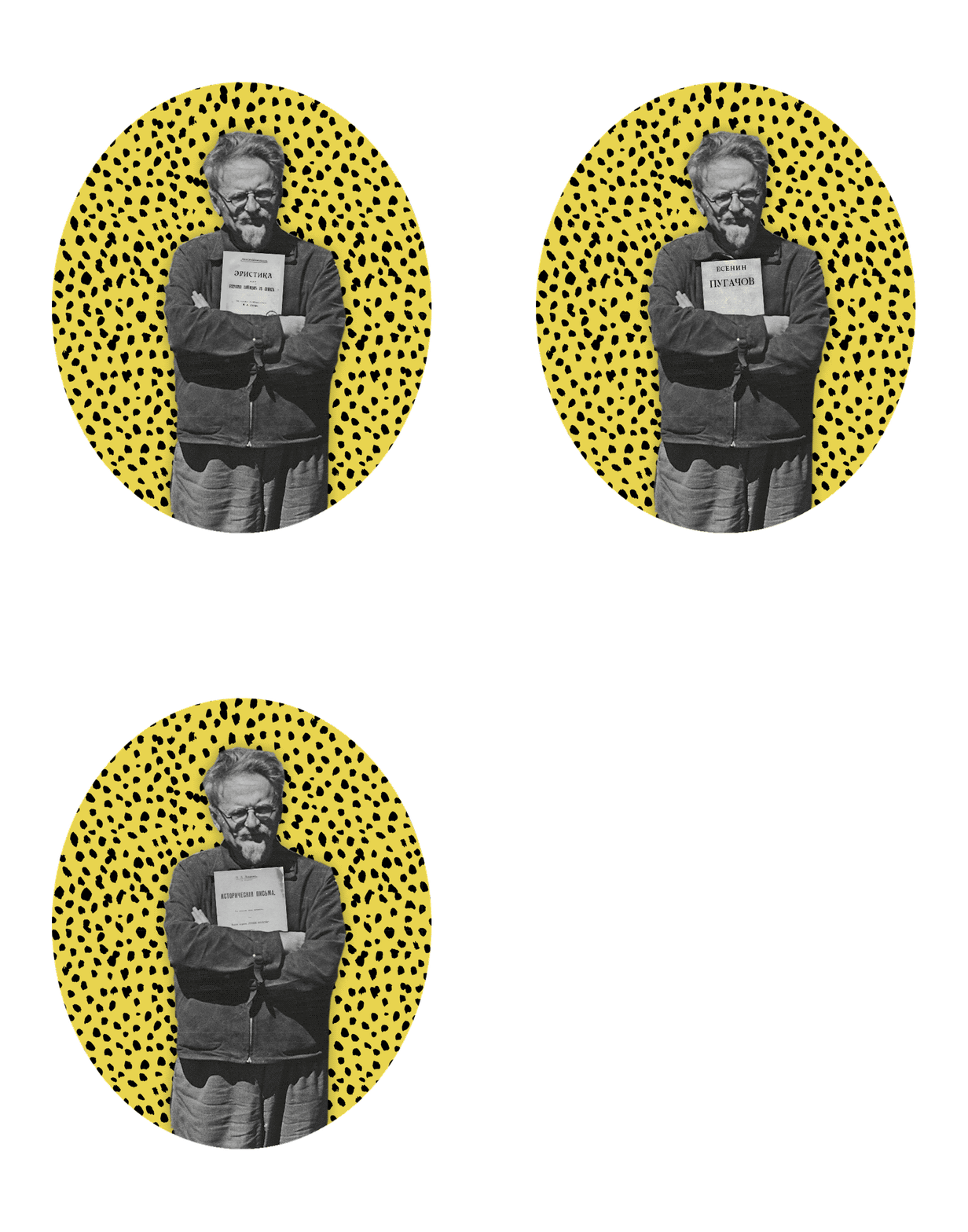
"Eristry, or the art of winning disputes", Arthur Schopenhauer
In the same years, Trotsky read this small work of Schopenhauer. Of course, the philosophy of the great Germans-mysticism and misanthrope-was not very close to the young revolutionary social democrat Trotsky. But he read Schopenhauer not to penetrate with such a beloved author with pessimism - no, he turned to Schopenhauer, hoping to learn how to argue and the ability to discuss his opponents. Schopenhauer actually offered a whole list of tricks and logical techniques that could be extremely useful for a politician undergoing hardening in small circles, at meetings with workers, in disputes with other revolutionaries.
So the young Trotsky hone his talents, assimilating many Schopenhauer techniques and remembering the final of the book: “Of a hundred people, it is hardly one who is worthy of a dispute to start with him. As for the rest, let them say what they want, since Despeure Est Juris Gentium (“A person has the right to be unreasonable”), and you should think about what Voltaire says: “La Paix Vaut Encore Miex Que La Verite”. True, it is not a fact that Trotsky listened to all these wisdoms.
"Small demon", Fedor Kuzmich Sologub
Trotsky has been familiar with Sologob since 1911 - then they met in Munich; Trotsky introduced his wife, Natalia Sedov, and Sologub Trotsky - his own. In general, it is quite difficult to imagine two less suitable people than Sologub and Trotsky: a gloomy pessimist-symbolist with a mystical look at the world and next to him is an energetic and jovy-bombed revolutionary emigrant. But Trotsky loved art and his figures, read poetry and followed the cultural life of his time; It is noteworthy, by the way, that the most famous work of Sologub “Small Demon”, according to rumors, was just not really liked by Trotsky.
One way or another, the old acquaintance had to be remembered after the revolution. In September 1920, Sologub wrote to Trotsky with a request for help. Having complained of a humiliated and distressed position, he asked to help Sologub’s departure abroad, to Revel, in order to correct his financial affairs: to sell a novel, to perform at creative meetings. Sologub wrote separately that the request is in no way connected with political goals and is needed only because of the monstrous financial situation. Trotsky answered very coldly, almost defiantly, but promised to help (drinking, however, Sologub about the inadmissibility of any political statements).
The Trotsky word restrained his own and achieved permission to leave. But he was not destined to take place: the trip was scheduled for September 25, 1921, and two days before the wife of Fedor Sologub went to her sister on the Petrograd side and rushed to Zhdanovka from Tuchkov Bridge. Sologub refused to believe in the death of his wife for a long time, was depressed and upset. He did not think about traveling abroad.
The work of Sergei Yesenin
It is worth noting that Trotsky supported many figures of culture and art - even those who hated Trotsky did not deny this and considered their opponent and enemy. His actions to protect Shklovsky, intercession for Pilnyak, help Meyerhold are known. But with Yesenin, the story was special.
The poet and revolutionary met in 1923, but Trotsky patronized Yesenin before that. The summer of 1923 was not the best for Trotsky: the Troika Zinoviev-Kamenev-Stalin conducted an active attack on the People’s Commissar for Military and Naval Affairs, accusing him of the collapse of the army and rising prices, so looking for a rather risky step from Yesenin in Trotsky at that moment. Thanks to the support of Trotsky, Yesenin agreed significant funding for the publication of the almanac of peasant writers. Who knows, live Yesenin until the end of the 1920s, how would this patronage come to him?
In general, the relations of Trotsky and Yesenin were quite contradictory. Yesenin spoke about respect for Trotsky several times, called him “the finished type of man”, admitted that he liked the “genius of this person”; At the same time, according to other testimonies, Yesenin somehow told the acquaintance of Guli that "he would not go to Moscow, as long as Russia was ruled by Leib Bronstein." Trotsky remarked that Yesenin still needs to teach and extend for the Soviet regime that he was only a fellow traveler. However, humanly Trotsky treated Yesenin well-both to him and his poetry.
One way or another, life judged everyone. Yesenin hanged himself in Leningrad in December 1925. Trotsky was the only representative of the Soviet government who visited the poet’s funeral who gathered almost 200 thousand people - so great was the desire to say goodbye to the Russian poet. And after that, Trotsky wrote an article “Memory of Sergei Yesenin”, in which Yesenin described and his role in Russian culture:
“We lost Yesenin - such a beautiful poet, so fresh, so real. And how tragically they lost! He left himself, saying goodbye to the unconscious friend with blood - maybe with all of us. These last lines are striking in tenderness and softness! He passed away without a loud resentment, without a note of protest, - without clapping the door, but quietly covering it with his hand, from which blood oozed. In this place, the poetic and human image of Yesenin flashed an unforgettable farewell light ... An unprotected human child fell into a cliff. Long live the creative life, into which the precious threads of poetry Sergei Yesenin fell into the last minute. ”