
Translated material
Frontiers of the pit horizon
From the book of David Anthony "Horse, Wheel and Language"
The taming of horses not only improved the quality of life of the ancient Indo -Europeans, but also contributed to the rapid spread of their language throughout the continent. This is confident in the American archaeologist and anthropologist David Anthony, author of the book “Horse, Wheel and Language”, an excerpt from which today suggests reading “Gorky”.Starting from February 24, 2022, we were all in the face of the advancing barbarism, violence and lies. In this situation, it is extremely important to preserve at least the remnants of culture and support the values of humanism - including for the sake of the future of Russia. Therefore, the editorial office of Gorky will continue to talk about books, reminding our readers that the world remains in the world and fiction.
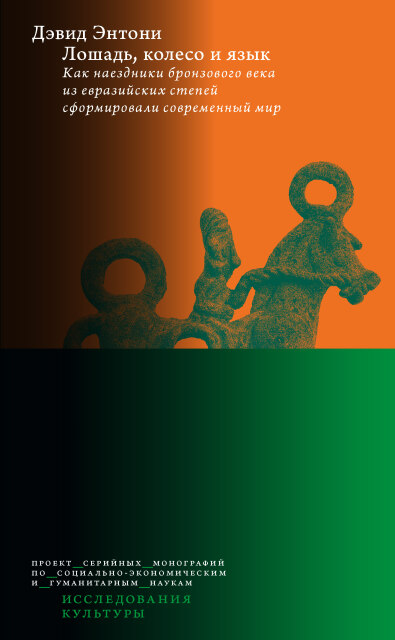
David Anthony. Horse, wheel and tongue. As a bronze age riders from the Eurasian steppes formed a modern world. M.: Ed. House of Higher School of Economics, 2023. Translation from English Andrei Fomenko. Content
 Changes in transport technologies are among the most effective reasons for the transformation of the social and political life of people. The appearance of a personal car created suburbs, shopping centers and motorways; transformed heavy industry; gave rise to a giant oil product market; polluted the atmosphere; scattered families widely on the map; provided a mobile and heated room for young people, where they could retire and have sex; formed a new and effective way to express individual status and identity. Horse riding, the invention of a heavy wagon and arba and the appearance of chariots with spoke wheels had combined consequences, which were not so fast, but over time were equally deep. One of these consequences was the transformation of Eurasia from a series of separate crops into a single, communicating system. How this happened is the main theme of this book.
Most historians, when they begin to list the changes caused by horse riding on horses and the first wheeled carts, think about the war. But initially the horses were domesticated by people for another goal. It was a cheap source of winter meat; Horses could feed themselves in the winter, when cows and sheep were required to provide water and forage. After people got acquainted with horses as pets-maybe when a relatively flexible male genealogy developed-someone found a particularly humble horse and sat on it, perhaps jokes for the sake of. But soon the riding riding received the first serious application in the management of the livestock of home cows, sheep and horses. Even in this one quality, it became an important improvement, which allowed few people to manage numerous herds and move them more efficiently, which was of fundamental importance in the world where pets served as a key source of food and clothing. By 4800–4600 BC. e. The horses were turned on - along with clearly pets - in the funeral rituals of Khvalynsk in the Middle Volga region.
Apparently, about 4200–4000 BC. e. The tribes of the Pontic-Caspian steppe began to make horse raids. From the moment they mastered the riding, nothing prevented them from using horses in interdepa -tribal conflicts. The muzzle made of organic materials was quite effective, the Eneolithic steppe horses were quite large for the rider (13-14 palms at the withers), and the leaders of the steppes began to wear stone maces at the same time, when they got herds of cows and sheep, about 5200–4800 BC. e. By 4200 BC. e. People have become more mobile, their individual burials, unlike previous communal burials, differed depending on the status of the deceased and its personal glory, the inventory of high -standing burials included stone maces in the shape of a horse’s head and other weapons, and military detachments made hikes for hundreds of kilometers to purchase the Balkan copper, which was then sold or presented with their own Sobelers in the Dnieper-Azov steppes. Apparently, the collapse of old Europe 4200–4000 BC. e., at least, was partially a matter of their hands.
Relations between horse -drawn steppeas and settled agricultural societies are usually described by historians either as hostile (an example is the confrontation of the Suvorovites with old Europe), either as parasitic or as combining both aspects. The “barbaric” cattle -breeding tribes, longing for grains, metal and wealth and did not know how to produce them on their own, terrorized their “civilized” neighbors, without which they could not survive. But, as shown by the Soviet ethnographer Sergey Weinstein, the Western historian Nikola Dikosmo and our own botanical research, these ideas are inaccurate and incomplete even for the historical era. The cattle breeders produced food in abundance - in medieval Europe and China, the nomads, apparently, on average fed better than farmers. The steppe miners and artisans independently extracted a large amount of ore and independently made metal guns and weapons from it; Giant copper mines in Russia and Kazakhstan and tin mines in the Zeravshan valley show that the situation was reverse: the Middle Eastern civilizations of the Bronze Age depended on them. For the prehistoric era, which is illuminated in this book, any model based on the relationship between the militarized nomads of the steppes and the medieval civilizations of China and Persia is an anachronism. Although the steppe societies of the Suvorovo-Novodanilov period seemed to really rob their neighbors in Nizhny Dunavier, they were clearly more integrated and, obviously, maintained peaceful relations with their Cuckuten and Typol neighbors. The Maykop merchants, apparently, visited the steppe settlements of the Lower Podon and, perhaps, even delivered their weaves there. Institutes regulating peaceful interchange and intercultural ties were as important as the institution of military raids.
The reconstructed great-European dictionary and comparative Indo-European mythology reveal the content of two such integrative institutions: these are, firstly, by oaths of relations between patrons and clients who regulated mutual obligations between strong and weak, and secondly, relations between guest and the owner, which provided protection for people beyond the usual social circle. The first institute that legalized inequality was probably very ancient: its beginning goes back to the period of establishing a cattle -breeding economy about 5200-5000 BC. e. and to the appearance of the first clearly expressed property differences. The second institute, presumably, was developed in order to regulate migrations into an uncontrolled geographical and social space at the beginning of the era of the pit horizon.
When the first wheeled vehicle appeared in the steppes - and this was probably about 3300 BC. e., - he, again, found the first practical application in cattle breeding. Early carts and arbs were slow carts with continuous wheels, a harness of oxen and wagons made of reed, possibly attached to a felt basis. Burials of the pit period often contain the remains of mats in combination with some other decomposed organic material. In some cases, mats were painted with red, black and white stripes and curved ornaments - probably within the framework of funeral rites. The carts allowed the cattle breeders to migrate with their herds deep into the steppes, into areas between river valleys, and spending weeks and months there thanks to tents, provisions and water delivered in these carts. Even if the usual annual range of movements was less than 50 km, which seems close to the truth in the case of yamniks, the combination of cargo wheels with fast riding revolutionized the steppe economy, making most of the Eurasian steppe accessible to economic use. The steppe, before that is mostly wild and useless, was now mastered. The hole horizon was rapidly spreading in the Pontic-Caspian steppe around 3300 BC. e. -And with him, apparently, the great-Europeans: their dialects were dispersed during the resettlement of its carriers, whose migration was sown by the seeds of German, Baltic, Slavic, Italian, Celtic, Armenian and Phrygian languages.
The chariot - the first wheel wagon, developed exclusively for the speed of movement - first appeared in the burials of the Sintashta culture of the Southern Trans -Urals around 2100 BC. e. She was supposed to be afraid of enemies. It was extremely difficult to build a chariot-it was a real miracle of a carpentry and stump craft. She needed a pronounced team of fast and strong horses. To control it, it was necessary to rule each horse separately and at the same time hold the balance of the body jumping body with the weight of his own body, transferring it towards each push. It was even more difficult to throw darts at full speed exactly at the target, but, as the Sintashta burials with chariots testify, that is how everything happened. Only people who have considerable time and resources, as well as courage and ability to hold balance, could learn to fight in a chariot. When a squadron of warriors armed with darts appeared on the battlefield, supported by foot and riding customers and supporters with axes, spears and daggers, this became a new, deadly method of fighting, which no one had come across before and who soon began to inspire admiration for even the kings of urban civilizations.
The vague memories of the heroic world of warriors-collapse were preserved in the poetry of the Iliad and Rigveda. The civilizations of Central Asia and Iran collided with them around 2100 BC. e., when the Sintashta or Petrovsky strangers first appeared on the banks of Zeravshan, apparently, quickly moving on top of the equids of a new species for these places. Probably, at first this strange way of moving was amused by the inhabitants of Sarazm and Zambababa. Very soon, however, both settlements were empty. Between 2000 and 1800 BC. e. The first Petrovsky, and then Alakul-Antronov groups settled in the Zeravshan Valley and began to extract copper and tin. Horses and chariots spread throughout the Middle East, and the success in the wars that waged the cities began to depend on well -trained horses. The ancient Indian religion, apparently, was formed among the descendants of the northern immigrants in the contact zone between Zeravshan and Iran and was a syncretic mixture of traditional Central Asian and new Indo -European elements. Since that time, the peoples of the Eurasian steppes maintained a direct connection with the civilizations of Central and South Asia and Iran, as well as, through intermediaries, with China. Arid lands in the center of the Eurasian continent were included in the transcontinental economy and politics.
Jared Diamond in the book “Runks, Microbes and Steel” expressed the opinion that the cultures of Eurasia had a geographical advantage over the cultures of Africa and both Americans partly due to the fact that the Eurasian continent was oriented in the western-eastern direction, which facilitated the spread of innovation as agricultural vehicles, between geographical zones, at the basis their similar ones, because they are located on the same latitude. But stable cultural frontiers like the Urals for millennia have prevented the spread of these innovations even within the same environmental zone of the steppes. On the average warrior, in the upper reaches of the Samara River, cattle breeding was mastered by 4800 BC. e., while hunters and collectors in the neighboring steppes of Northern Kazakhstan at the same latitude over the next two thousand years rejected domestic cows and sheep (although by 3700–3500 BC they mastered horseback riding). The potential geographical advantage described by Diamond has been leveled for a long time due to human distrust to the alien lifestyle and commitment to traditions. This trend prevailed when two very different crops came into contact due to distant migrations or on the boundaries between environmental zones. In the case of the Ural Frontier, the Khvalynsk Sea for millennia divided the population to the east and the west of the Ural Mountains, and the solonchak semi -deserts that replaced it remained a serious ecological barrier for foot collectors. Territories such as the frontier along the Urals became the boundaries between deeply rooted, mutually irreconcilable traditions. Long-term, stable frontiers of this kind were, apparently, a rarity in the prehistoric world of tribal policy. We are used to them only because modern national states made them a standard type of boundaries for the whole world, encouraging patriotism, chauvinism and a suspicious attitude to other nations on the other side of clearly drawn borders. However, the Pontic-Caspian steppe turned out to be the space of an unusually high number of strong tribal frontiers, since there were clear environmental ecotons and there was a comprehensive history of distant migrations-two important factors responsible for the formation and maintenance of such frontiers.