Translated material
The secret of money
Sociologist Ule Bjerg about the illusions of the theory of finance and jiske's jokes
Where does the money come from, what is the main problem of the modern financial system and how do Heidegger and Zizhek help you understand all this? Recently, Danish sociologist Ule Bierg came to Russia - his book "How is the money done?" Soon the AD Marginem publishing house will be released. At the request of Gorky, Arnold Khachaturov spoke with Bierg.In the annotation to your book it is said that you offer a new look at the “essence of money”. But is there anything unchanged in money?
No, I would not search for the essence of money. You can often hear that money is ultimately gold, or trust, or violence, or something else. I just wanted to raise the question of how the money is changing in the course of history. In the mainstream textbooks on economics, you will not find any reflection on the nature of money. The generally accepted story sounds like this: once there was no money at all, then people came up with gold, then paper money, credit cards and so on. Before you come to Moscow, I was in St. Petersburg and went there to the Museum of Money. I visited many such museums - in Estonia, Greece, Morocco. Each time they try to tell the story of money in the same way, without mentioning the concept of duty. Money is considered primarily as a means of exchange, which means that everything that we use for this purpose can be considered money. This hides many other functions of money from us: pay taxes, borrow and so on. These are only a few things that are lost if we do not reflect on the existence of money.
Speaking of being. To start a reasoning about financial capitalism with Heidegger's philosophy is a rather bold decision ...
Obviously, Heidegger had nothing to say about money as such. There was one researcher who checked all his work and found out that the word “money” is not found in any of them. In Heidegger, I am inspired by the ability to pose fundamental issues. Heidegger does not ask “what is there?”, He asks “how is it?” Or "What is the being x?". I am trying to study the existence of money and claim that a certain ontology enters the game here, which makes money with money. Mainstream work only talk about changes in the material shell of exchange products, and this is only a tiny piece of the entire history of money.
Usually, the economic view of money is criticized by the fact that it ignores the social technology that is behind them. Your approach, as I understand it, is more fundamental?
Yes. Although I am a sociologist by training, I do not like everything in this discipline. For example, sociology often uses the word “social” and thinks that something explains something. Is everything around a social construct? Well, in a sense, yes, but what follows? Money comes down to the next social phenomenon, in which there is no secret. In the same way, neuronauki are trying to reduce human subjectivity to the set of physical reactions in the brain. I want to raise bets and therefore start with Heidegger and ontological issues.
Heidegger only allows you to see the secret of money or can help resolve it?
Good question. Heidegger said that the most difficult thing is to think about what is closest to us. This also applies to money - we constantly use it, but rarely think about their nature, so the first thing we should ask ourselves: what kind of strange thing is, where does it come from? I turned to three theories of money - commodity, hartal and credit. All of them give an idea of what money is, but they are all insufficient. But this, of course, does not mean that you can just sit further and say that money is a big riddle. As soon as we asked the right question, we should move on. And then my approach becomes more sociological. I will explore how the modern banking system, government, central banks work. This is the second step - to see what money is today.
You were inspired by the financial crisis of 2008?
Not only. The crisis really played a role. I was interested in the events, I read a lot of economists, but I felt that something was constantly slipping away from me. It's all about the bubbles in the real estate market - okay, but how could the local phenomenon spread so widely? The second important point is due to the fact that I used to study compulsive gambling, wrote a book about poker. I was struck by how the nature of money changes depending on the context. The money that we spend on coffee, and those that are present in the game, seem to be the same, but at the same time others. During the game, they completely change their nature. Studying gambling, I realized what incredible power money possessed. From the point of view of material equipment in poker, everything is very simple: you have paper sheets and plastic disks. These things move from one player to another, and then a person suddenly leaves the room and shoots in his head. How can such a simple material context cause such strong emotions? Therefore, I quickly became interested in this topic, and I think I was lucky. Philosophers, oddly enough, often begin the study with what they already know, or do something that they absolutely do not care.
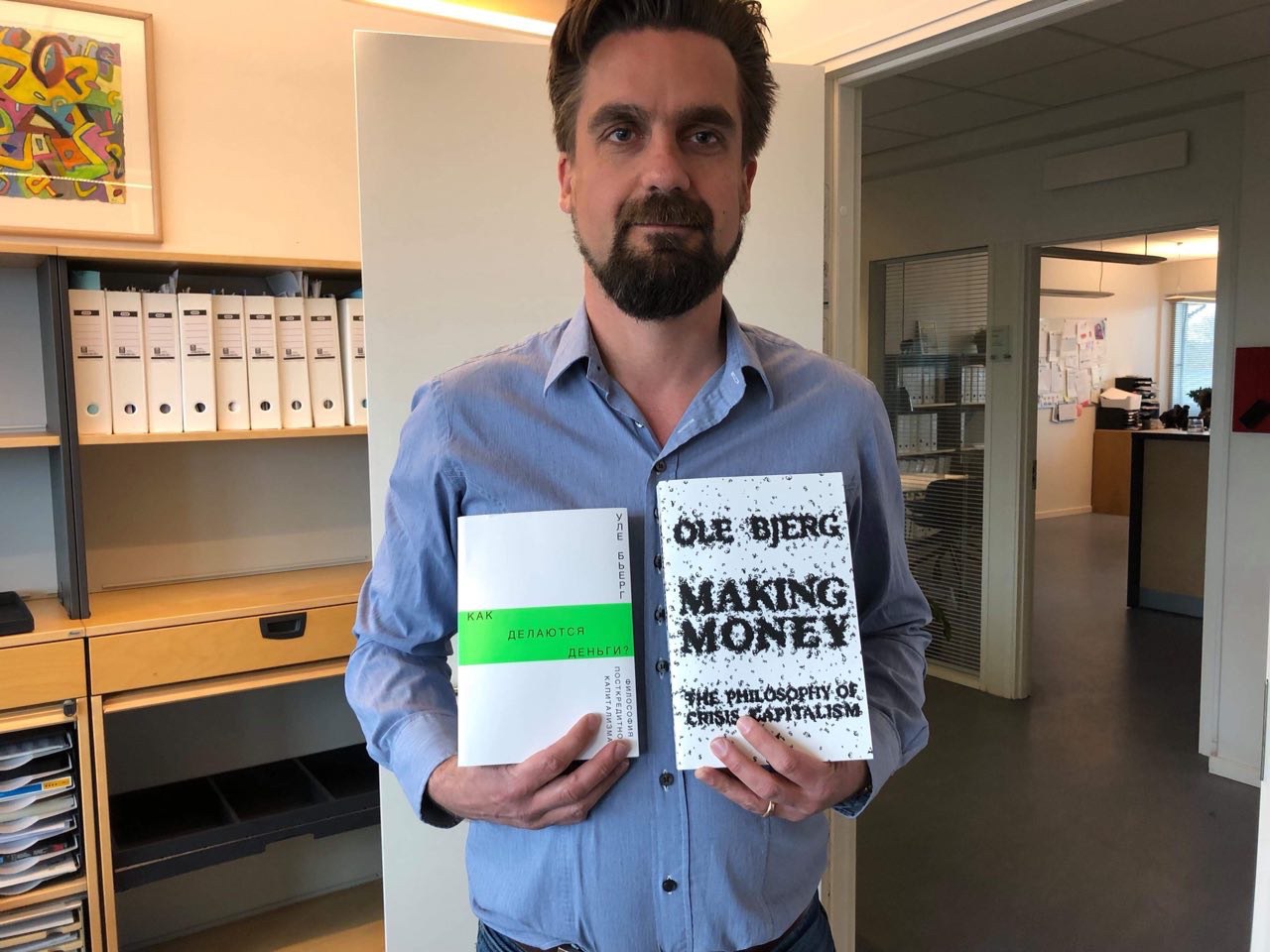
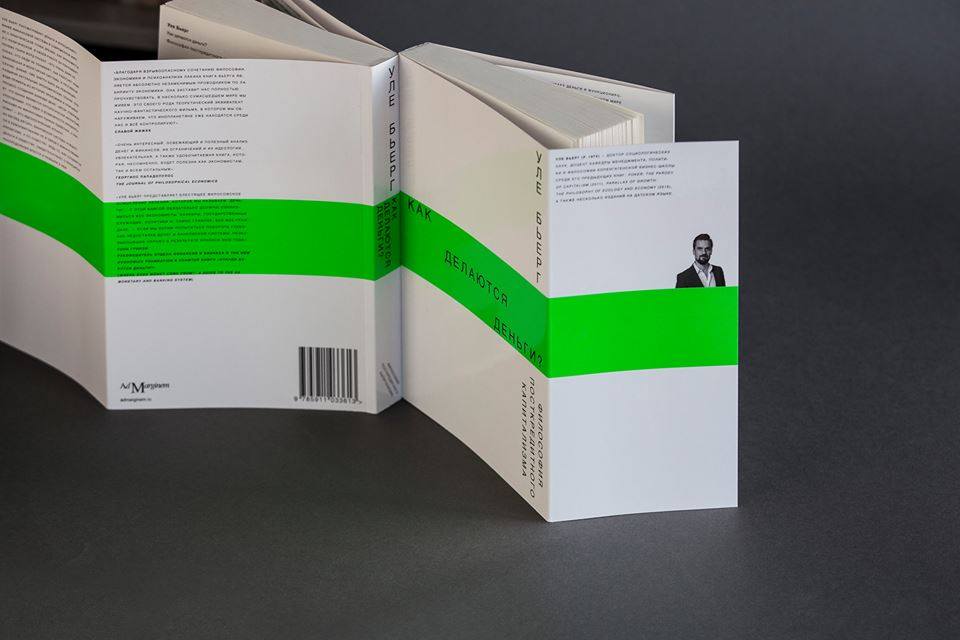
Ule Bierg and his books
Photo: Ad Marginem / Facebook
And your first discovery was that there are practically no fundamental money about money in the economy?
The first thing I did was to read books about what money is, what functions, forms, local currencies, and so on. Some time later, I still did not know what money was, but I realized that this was definitely not what they write about in books. Then I came across the work of Thomas Greco, in which he explains how private banks create money. I thought: it couldn’t be like some kind of conspiracy, began to ask his colleagues, whether it was true, but he never received a clear answer. Then I read a few more books where the same thing was written (for example, the book “Where the Money comes from?”). For me, this has become a real revelation. I also realized that good books on the topic of interest to me were written mainly in the 1920s and earlier. Everything that goes later is seventy years of emptiness, and only now the problem of money is gradually returning to the mainstream.
You write that after the collapse of the Bretton Wood system in the 1970s, the states actually privatized monetary policy, not even really noticing this.
Yes, this is a very accurate formulation. The thing is that there is a huge gap between the central banks that are responsible for the national currency as a unit of account, and by private banks that are engaged in the production of money as funds. The first to ensure that the currency retains purchasing power and so on, and the latter administers our accounts and create relevant money that we pay. It turns out a very strange distribution of responsibility when the production of exchange products is given to outsourcing to private banks. But the supply of money has important macroeconomic consequences - for example, it affects prices in the economy. Therefore, only public institutions can take such responsibility.
The economist would object to you that the monetary cartoon is the most important attribute of the modern financial system, which makes financial markets effective.
This is a very specific theory, and, unfortunately, it is erroneous. Suppose you put in the bank the initial deposit of 1 million rubles. Then, another person takes 900 thousand of them and shifts to a deposit to another bank and so on. In any case, the process of creating money begins with the fact that someone has the first million rubles. But where does this million come from? Is it cash or not? No one explains this to us. Such a story was invented in order to explain why there is more depository money in the economy than the money created by the Central Bank. It is important for economists to save the idea of exogenous money in order to show that the situation is controlled by the Central Bank, because all other money is supposedly the result of multiplication of the initial million rubles. But this is an erroneous theory, and the central banks themselves openly recognize this. Another explanation why this approach is beneficial to everyone is that the idea of exogenousness of money allows you to build models that do not include the process of creating money. If you want to build models and it does not matter to you whether they correspond to reality, then it is very convenient. Many models are based on the idea of balance. You simulate a stable state, then enter some kind of shock into it-for example, interest rates increase-and then you get a new balance. But if you enter money into such a scheme, all dynamics will change. Although it is not a fact that you will find a new balance, and the system can survive a new collapse. Another economist Haiman Minski said that the longer the lull lasts in the economy, the stronger the subsequent storm will be.
You write that in the 20th century the economy became the "science of life." What is meant here?
If the sociologist advises something, people can listen to him, but they will say: you are just a sociologist. And he will agree: yes, it is, there are different points of view on this question. The special quality of economists is that they can look into your eyes without blinking and explain how everything works today and how everything will work in five to ten years. Moreover, economists are listened to by both left -wing and right -wing political views - even the crisis did not make us big skeptics in this regard. This situation is satisfied with politicians because they want to have power, but do not want to make real decisions and shift responsibility to economists. In general, I think that economists have captured the role of philosophers, that is, those who talk about fundamental things. Have you ever heard the philosopher be a key adviser to the modern government? No, but everywhere there is an army of economists. This is what I meant by the "science of life."

In fairness, I will add that there are types of economic analysis that are not necessary to include money - especially in microeconomics. But in macroeconomic models, especially when it comes to long time segments or about the times when the money systems undergo changes, the money must be taken into account. Remember, in 2008 everyone asked why none of the economists could foresee the crisis? But there were such people, they were just considered marginals: Steve Kin, Michael Hudson, Richard Werner and so on. There was even one Danish economist who had to leave for Australia, because his ideas about the crisis were rejected. The general feature of all these thinkers was that they looked at the level of private duty in the economy, while the course of the reasoning of the mainstream economists was this: I have a duty, you have savings - they neutralize each other, which means that the debt can be ignored. Here is just one example of what happens if you neglect money in forecasting.
Another common claim to the modern neoliberal economy is that we have ceased to understand how the market works. In addition to fundamental parameters, such as the balance of supply and supply, the price is determined by the mass of random factors - geopolitics, the emotions of investors, the actions of exchange algorithms ...
The problem is that in the mainstream economic theory there is no difference between the production and financial sector. It is believed that the financial economy is also productive, that it is just a branch that provides financial services for the effective allocation of capital and obeys the general laws of the market. That is, the bank’s activities can be modeling, as if it were an ordinary bicycle production enterprise. But, in my opinion, the situation is different, banks have a completely different logic. If the economy is littered with bicycles, people will once say: we are enough. However, if you make a lot of money with the help of a debt, then you simultaneously create both demand and offer, because you need money in order to pay the debt. There is a completely different dynamics that macroeconomics ignores. The theory of finance is generally a rather strange area that begins with a hypothesis about an effective market and builds its own analysis of the observation of deviations from this effectiveness. As soon as they see something irrational on the market, they immediately wonder: wow, what news! In my opinion, this is not surprising, this is a strange game in which they play. For example, Black and Showles built a theory about why the markets are effective, and then they came to hedge funds and earned millions of dollars, “deceiving” the market. People who work in finance rarely believe in such theories. They simply find a small niche from which you can extract money, and do not think about the system as a whole. I know one of the former investment battalioner who worked in this area for fifteen years, and then left, to begin to read different books and, after so many years of work, was extremely surprised when I found out that banks were creating money! One of my arguments is that the ideological functioning of modern finance is arranged in such a way as to maintain the idea of a certain mind that controls everyone. We can rely on the market so that he takes care of our pensions, prices for goods, and so on.
In the book, you not only often use the ideas of Zizhek, but also very funny characterize it - “Goldman Sachs of modern philosophy”. Do you think he would appreciate such a comparison?
I am sure that I would appreciate. When I began to read Zizheka in the 1990s, I have not met anything like it. To alternate Hegel with some jokes-how is this generally possible?! There are directions in philosophy that suggest that you can resort to only certain intellectual references. The jigs, on the contrary, is not afraid to get hands: he thinks about anything and uses anything as instruments of knowledge. There is some kind of shamelessness that I like. But now, perhaps, the world has already caught up with Zizhek - today many write so. In any case, I borrowed his style, which allows you to philosophically think about finances. The second point is a psychoanalytic distinction between real, symbolic and imaginary, which I use as a key principle in my analysis. Zizhek allows you to think about complex relationships in which the meaning is not determined by the physical shell of things, although it is also important. That is, for me it was a way to break with social constructivism and, as it seems to me, is a little more nuanced analysis.
What are the relations, according to your scheme, between desire and the market?
The concept of price contains an internal contradiction. We do not know how much a used car costs until we put it on the market and find the buyer to some price, which will be the answer to our question. The paradox is that although both parties agree to the price of the goods, they do not agree about its value, because otherwise there would be no transaction. The buyer must assume that the car is at least a little more valuable than the seller thinks. Therefore, there is constant uncertainty on the market about the true value of the goods. Prices are always restive - they reflect the last deal, but we do not know anything about the next. Okay, when it comes to cars - here the market is limited, you are unlikely to need more than two. And if you sell promotions to make money on this? I give such an example. If Jesus came to the stock market and said: here is the true value, then the trading would stop immediately, no one would pay more than it should.
How with centralized planning? Jesus was the first communist.
(Laughs). This is a big question - what is the equivalent of this system in state planning. I don’t know exactly how the money functioned in the Soviet Union, so I can’t answer your question. Sometimes I generally doubt how what I say is applicable here in Russia.
I think it is quite applicable - the monetary policy in Russia is built absolutely according to Western canons. What, by the way, is the main flaw of this model?
This is an idea of the independence of the Central Bank from other branches of power. In Europe, there are now a lot of debate on the topic of how good such a system is. After the crisis, it became obvious that this model should be reviewed. What does the independence of the Central Bank mean, is it that it becomes just dependent on the private banking sector? The situation in Europe is largely like that - the Central Bank perceives itself as a service for the financial sector, and not for society as a whole. I don't think this is a healthy situation.
Are there any ways to politicize monetary policy?
Everything is quite simple here. Firstly, you need a philosophy to constantly ask the question: where does the money come from? This should be followed by a discussion among politicians, and everyone will understand that they have no ideas on this score. The second question: who should create money - the Central Bank or private banks? If people say that it is private, then we must ask: well, what about cash about cash? Why not trust their private banks? You can engage in such a redlife for a long time. In the course of my study, I became one of the founders of the Danish department of the international movement for monetary reform (IMMR). We were inspired by the British equivalent - Positive Money, but there are similar organizations in most EU countries. В них входят люди с разных сторон политического спектра, но все они говорят, что нужно вернуть в политическую повестку вопрос денег. А затем нам нужна будет монетарная реформа, после которой цифровые деньги сможет создавать только ЦБ.
Если бы Маркс жил в наше время, он призывал бы бороться за собственность на средства производства денег?
Yes, that is how. Коммунистическая революция призывала забрать физические средства производства — это масштабная задача, вы сами знаете о возможных последствиях. Но в нашем случае речь идет всего лишь о компьютерных системах. Достаточно изменить определенный фрагмент кода — и все, наши аккаунты теперь в ЦБ, создана новая монетарная система. It is very simple. Так что я не уверен, что нам нужна революция. Революция уже случилась в 1970-х, когда банки получили возможность выпускать деньги, и начался экспоненциальный рост финансовых рынков. Сегодня нам нужна контрреволюция, необходимо вернуться к нормальному состоянию экономики.
Не стоит думать, что люди, предлагающие какие-то изменения, обязательно левые. Конечно, бывает и так, но можно оставаться либералом и выступать за возвращение «нормальных» денег. Я бы даже сказал, что большая часть критики денежной политики идет именно справа, в то время как современные левые делают ставку на политику идентичности, которая совсем не резонирует с тем, что я говорю, и вполне вписывается в бизнес-модели больших корпораций. Лично я не имею ничего против капитализма как такового. Проблема в том, что банки не соревнуются на настоящих рынках, они только администрируют свои государственные привилегии. Существует антагонизм между финансовым сектором и производительной частью экономики. Но в целом я настроен оптимистично — сегодня дебаты вокруг денег расширяются, и чаще всего люди, узнав о реальном устройстве банковской системы, не поддерживают такое положение вещей.