
Translated material
Theater against sociology
We study the long list of the Enlightener prize: Humanitarian sciences
In early June, the Long List of the Enlightener Prize, which is awarded for the best popular science books, became known. Gorky talks about the third part of the list - about six books on the humanities. A review of books on medicine can be read here , and books on natural sciences and technology - here . 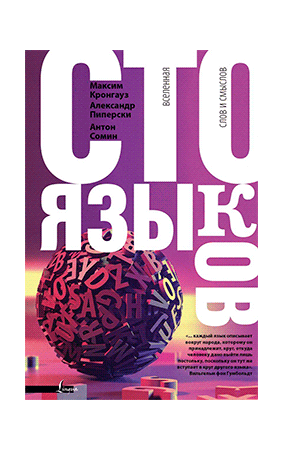 Maxim Krongauz, Alexander Piperski, Anton Somin and others. One hundred languages. Universe of words and meanings. M.: AST, 2018
If this book enters the short list or receives a bonus, then its authors will go on stage with a small but confident crowd: there are thirteen people in total, and only headliners are made on the cover. In the book - one hundred essays about one hundred languages: the first to predictly go to Abkhazian, the last, also predictably, Japanese is also predictable. In each chapter - the history of the language, its features, writing, reform and quote from the literary work in this language with translation into Russian. “The Serbian Cyrillic alphabet in its current form was fixed by the outstanding enlightener Vuk Karadzhich (1787–1864). He proclaimed the principle of write kao Speak, and read the kao, it is written (write, as you say, and read, as it is written). ” If you summarize, then the book, of course, is extremely informative, but does not differ in particular depth. But we know that this author’s team (there are two laureates of the “enlightener” of different years) can talk about languages and linguistics more serious and at the same time fascinating.
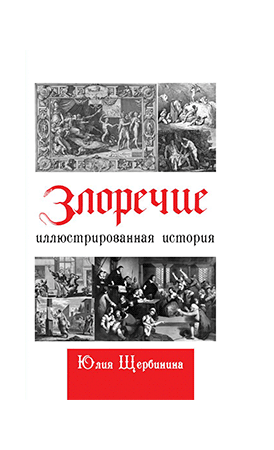 Shcherbinina Julia. Slave: An illustrated story. M.: Neolit, 2019
The constant author of Gorky Julia Shcherbinin teaches the bad: he offers a brief excursion into the history of curses, describes the theory and practice of slander from biblical times to the present day, talks about the history of gossip, explains how blackmail has begun. And she writes about rudeness, blasphemy and the language of enmity. “With the artificial constructing of the enemy vocabulary, the inner form of words, their sound and morphemic composition are cynically played cynically: propagandon, Crimean, bum, the Orthodox, a commander, etc. This reception is by no means new. Belinsky called Slavophiles Slavenopers. " Each fact separately is interesting, but in a single book with a slender concept, episodes from the history of bad words are not very formed.
 Pavel Rudnev. Drama of memory. Essays on the history of Russian drama. 1950-2010. M.: New Literary Review, 2018
Rudnev is a famous theater critic, but the “drama of memory” is closer to academic theater studies than to journalism. Rudnev offers his version of the history of the late Soviet and Russian drama, which he sets out in several dozen essays about playwrights: here Viktor Rozov, and Alexei Arbuzov, Venedikt Erofeev, and Nikolai Kolyad, and Vladimir Sorokin, and Yaroslav Pulinovich, and a separate section on the documentary theater. Each chapter consists not only of a biographical reference, but also of a detailed analysis of plays, the creative method of the playwright, a brief but capacious definition of the essence of the work and characteristics of a typical protagonist. And if the once popular playwright has lost its relevance and popularity, Rudnev makes a merciless verdict:
“What did not let Evgeny Grishkovtsya develop further? Advantages very often turn into shortcomings if you do not work with them. The egocentric was a turning point for opening the reception of a new Russian theater. But the excess of the egocentric and made the innovation of the Grishkovtsy a little later by a commercial product - his typical manner after some time migrated to mass culture and was prostructed there. The moment was missed when the writer must change tactics: to abandon endless self -knowledge and self -love, from egocentric, and switch to comprehension of another, other people's experience, peering experience into not his world, into the boundaries of one personality of alien experience. ”
This is a great book for the one who has missed the last half a century of theatrical history of Russia and who wants to know how to support the conversation with the circle of colleagues. If the jury members are in the same position, then, perhaps, Rudnev’s book has good chances.
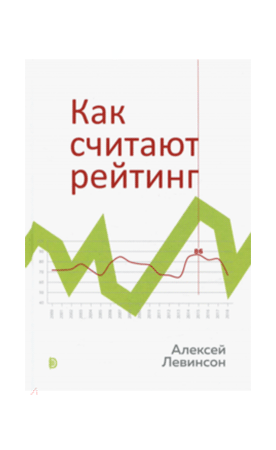 Alexey Levinson. According to the rating. Minsk: Discourse, 2018
The book is probably the most authoritative of modern Russian sociologists - Alexei Levinson. In principle, this is exemplary work in the genre “Everything you wanted to know about sociology, but there was no one to ask; So, now there is. ” This is a trip to a sociological cuisine: how the work of a sociologist is arranged, what a sociologist can and cannot, a brief history of sociology in the world and Russia, and, of course, a reasoning about how the work of a sociologist can become part of political manipulations. Cynically assume that the premium fate of this book will largely depend on the popularity of the topic. If the current protests continue and aggravate, then sociology will be in sight, which means that the chances of victory with the book “As the Rating” will be high will be high.
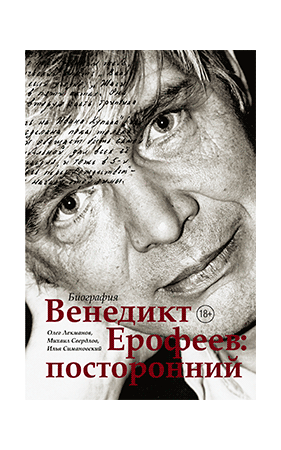 Oleg Lexmanov, Mikhail Sverdlov, Ilya Simanovsky. Venedikt Erofeev: outsider. M.: AST: Edition Elena Shubina, 2019
Dreamy of two philologists and one Erofeevo-amateur wrote a very detailed and very thorough biography of the author of the poem “Moscow-Petushki”. One of the most important ideas of the book was made in the name: Erofeev was another, different, unhealthy, outsider. The authors confirm this idea with replicas of dozens of witnesses and a detailed analysis of the texts. The work is meticulous, fundamental and claiming not only to the "Enlightener", but also to the "Big Book". The only, though important claim to the “outsider” - this book does not answer the most important question: why “Moscow -Petushki” has become one of the main works of Russian literature and where Erofeev’s magic is coming from, which already acts for several generations of readers.
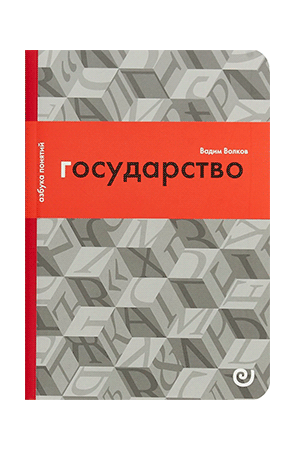 Vadim Volkov. State, or the price of order. SPb. : European University Publishing House in St. Petersburg, 2018
To begin with, it is worth noting that the St. Petersburg sociologist Vadim Volkov is certainly a great enlightener. At the beginning of the zero of his work on the sociology of organized crime (or, as he wrote, “power entrepreneurship”) was very popular. His new book is dedicated to the state: at first the idea itself, then its elevation, finally - its inevitable crisis. With a separate and particularly thorough analysis of the Russian situation, where the nineties began to retreat the state in the nineties and its counterattack began in the zero. In general, Volkov is undoubtedly a strong contender for victory.
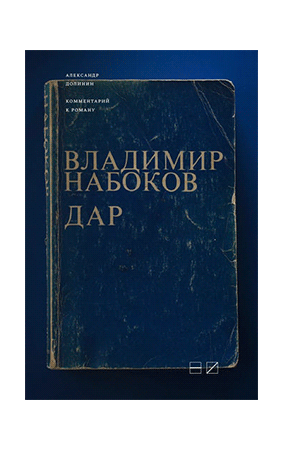 Alexander Dolinin. Commentary on the novel by Vladimir Nabokov "Dar". M.: New Publishing House, 2018
At first glance, the circle of readers of the work of one of the leading (if not at all the main) nabokovs of the planet Alexander Dolinin is limited. It includes only those who, firstly, read the novel “Dar” and who have questions. And secondly, these are fans of detailed comments. But in fact, the book of Dolinin simply certainly and immediately needs to be read by all those citizens who go to a variety of writing courses and dream of becoming writers. Because Dolinin wrote not just a commentary explaining the incomprehensible places of “Dara” and putting a novel in the context of Nabokov’s work. The author makes it possible to visit a writer's laboratory. Dolinin explains the Nabokov method in detail, the way the heroes were formed, the way the plot was formed, why the original plan differs from what happened in the end. Sometimes it gives an explanation for almost every word and its position inside the sentence.