
Translated material
Shrits and screams
About the book of Ksenia Filimonova about the aesthetics of Varlam Shalamov
Not only the wide, but also the most meticulous reader Barlah Shalamov is known primarily as the creator of Kolyma Stories, the worst of the works of the Stalinist camps. Ksenia Filimonova, Shalamedka, however, suggests at least temporarily to forget what is written in the works of Varlam Tikhonovich, and look closely at exactly how and in what cultural context they are created. Eduard Lukoyanov talks about the new book of the researcher for readers of Gorky.Starting from February 24, 2022, we were all in the face of the advancing barbarism, violence and lies. In this situation, it is extremely important to preserve at least the remnants of culture and support the values of humanism - including for the sake of the future of Russia. Therefore, the editorial office of Gorky will continue to talk about books, reminding our readers that the world remains in the world and fiction.
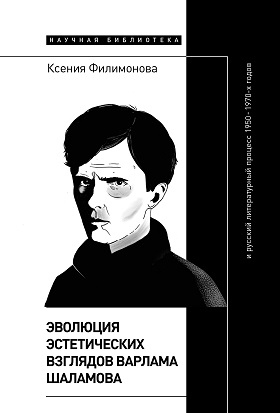
Ksenia Filimonova. The evolution of the aesthetic views of Varlam Shalamov and the Russian literary process of the 1950-1970s. M.: New Literary Review, 2023 . Content . Fragment
 The poet Gennady Aigi once recorded such a memory of his meeting with Varlam Tikhonovich Shalamov: “Ivan Dmitrievich Rozhansky invited V. Shalamov to record his reading on a tape recorder. Shalamov willingly agreed: he wanted to read poetry. Two or three quiet voices were heard: “You would not read your prose.” Varlam Tikhonovich read one story, I did not remember which one. And for what reason (let me say goodbye to me that I should say this), during his reading, something happened even more intensifying the overall numbness: the writer suddenly lit up “twisted”, switched to a tongue twister ...-and ...-apparently, it is better not to determine our impression, not to reason in which “reached” the “language”, unlike the generally accepted ”.
In this small passage, the myth of Shalamov, which arose during his lifetime, is concise concisely, and here he was subjected to amazingly protracted splitting. Shalamovsky myth is built around the exclusivity of his catastrophic life experience, transferred in prose, primarily in the Kolyma stories. Listeners of Varlam Tikhonovich from the excerpt clearly wanted to join the secret camp knowledge, who had been there on behalf of the one who visited there and was able to return. The poems of Shalamov in this sense seemed unsuitable for them to touch the transcendental.
They were mistaken. A shock for them was not the texture of this human document, not its event series, but the language itself, which it is written. The exhaustive definition of such a language was given by Shalamov himself, speaking of the Solzhenitsynsky "one day of Ivan Denisovich" - "very accurate and new, burning new." Only in such a language could literature exist after “Hiroshima’s fires, the shame of Kolyma and Auschwitz’s furnaces” (so Varlam Tikhonovich once expanded what the aphorism of Theodore Adorno, adding to his approval, the fat sign of the question). And each line of Shalamov, prosaic, poetic, journalistic, first of all reports: its author would like the artistic language that this line is written more than anything else and under no circumstances to exist. On this occasion, he will write in 1958, putting his thought in the mouth of Alexander Voronsky, executed at Stalin, the “Perevalovtsa” writer:
“Gorky brought a pack of books published in Berlin, Gorky and Grzhebin, and showed Vladimir Ilyich. Lenin picked up a collection of ancient Indian fairy tales, leafed through.
“In my opinion,” he said, “this is premature.”
Gorky answered:
- These are very good fairy tales.
Vladimir Ilyich remarked:
- Money is spent on this.
Gorky: - This is very cheap.
Lenin: - Yes, but for this we pay the golden currency. This year we will have hunger.
It seemed to me then that two truths collided; One, as it were, said: “Not a person will not be alive about bread”; the other answered: “And if there is no bread ...”
And it always seemed to me that the second truth, the truth of Vladimir Ilyich, is stronger than the first truth. ”
The language of Shalamov, his aesthetics, identical to Shalamov’s ethics, is primarily devoted to the book of Ksenia Filimonova with Sukhim, detached and therefore the most suitable title “The evolution of the aesthetic views of Varlam Shalamov and the Russian literary process of the 1950-1970s”.
Of course, many high -quality research pages are devoted to the large literary project of Shalamov to create “New Prose”. In one form or another, this topic is touched upon, for example, in the illegal comet Elena Mikhailik - perhaps one of the most remarkable books not only in huts, but also from all the disaster dedicated to the Soviet literature. However, apparently, in the monograph of Ksenia Filimonova, for the first time, it becomes a completely independent topic , but as it is written in prose and poems by Shalamov. And it is clearly demonstrated as the form of writing in these for the most part of unbearably terrible texts interpenetrates with their content.
“The experience of literary creativity after the experience of hell cannot be completely reconstructed in a word,” in particular, writes Ksenia Filimonova. - Shalamov understood this and for many years was looking for a different way of transferring feelings and physiological sensations of prisoners: hunger, cold, exhausting labor, wet clothes, diseases, exhaustion, beatings, humiliation and, in the end, complete indifference to everything that happens, indifference to death. The closest approach to the definition can be described by the words of Shalamov himself, who said that his stories are “shouted”. ”
The strongest side of the book of Ksenia Filimonova is that it is carefully reconstructed in how this “shouting” became possible and what it rests, which serves the supports of this bark , which would not become so piercing, without strong cultural foundations. We constantly forget that Shalamov, who had fallen from earthly reality to the hell of Kolyma for sixteen, was an extremely well -read person who was freely oriented in the classical and modern literature - both Soviet and foreign, both official and semi -underground, and even decisively underground.
Ksenia Filimonova C, I’m not afraid of this word, grace (as far as possible in strict academic borders) placed accents on those authors who were certainly important for Shalamov, but at the same time they hardly quickly come to mind in a conversation about the Shalamovsky myth. First of all, this is Boris Pasternak - a man whom Varlam Tikhonovich visited the next day after returning from Kolyma. Pages dedicated to how the “living Buddha” and Shalamov talked, exchanged opinions about the drafts of “Dr. Zhivago” and eventually stopped communication, so interesting that I will refrain from rude retelling and leave the reader the opportunity to get acquainted with them on my own. But still I will give one case indicated by Ksenia Filimonova.
From the novel "Dr. Zhivago":
“They built a wide polygon in the entire field, with their backs inside, so that they do not see each other. They ordered to their knees and, under pain of the execution, not to look around, and an endless, for a long time stretched, a humiliating roll -call procedure began. And all on the knees. Then they got up, other parties were divorced by points, and ours announced: “Here is your camp. Strive up as you know.” The snow field in the open, in the middle of the pillar, on the pillar the inscription "Gulag 92 I n 90" and nothing more. "
On this occasion, Varlam Tikhonovich writes to Boris Leonidovich:
“There are no pillars there - the gulag is the name of Ch. management. The rectangle of prisoners with persons out - it does not happen. There is no need - because they will inevitably work together. ”
It is easy to check that Pasternak after these seemingly good comments did not bring a single edit to his manuscript. I can make an assumption from myself: in this correspondence, to understand both authors, it is important not that Shalamov explained the inaccuracy of the text, but that Pasternak missed the instructions of the addressee. Here, two qualitatively different traditions come across and illuminate each other: traditional, focused on artistic persuasiveness, even if it does not correspond to reality, and “new”, the dictatorship of which is reality and its persuasiveness as a self -sufficient form of artistry. Saying “this is not there”, it seems to me, Shalamov indicates not so much that the described scene is not needed in life, but how much that it is not needed in the text.
But let's return to the way, in the book of Ksenia Filimonova, accents are placed on what kind of literature was of particular importance for Shalamov as a reader. Two points are very indicative here. Firstly, Varlah Tikhonovich was a fan of what is called non-nonsense today-in particular, he appreciated the essays of Charles Darwin. Secondly, he carefully and with total acceptance followed the relevant modernist experiments of the writers of those countries in which such searches were legal, and in Soviet realities-not quite. Probably, the reader, who is behind the iron curtain, finds himself in a much more advantageous position than the reader “from the other side”. It was as if he can clearly see the true content of literature, which in a “bourgeois-capitalist” society was perceived at that time for the most part in the order of scandalous experiment:
“The best artistic prose is modern - this is Faulkner. But Faulkner is a hacked, exploded romance, and only writer's rage helps to finish the matter, to complete the world from debris. ”
Or:
“The Nobel Committee gave the Prize in literature for 1969 to Becquet, and this is right - for the literary truth is behind Beckett today. <...> The victory of Goskete, the recognition of Beckett hides one important feature. This is the victory of life itself. ”
Or this - not so, for my taste, indisputable - judgment:
“The play of the century is the“ rhino ”Ionesko.”
Faulkner, Becket, Ionesko - these are three completely different author, which you can hardly just put it to Shalamov, but which, surprisingly, are close to him like no one else. So, according to Ksenia Filimonova, to the much less Barlam Tikhonovich was interested in Lev Tolstoy: “Mentioning Tolstoy, Shalamov wrote only about the need to film“ war and peace ”and“ Anna Karenina ”in order to“ solve the issue ”, which the Cossacks and Sunday do not solve. What kind of issue was to solve the film adaptation of Tolstoy’s novels, Shalamov did not specify. ”
Ksenia Filimonova pays special attention to one fact from the biography of Varlam Tikhonovich - it seems to be well -known, but remaining on the second, or even third plans for readers and researchers of Shalamov. This is the fact that Shalamov for several years collaborated with the New World magazine: he was one of those unfortunate who read all the manuscripts sent and did it without fail. The memories of this are close and understandable to anyone who has to work with large arrays of the texts of the authors unknown to him: “Sometimes it seems that there should be psychiatrists in the editorial apparatus, much concerns their competence.”
The significant share of this previously inconspicuous “Novomirov” part of the Shalamovsky archive was collected in the book of Filimonova as an application - reading the internal reviews written by him is no less exciting than acquaintance with the canonical corps of “non -artistic” (if this division in this case is applicable) of Varlam Tikhonovich's texts.
In the end, I would like to notice: the main property of the monograph of Ksenia Filimonova is that it gives an example of how the conscientiously done intellectual work allows you to rethink our assessments of a particular cultural phenomenon. The key word here is “conscientious”, that is, meaningfully and responsibly.
Unfortunately, I had to see me more than once how a spontaneous reassessment of the creativity and personality of Shalamov is taking place on the Internet, when the publications dedicated to Varlam Tikhonovich are accompanied by the famous photograph from the investigation (RGALI. F. 2596. Op. 2. Hr. 167. L. 12). Which, in turn, causes a storm of ironic emotions among commentators who write “handsome”, “hot”, “crash”.
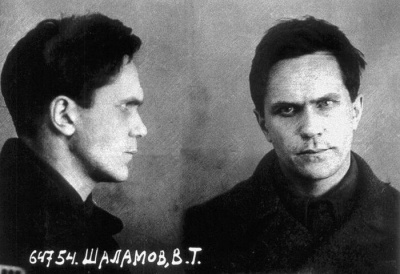
Such a spontaneous rethinking of Shalamov is quite natural and has every right to exist. But is there no Stalin era in this collective and conscious glamorization of the repressive experience of the Stalin era? Is this not the obvious need for rethinking and the final understanding of such an experience, but - unscrupulous and irresponsible?
Think about it at your leisure.