
Translated material
Nail in the forehead: books of the week
What to ask in book
The new novel by Orhan Pamuke, “King in Yellow”, the anti -philosophy of Boris Groys, TRIP on the wilds of the Haitian vudism, as well as an original view of the problems of literary translation. As usual on Fridays, Gorky editors talk about the most remarkable new products of the week.Ilya Vinitsky. Translated pictures: literary translation as an interpretation and provocation. M.: Ruthenia, 2022. Content
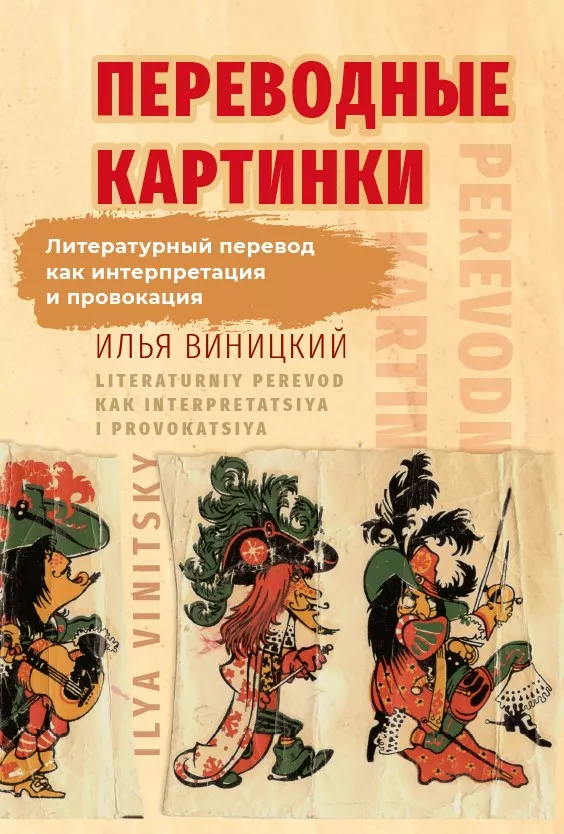 The new book of Ilya Vinitsky, the philologist and the permanent author of Gorky, is devoted to translating as interpretative practice - and he often becomes interpreting in addition to the will of the translator himself, and new meanings arise in a roundabout ways, which are almost detective methods. In the preface, the author tells how in his student years he discovered that in the translation of one English ballad Vasily Zhukovsky allowed himself a number of such liberties that demanded a special explanation:
“The point here was not at all in the notorious rivalry with the original poet, but it was precisely in the act of conscious or unconscious integration of the translation (and the same particle of someone else's tradition that the original of the translator close to Zhukovsky reflected, and even more precisely, in the use of the translation as a means of expression of his content, which, for some reason, cannot be expressed otherwise . ”
The main thing, however, is not even in the original author’s methodology of analysis, but in the wit of Vinitsky and his ability to find in the history of literature the most non -obvious and at the same time demonstrative plots that, without real devotion to their fingers from a finger, do not suck anyone.
“In his essay, Semevsky used the notes and letters of the Mons found by him, including love poems and the seals of the latter. Mons wrote Russian poems (and love letters) in the so -called Slobodsky dialect - not knowing Russian letters, he translite Russian sounds by earlier. In the main text of the study and in the applications to it, Semevsky placed excerpts from German and Russian (written by Latin letters) of Monsiy poems with the preservation of all the errors of the original spelling. Here are the Russian Virsch Cavalier (they are often quoted as a curiily example of poetic ignorance of the Petrine era):
Ach Sto Gesi Swet I Fswete, Ach FSO Pratifnaje,
Ne Magu Schit Ne Umerty, Sertza Tasklywaja,
Dolgo type mutzilsa, Net Upokoy Sertza,
Kupido Wor Proklaty, Welmy Radagitsa.
Probil Streloyu Sertza, Leschu Bespamety,
Ne Magu Ja Atznutza, I Otzi My Plakaty,
Taska Welikaja, Schnotze Krawwaja,
Rudoju sapeklosa, I fso prabitaja. "
Wade Davis. Snakes and rainbow. M.: Publishing house of the Tsiolkovsky bookstore, 2022 . Content
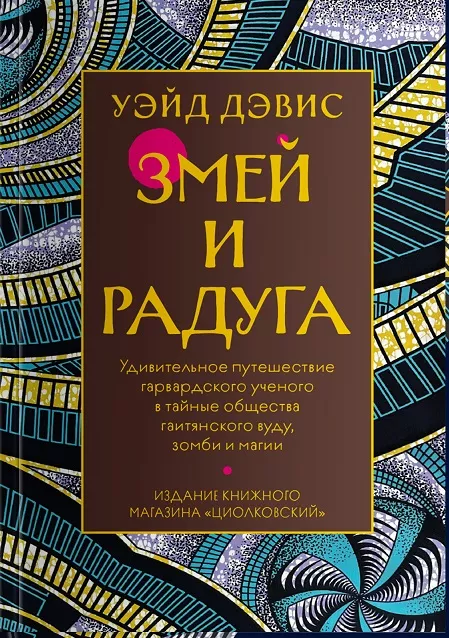 Wade Davis, a new book of the “Tsiolkovsky” publishing house, is very bizarre: to understand what it is - a report on the field anthropological study or a fiction Trip on the wilds of the Haitian vudism, and the preface of Sergei Mokhov, as well as written specially for this publication. Scientific comments, in this regard, do not clarify anything and even seem unnecessary. It was impossible to read anything more likely about the zombie in Russian before, and the translation of George Osipov automatically makes any book a significant phenomenon of modern Russian literature - so do not pass by.
“Two weeks later, a final meeting took place, during which Professor Shults took out several cards and outlined possible routes. In addition, he gave only two tips. There is no need to buy strong boots, he said, because the snakes there usually dig into the neck, but the cork helmet is an indispensable thing. Then the professor hoped with all my heart that I would not return from the Amazon without tasting the aahuasks, wine, causing vision, one of the most powerful plant hallucinogens. In general, I left the professor’s office with the feeling that a lot now depends on me . ”
Boris Grois. Introduction to antiphylosophy. M.: Hell Marginum Press, 2021. Content
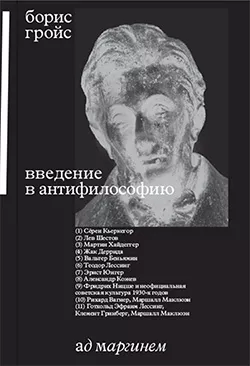 The prefix "Anti" has truly magical properties. It is worth adding it to anything, as everything around begins to shine with resolutely new colors. The unreasonable gymnasium player will rather read Anti-Edip Delea and Guattari than the “Oedipus” of Sophocles, and the citizen will be more willing to give the soul to the Antichrist more than the spirit than to entrust it to Christ.
Such and at the same time, not at all such a “introduction into the anti-philosophy” of Boris Groys, a philosopher, whose mind is sharp, like a homo jabbar, and elegant, like a nigghurat. The fate of this book turned out to be ornate. It was first published in German in 2009, three years later the English version was released, and now, finally, it became available in Russian. This is late, oddly enough, great luck for the book, and for its author, and for readers.
On the pages of “Introduction to Anti -Philosophy”, Grois proposes to look at the world and being of approximately sixteen billion eyes, insisting that each of us is a philosopher and artist, although most are not even aware of this. His associates on this ecstasy of radical solipsism are Kierkegaard and Shestov, Heidegger and Junger, Kozhev and Nietzsche - a time -tested combined detachment under the sensitive leadership of Boris Efimovich proves his combat effectiveness to our iron age. But, most importantly, in the prism of “introducing into anti -philosophy”, ideas imposed in recent years about a deep crisis of democracy (or at least democratic forms of thinking) are not so obvious.
Well, when, by the will of Grois, arthropod creatures from the Star Troops begin to run along the pages of the Junger’s “worker” (the film by Paul Veruhven, and not Roman Heinlin), the heart simply joyfully rejoices. And this is not tautology and not even pleonasm.
“Post -structuralism or, more widely, postmodernism is a doctrine of class domination of intellectuals, the ideology of the wide layers of the elite. She is deeply indifferent to all those who “did not get into the museum”, did not fall into history, into library holy. For these others, she does not even know the Apocalypse: since they did not live in the immortality of the archive, they cannot also die. But does this not mean that it was these others who are already in the apocalyptic time that could rather tell about him than constantly experiencing mourning for themselves by post -structuralists? ”
Robert Chambers. The king is yellow. M.: Ripol Classic, 2022. Translation from English Katarina Vorontsova
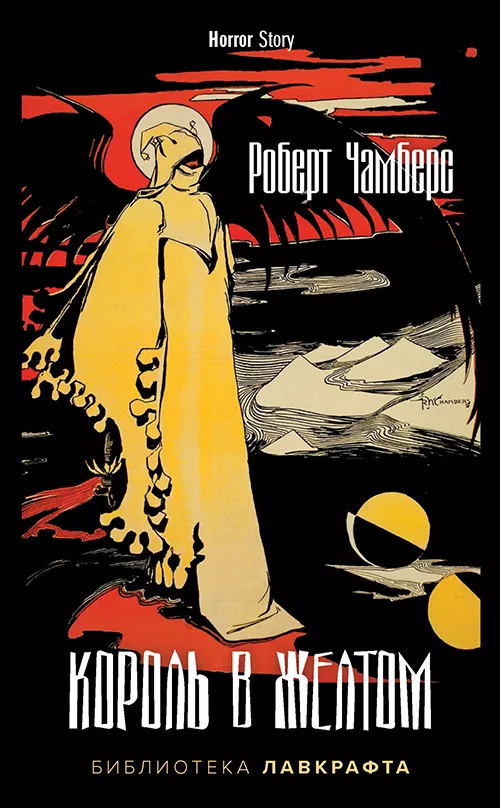 The ancient prophecy says: the end of the days will come when in the text about the “king in yellow” Robert Chambers will not be mentioned that they were inspired by the creators of the first season of the series “Real Detective”. So, having fulfilled our duty to humanity and slightly shifting the day that will bring its natural result, we recall what kind of book it is.
“King in Yellow” is a collection of ten novels, almost in no way connected with each other, but united by the topic of horror, death and the accompanying decadent chic. The heroes of these stories from time to time face the play, which is called - "King in Yellow." This wicked work drives them crazy and makes you worship the ancient god Hastur, whose one name defiles everything that can be desecrated. In general, after reading Chambers, it becomes a little clearer how the crazy Arab Abdul Alkhazred and his “necronomicon” were born. However, Howard Phillips Lovecraft, who highly appreciated the CHAMBERS NOT and considered his stories to the peaks of cosmic horror, did not particularly hide it.
Read more about Robert Chambers and his “King in Yellow” inan interview , which Gorky once took from the translator Galina Erley.
“During my recovery, I bought and first read the“ king in yellow ”. I remember that after the first act it became clear to me that it was better to stop. I jumped up and threw the book into the fireplace. Tom hit the fireplace bars and, opening, fell on the stove in front of it, frozen in flames. Do not look at the epigraph of the second act, I would never return to the “king in yellow”, but as soon as I leaned after him, an open page riveted my gaze, and with a cry of horror or delight, so acute that he surrendered in every nerb, I grabbed a book of coal and trembling, creeping into my bedroom, where I read it and laughed and laughed, and laughed and laughed and laughed and laughed and laughed and laughed, and laughed and laughed and laughed it. Shaking with horror, which to this day torments me. "
Such a story is interesting.
Orhan Pamuk. Plague nights. M.: Foreigner, ABC-Atticus, 2022. Translation from Turkish M. Sharov
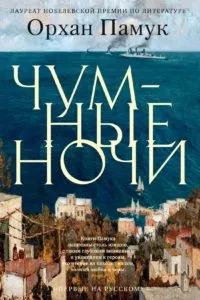 The main person of the export of Turkish literature composed a novel, the plot of which unfolds on a fictional Ottoman island in the Eastern Mediterranean; There, in the early 1900s, there is a flash of a bubonic plague. According to the author, who, even before every Covid, was extremely sensitive to the topics of isolation and quarantine, he began to write “plague nights” a few years before the events in Juni, but shortly before the publication, the novel gained an acute -social character.
The main characters of the book are the governor of the island, an officer and their lover, a doctor who arrived on the island to stop the epidemic, and the daughter of the Sultan, telling about what is happening in letters to his sister. The exquisite narrative consists of a description of desperate attempts of love, power and knowledge to streamline the decaying world, and also, as always in Pamuk, reflection on the middle position of the Turkish culture between the East and the West. The reflection turned out to be quite acute: immediately after the release of the writer’s book was accused of insulting the national flag and Kemal Ataturk.
“Five days earlier, when Bayram-Efendi had the first signs of the disease, he did not take them seriously. He was thrown into the heat, his heart was beating more often, then he felt a chill. It must have been too much in the morning along the bastions blown by all the winds and courtyards of the fortress, so he caught a cold. The next day after noon, weakness joined the heat, I did not want to eat at all. Passing through the courtyard, paved with cobblestone, he suddenly sat down, then lay down and, looking into the sky, thought that he could die. It was as if in his forehead was injected with a nail. ”