
Translated material
Why do hurricanes give names?
"Gorky" in "Labyrinth": Do not miss these books
Secrets of meteorology, Indian fairy tales in the western manner, adventure novel and adult book for teenagers. Meet the next issue of the “Gorky” section in the Labyrinth. ” Today we will talk about books that Roman Wilfand, Vlas Doroshevich, Zinovy Zinik and Christel Dabo. 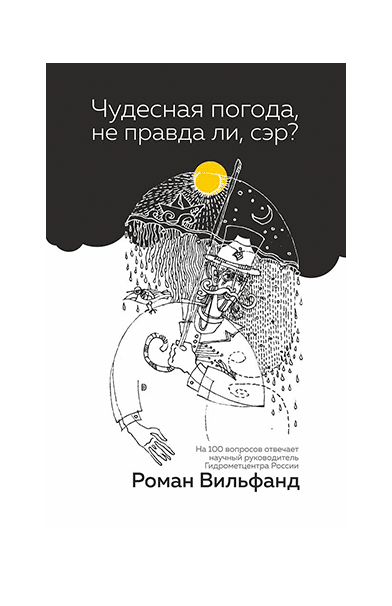 Roman Wilfand. Wonderful weather, isn't it, sir? Minsk: Discourse, 2018
Roman Wilfand is the supervisor of the Hydrometeorological Center of Russia, who reached this position from the position of an engineer, and also the chief of the magazine dedicated to this organization and the author of more than 150 scientific works. The book is compiled on the principle of short answers to questions. If Wilfand Blogger, who arranges regular online stams for his subscribers, would have come from them such issues, completely diverse: specific and too general, popular and “cunning”, quite serious and pushing the ironic response. For some of them it is even embarrassed (for example, “Can global warming can be stopped?” Or “What is an interesting profession of a meteorologist?”), A others make you think and intentionally, for the sake of interest, as long as possible not read the correct answer (say, does the height of houses affect the development of meteorological processes? ”).
The heads in nature can be divided into the following groups: the former speak of the functioning of natural processes on Earth in general; the latter - about the change in these processes and, accordingly, change in the weather; third - about the work of a meteorologist; The fourth - about the relationship of man with nature; The fifth is about the history of observations of the weather and plans for the near future.
If you believe that the whole hundred points in this improvised questionnaire were invented by imaginary spectators, then the authors of the following issues should be praised separately: "How much does the weather forecast cost?" (it's hard to believe, but no one knows this); "Why is it so cold with global warming?" (because global warming is not what it seems); "What folk signs are working?" (generally none, but there are a couple who migrated to signs more from the textbook in physics); "Why do hurricanes give names and where do they come from?" (Surprisingly, a sophisticated thing-to learn some rules of Japanese etiquette, maybe easier than the rules by which hurricanes are assigned names). There are many questions - you will definitely find yours. At the same time, they may well be even more, the topic is not at all exhausted - let the publishing house think about continuation.
Buy on Labyrinth.ru
 Vlas Doroshevich. The gift of the word. Indian fairy tales and legends. Compilation, preface and notes by S.V. Bulemchin. M.: Time, 2019
Doroshevich - known in the time, at the turn of the 19th and 20th centuries, a journalist and writer, who was reviewed by Chukovsky (though not too flattering) - today is almost completely forgotten. Then he gained fame thanks to his feuilleton and articles, but his travel experience turned out to be more valuable after time. Where he was not: in the USA, Japan, Iran, China; In Russia, he went after Chekhov, to Sakhalin. Doroshevich was in junk-mindedly curious to the life of unfamiliar nations and nationalities, to their traditions and beliefs. But if he brought a whole pile of spicy -social notes from Sakhalin, where he told how difficult it is on the island, then foreign trips, in addition to rather hard reports, inspired him to literary experiments, in which he intentionally departed from realism as far as possible.
Readers who do not know all this background are easily confused. “Indian fairy tales and legends” is not a collection of original parables and traditions, which Doroshevich accurately recorded from the words of local residents met in India. This can be seen in the text: the heroes here are from local folklore, but the plots are too “European”, and in form they resemble artistic fables rather than fairy tales. Yes, the journalist was delighted with someone else's culture and drove numerous things, jewelry and interior items home. But the most important thing that he had left is a new aesthetic experience, accumulated emotions and the spirit poured in the atmosphere, which he tried to focus, so that then things emerging from under his pen were the same colorful.
He “brought such tales” from Turkey, China and other countries of the East, but, I think, the Turks or Chinese themselves read them, they would be very surprised. It was a kind of imitation from a noble student - an example of disinterested stylization, when the writer created an exotic little thing with his own hands. For all the exotic, the social component was guessed by the Russian reader at the moment: the reconciliation (!) Of good with evil, which ended in the literal destruction of the world; the vulgarity and stupidity of the most perfect being on earth; A very thin line that distinguishes God (read: anyone who is endowed with power) from an ordinary pig, which is enough and puddles of dirt. The foreign “origin” of these fairy tales was an extra “protection” for them, however, and unacceptable.
Buy on Labyrinth.ru
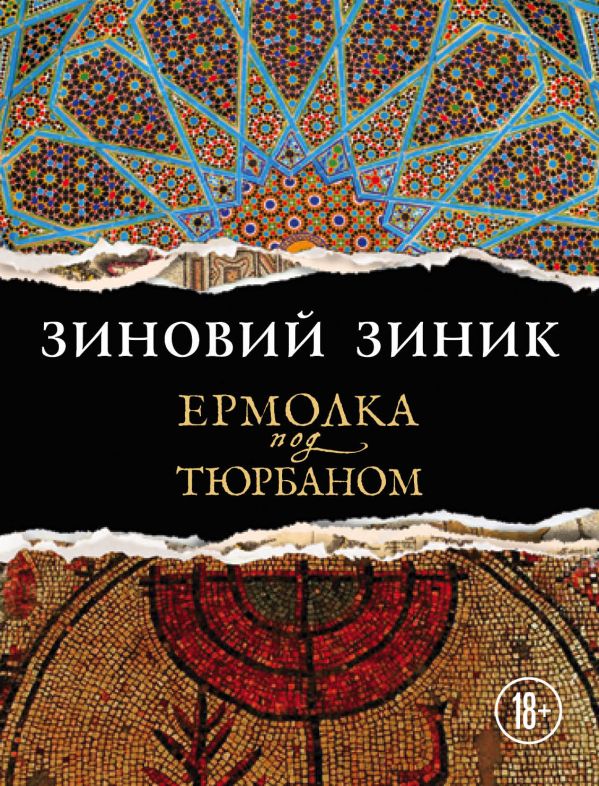 Zinovy Zinik. Ermolka under the turban. M.: Publishing house "E", 2018
Zinovy Zinik is a writer and critic who left Russia back in 1975. Through Israel, he got to the UK, began to work in the Russian BBC service and still lives in London. Personal biography - in any case, traumatic, no matter how the author lives in the new homeland - became the main line of literary works. Zinik wrote several novels and collections of essays, in which, perhaps, he never departed from the image of an emigrant or from the topic of human migration between cultures at different times.
A new novel is also about this, and Zinik finds an ideal hero for his favorite topic. Shabtai Zvi is a Jew who declared himself in the 17th century a new Messiah and easily gathered a large circle of followers, hiding from persecution and everywhere found the support of his students. At the end of his life, he unexpectedly accepted Islam, leaving in bewilderment everyone who knew him personally or simply heard about him. It is this, the most famous act of ZVI, that attracts Zinik, who understands emigration not only from a geographical point of view. Emigration is a change in life, culture, sometimes a whole religion; This is an extraordinary act for which there are no identical reasons. Here it is worth making a reservation that ZVI is the most ambiguous personality, and some of them explain his appeal from one faith to another with a banal preservation of life, but this is only a version, which in any case is not too interesting to Zinica.
One way or another, Shabtai Zvi is still remarkable at least by the fact that all his life he moved from one city to another, he was in a state of eternal movement and renewal, as they would say today. This inspires Zinika; Of course, he sees himself in this hypostasis. Having gone to Turkey to find out about a falseession, he falls under the Hypnotic Fleur Istanbul and is going to buy housing here. At some point, we even read: “In my confused and embarrassed by Turkish tea, the thought crept in the mind: Wouldn't I go to Islam?”
However, you will not find here the full biography of Shabtai Zvi - the hero is only a reason to think about yourself. And in the end, we really are not really a lot of new things about him. Zinik himself defined this book as an “adventure”, that is, literally: whatever happens. He lets himself in his free swimming and himself and his thoughts. And it can go too far. From the strange rituals inherent in sects (and the followers of ZVI, of course, can be called a sect), thought goes to the “exchange of wives” between Soviet artists and nomenclature; From Trotsky, hiding in Turkey, to its founder ataturk; From the bias of Russian people to the "Asian Turkey" - to Russia itself and its "Asianism." “High technology and mental wildness, emotional barbarism and social progress never interfered with each other in its parallel neighborhood,” he writes in one of the heads, and, it seems, he really, he really likes it.
Buy on Labyrinth.ru
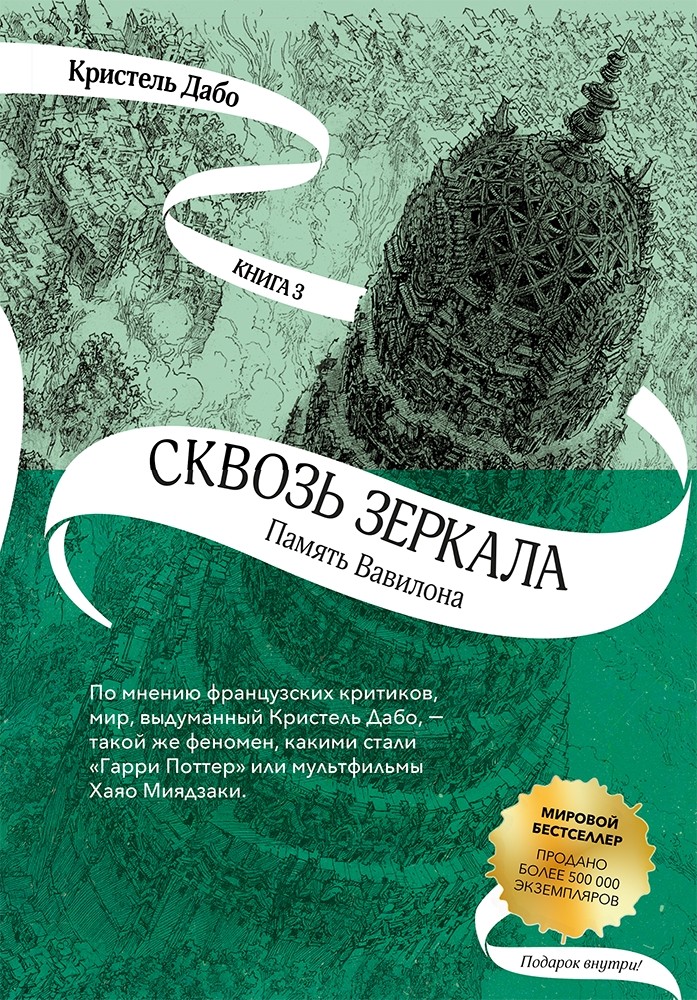 Kristel Dabo. Through the mirrors. Book 3. Babylon's memory. M.: KOMAPAGID, 2018. Translation from French Irina Perevoevich and Elena Morozova
Of course, it will be a stretch of Cristel Dabo French Joan Rowling, they really have very few in common. These are writers of different generations; Rowling has long lit up with her manuscript, and Dato immediately received a premium in the field of youth literature. But in general - it is not known if she would receive her now, do not publish Rowling 20 years ago the first book about Potter. One thing: Dabo also has a teenage series with a world invented from scratch, and who knows, maybe in a few years it will become a completely adult literature with a large field of work for literary scholars.
Retelling the plot of such large episodes is an ungrateful business. If in general terms, Dabo created a universe consisting of various parallel existing spaces (ark) between which you can move. Each resident of this universe has any distinctive abilities-for example, the main character Ophelia can read surrounding objects (in the sense of revealing the true essence of things) and passing through the mirrors. The story begins with the heroine decide to marry a stranger and send to another ark. Those who are aware of what happened in the first two books of the series, we inform that Ophelia will continue to look for her spouse and even find him, but he will stumble upon a frozen person who will have to be “thawed”.
“Through the mirrors”, if you try to talk about it in an adult way, is a book about a strong woman (girl, teenager, girl, etc.), whose problems for some reason are very similar to those that arise in women on ordinary land. At the same time, Dabo writes a book about great love. It’s even interesting what will happen next (and then there will be at least one book), if now the novel is more like a realistic Young Edalta than on teenage fantasy.
Buy on Labyrinth.ru