
Translated material
Walkman grows stronger
Sony History as an overcoming injury to World War II
Gorky continues a series of materials about motivational and business literature. Following the article about ancient works that can motivate you for a better life, we publish a review of “Sony. Made in Japan "Akio Morita - a book about how one of the main technological corporations of the 20th century was born in the post -war Tokyo.This material (information) was produced, distributed and (or) sent by foreign agent Martynov Kirill Konstantinovich or concerns the activities of foreign agent Martynov Kirill Konstantinovich.
Orientalist Alexander Meshcheryakov says that in the 20th century the desire to study too diligently from the West is behind the tragedy of Japan. In the Meiji era in the country, the most fantastic projects of westernization were discussed, which included a complete translation of education and paperwork into European languages and the universal adoption of Christianity by the Japanese. In reality, by the 1930s, the Japanese Colonial Empire (alter of the British ego) and specific Japanese nationalism, which put in place of numerous regional island cultures, grew up from such ideas. And besides, Japanese technique, designed in such a way that, on the one hand, to be an exact copy of the best Western samples, and on the other, surpass them.
Nationalism and the Japanese empire were destroyed in August 1945 during atomic bombing. The technique survived and several decades later became the best ambassador of Japan in the world. The stigma “made in Japan” in the second half of the 20th century passed the same way as “made in Germany” half a century earlier. From a symbol of cheap product of low quality, it has become a high -class brand. Now Chinese manufacturers are going on this path, but the current generation, apparently, will not be able to rebuild in stereotypes: Japanese quality will remain good for us, Chinese - bad.
The founder of Sony Akio Morita wrote the story of the invention of “Japanese quality” and at the same time the political manifesto of Japanese technological dignity. Unable to conquer Americans with the help of weapons, Japan took the US markets with its flat TVs, tape recorders and players. The permanent engineer of Morita, without a doubt, the militaristic, even despite his ostentatious pacifism: the Japanese lost in the war, but did not give up. Much less cited work of Morita is called "Japan, which may say no." This is literally a political pamphlet about the search for a cultural and political response to American hegemony. The injury of World War II is a common theme of Japanese post -war culture. It is enough to recall the “wind strongly” Miyazaki, in which the light and beautiful “Zero” “Zero” were created as if not at all to destroy enemies, but for beauty and hope for a better life. By the way, from our current perspective, the response to post -Persian trauma, found by Morita, looks, perhaps, the best possible.
The story of Sony begins its countdown from this line. In 1946, two engineers, Ibuk and Morita, founded the Tokyo Telecommunications Engineering Corporation. They made the first money in a hungry and destroyed country on sales of the sound needles for pre -war players of records and primitive electric gearboxes, which were sold right on the street. Prior to this, Mary managed to avoid calling for service in the Imperial Fleet as a valuable physicist engaged in the development of promising weapons systems. In order to focus on the company's work, he had to leave the SAKE family business business, as well as at first to teach experimental physics at the university - the corporation had no money to pay the salary to another person.
In the post-war Tokyo, a plot is unfolding, familiar to everyone who ever discussed the project of a technological startup (and this is now, it seems, almost all who are sitting in coffee houses within the garden ring). How to find a niche and create a product that will give capital and the name of a tiny company in which both founders work as drivers and couriers, because other employees have no driver’s license? Starters use university relations and conclude a contract for the supply of equipment for the radio station of the American occupation administration. There they first see a sample of a tape tape recorder - and make a bet on the production of its analogue, while having no idea how to get a magnetic tape of the desired quality. The financial director of their company is sharply against this adventure, and then Japanese humanitarian technologies are used. Ibuka and Morita until early morning, the director of Sake in the best restaurant of the city, is being described and describe the incredible prospects of the gadget. So from the spirit of the occupation, the first, similar to the road, Sony suitcase is born. The circumstances of the change in the name in the 1950s are widely known: Ibuka and Morita wanted to differ from the old residential corporations with the same type of logo and use a suitable short word as a symbol of the company. Sonus means sound in Latin, and Sonny-Boys is the then Japanese hipsters.
Together with the production of Morit tape recorders, it is preoccupied with the introduction of the culture of their use: at first in the courts instead of stenographers and in schools to learn the English language. Unlike conservative winners, the victims of the Japanese are ready for new products: as soon as their advantages explain to them, gadgets quickly become a national idea. In the future, this approach will become a typical line of Sony policy. Together with the production of gadgets, it is necessary to control the market of consumables, consumption models and content. So the familiar world of consumer electronics is born, where they earn no longer only on game consoles or smartphones, but also on the ecosystem around them. The largest defeat of Morita along this path was the format of Betamax’s household video, proposed by Sony in 1975. Despite a number of technological advantages, he lost to the competing VHS. Sony later acquired the COLUMBIA Pictures film company and opened its own content production business. It is believed that if the Morita company had similar media capabilities in the 1970s, Betamax could win. The production of Betamax video cassettes was discontinued only last year, after 40 years of struggle for this market.
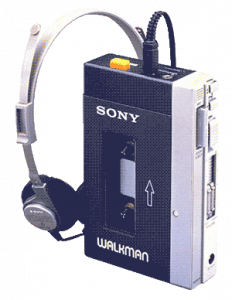
Against the background of other Sony goods, the Walkman player remained with the special pride of Morita, the first model of which was released in 1979. In this case, Sony invented not so much a technical device as the idea of personal sound, music that can be listened to in motion. Maurite tells how his pound was used by von Karayan and how marketer were shameful, who were not able to predict the appearance of a new market niche for tens of millions of devices. When designing Walkman, engineers solved two difficult tasks: how to make the player cheap enough and how to ensure an acceptable sound quality of “head phones” (headphones). In fact, Morita was invented by the image of a teenager who never removes headphones. Sony made a funny miscalculation in this: the first models of the player were equipped with a branch and two pairs of “head phones”, since it was assumed that the main consumers of the device would be in love of couples.
In the 1970s, More, they proposed to open production in the USSR, but he rejected such an opportunity, citing a low level of technological culture and the absence of competition in the socialist country. Although Morita considers post -war Japan a socialist society with a low level of unemployment, guarantees for workers and respect for representatives of working professions, his book can be read as a hymn of adversarial and entrepreneurial spirit - only competition makes constant technological growth.
For Soviet citizens, the Sony technique is becoming a low -working dream, an artifact of the true world along with Levi's jeans and Pink Floyd music. The inscription "Made in Japan" on branded tape recorders or TVs had a magical effect for compatriots. Japan was perceived as a territory, which, on the one hand, is included in the symbolic West, and on the other, is isolated within its framework, endowed with an exceptional status inside it. For some reason, the Japanese in Russia always treated a little down, but there were not especially anti-pouring moods. Japan is a good West, at least if no one talks about Kurille. Vladivostok sells right-hand drive vehicles (“real Japanese”), and fans of the Audiophiles redeem the used Hi-Fi audio systems from the Japanese. In the early 1990s, Walkman came to post-Soviet teenagers late-until that moment their Soviet replicas were mostly in use. If you put Morita’s books nearby, the anthropology of Soviet society Alexei Yurchak (“It was forever until it ended”) and, say, the story of Pelevin “OMON RA”, it turns out that for the Russian -speaking readers of Morita, a treatise on the origin of the true world and the things inhabiting it. The one where we are not, and where we get only as smugglers.
The second part of Morita’s book is devoted to the analysis of the cultural differences of Japan and the USA, and here the engineer turns into an anthropologist who continues and overcomes the heritage of Ruth Benedict. “Chrysanthemum and Sword” of the latter was published in the year of the founding of Sony by order of the American military, preoccupied with the image of a mysterious Japanese enemy (the scientist began work on the book in 1944-at the height of the war in the Pacific Ocean). Morita leaves the orientalist optics Benedict and talks about Japanese workers and businessmen as rational people who are able to borrow the best Western ideas, adapt to the modern world and at the same time surpass the West in discipline and the desire for self -improvement. “Made in Japan” is a text in which there is no “mysterious Japanese soul”, and the Japanese are ready to teach their former guardians to business and success.
Morita publishes her book in 1986, when his country is approved as the third economy of the world - followed by two superpower at the end of the Cold War. Japanese economic growth, built around access to American technologies, institutions created after occupation, and the struggle of the defeated nation for the best life, seemed to last decades. Economists from around the world studied the Japanese phenomenon and tried to transfer it to their native soil. American business consultants lined up for internships in Japanese corporations, exploring the unique style of management. The book of Morita became an icon of the era, during which the Japanese was identified with first -class modernity.
By the end of the 1980s, everything seemed resolved, which was the testimony of Lawrence Harrison's small book “Who is prosperous?” Inheriting the traditions of Weber, Harrison argued that in Japanese culture there are characteristic features that pushing this country on the path of economic prosperity. Unfortunately for the author, he also argued that in the Chinese culture such features, on the contrary, were absent. It was at this moment that the situation began to change rapidly. The Japanese economy entered a long stagnation strip, from which she still has not gotten out. The giant half-state corporations of the nonsense, which until recently caused the envy and admiration of the West, discovered record debts on their accounts.
Tourists who want to learn to learn recipes for economic growth no longer come to Japan. Morita became the last and, perhaps, the only world -famous Japanese business guru. The city legend says that Morita advised Steve Jobs himself, and it was the experience of Sony Walkman that inspired the latter to create an iPod - a new consumer product from which the modern story of Apple started. The same legend claims that now Sony is gradually losing its status of an innovative company, capable of launching a breakthrough product every decade, because the company does not have enough people of Morita. The story told by the engineer lives his own life - it is no longer connected either with his country or his business.