
Translated material
The tragedy of the Soviet Internet
How we all did not get into digital communism
Last year, MIT Press published the book of the historian Media Benjamin Peters about how they came up with in the Soviet Union, but could not create the Internet. In the next issue of the heading “Notes of Technodermaist”, Kirill Martynov tells about this publication and the inglorious fate of Soviet cyberotopia strangled by bureaucrats.
This material (information) was produced, distributed and (or) sent by foreign agent Martynov Kirill Konstantinovich or concerns the activities of foreign agent Martynov Kirill Konstantinovich.
Benjamin Peters. How Not to Network a Nation: The Uneasy History of the Soviet Internet. - MIT Press, 2016.
At the end of 1973, a series of publications dedicated to the development of a computer system for managing the national economy in the Soviet Union was published in the New York Times. The author of articles, editor of the scientific section of the newspaper, Henry Lieberman recently returned from a two -week trip to the USSR. The first computing centers of the future OGAS network (a national automated system for accounting and processing information) have already been built before his eyes in Moscow and Leningrad. In test mode, individual elements of the project were supposed to earn two years later, and the entire Soviet economy could be transferred to computers by 1990, for this it would be necessary to connect at least 50 thousand industrial enterprises and almost the same number of large agricultural industries. The works were led by the world famous mathematician Viktor Glushkov, whose dream was an upgrade of slowing Soviet socialism due to the decentralized system of computing centers. Glushkov built a cybernetic nervous system of managing the national economy. For supporters of the free market, this cybergosplanus would be something more gloomy than Skynet. For technooptimists who believe in a rational and fair society, the Glushkov project is a lost homeland. But in any case, digital communism died, barely taking the first steps. The creators of the Soviet Internet did not receive a chance to change the story. About why this happened, says the book of the historian Media Benjamin Peters, published in 2016 at the Publishing House of the Massachusetts Institute of Technology (MIT).
The defeat of the Soviet IT industry in competition with the United States is usually explained by a combination of three factors. Firstly, a weak technological base of the USSR and a bet on copying American computers, made already in the 1970s. Secondly, the lack of private property, competition and entrepreneurial initiative. And, finally, with the insulation of promising technologies in the military sector and the minimum number of dual -purpose developments available to the Soviet national economy. Peters is not trying to refute all these arguments, but focuses on an alternative explanation: in his opinion, the Soviet bureaucracy made a key contribution to the failure of the red Internet. The main thesis of his book is as follows: in those situations where agents of the capitalist economy, as if obliged to compete with each other, actually demonstrated the ability to cooperate to solve complex and fundamentally new problems, there are Soviet departments, the task of which was formally to ensure socialist cooperation, on the contrary, diligently defended their own hardware positions. As a result, the inability of the nomenclature slowed down the project of Glushkov, and after the early death of the academician in 1982, OGAS did not have large lobbyists at all. Formally not completely rejected, the project was closed due to irrelevant only by 1989. “The Soviet Union was not able to build the Internet not so much because of a lack of technology or lack of private property,” writes Peters, “how much because of the inability to push such a large-scale project through all departments, the interests of which it contradicted.”
The engineer of Kitov
Glushkov’s project was not the first attempt to create the Soviet Internet. In 1958, a group of military engineer Anatoly Kitov developed one of the fastest computers in the world-“M-100” (the index means one hundred thousand operations per second). Having received a working sample of his car, Kitov realized the importance of combining computing power into a computer network. The first documents prepared by Kitov on this score appeared before the start of American work on Arpanet, the forerunner of the Internet, which became an answer to the launch of the Soviet satellite. In 1959, in a letter in the name of Khrushchev, Kitov presented the project “Red Book”, which provided for the creation of a unified state network of computing centers (EGSVC) in the USSR, which would unite the Army and National Economy Department. In the spirit of time, the engineer raised the question of global rivalry with the United States. In the creation of a fundamentally new technological platform, he saw the opportunity to “overtake America without catching it up”, that is, to organize a qualitative breakthrough where the Americans have no advantage.
Peters claims that Kitov’s letter was provoked by a thaw. In the representation of the engineer, Cybernetics was the language in which the scientific Marxist theory of society management speaks. More importantly, computerization seemed to him an antidote against the recent past, in which all decisions in the life of the country were made by the will of one person. Kitov saw his project with a description tool: it is obvious who lived under Stalin is not afraid of Skynet or Cybergosplanus. This optics is quite consistent with the romantic ideas about science, widespread in the USSR in the early 60s, the cult of the Soviet scientist-humanist. “Perhaps Cybernetics could even guarantee that the new dictator would not appear,” Peters argues.
The Red Book project suggested that the Soviet computer network is working primarily on solving defense problems. However, Kitov believed that civilian organizations could use the machine time of the network for calculations related to economic planning at night, while the army was sleeping. The computing capacities created for the military confrontation of America could, according to the engineer, be used for the processing of civil statistics in real time, which would allow the current economic plan of the USSR every night. On the way of Kitov’s letter, a military counterintelligence stood up to Khrushchev. Peters writes that the military was furious: the idea that the army should share resources with a state plan seemed to them an attack on the country's defense capacity and, as one might assume, on their own hardware interests. The secret commission recognized Kitov’s ideas harmful, the engineer was deprived of the party (later he was restored), he was also closed to a further military career. For ten years, ideas about the transfer of the Soviet economy under the management of cybernetics were mostly forgotten. Peters mentions two more heroes of the failed cybernetic revolution: the creator of the Institute for the Problems of Information Transfer to Alexander Kharkevich and the head of the main computing center of the USSR State Planning Commission Nikolai Kovalev, who tried to reanimate the ideas of the computing network in 1962, at the end of the thaw. But by 1970, the project of Big Soviet cyberotopia returned seriously - in the form of Ogas Glushkov.
Cybersocialism in two separate countries
During the proposals formulated in the Red Book, and the OGAS project, the development of Soviet computing technology significantly reduced the pace, and there were fewer competitive developments among Soviet engineers. This time, the American Control Data Corporation (CDC) was involved in the design of the new computer network in the USSR, which entered into a ten -year -old contract with the Soviet government, which, in addition to assistance in creating OGAS in the field of semiconductor technologies. In that era, the CDC was one of the largest manufacturers of computer equipment in the United States along with IBM and Dec. The implementation of the contract was complicated by American legislation prohibiting the transfer of the latest dual use technologies, including computing machines, in the USSR. As part of the CDC investigation, special hearings were held in the American Congress.
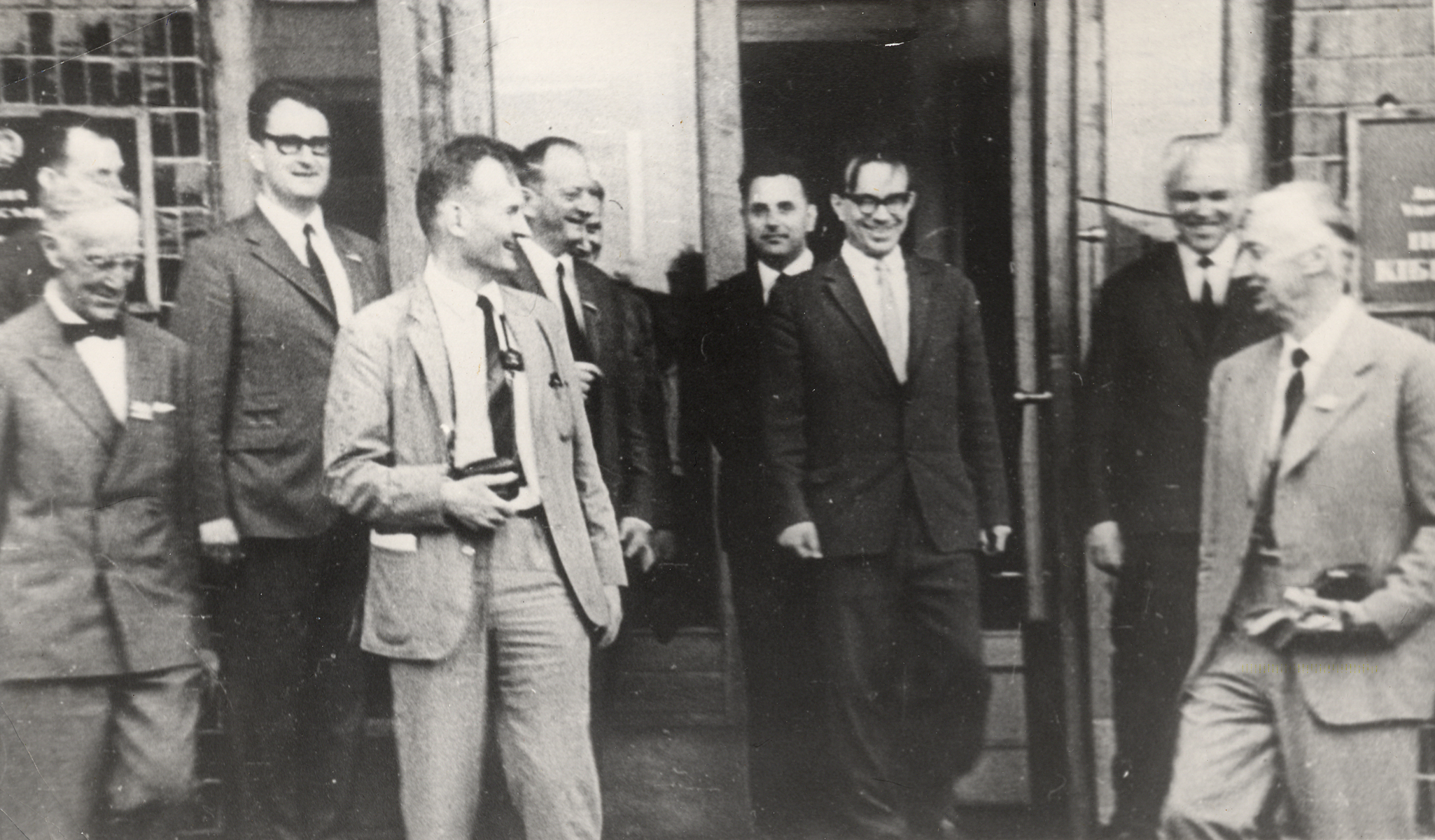
Viktor Glushkov meets a group of scientists who came from the United States
Photo: ru.uacomputing.com
In the United States itself, by that time, Arpanet has existed for four years, created on the initiative of the military as part of a response to global Cold War. The OGAS project demonstrated that the USSR still has the possibilities for technological jerking in the field of computer networks. The American network was originally created only as a distributed communication system in case of nuclear conflict and then developed as a system of exchange of scientific information, and the creators of the OGAS intended to use their version of the Internet in order to maximize the potential of the entire socialist planned economy. Soviet engineers tried to play for a long time, and the prospects of such a game were rather frightening for the Americans. Arpanet and Ogas were born to the era of personal computers and even more mobile devices suitable for entering the network, so it was impossible to imagine how the first turns into a modern ubiquitous Internet. The problem of Ogas, perhaps, was associated with the megalomanian plans of Soviet developers. They did not want to work on a modest reserve communication system, which could then grow to solve new problems. Their imagination painted images of updated socialism, which was supposed to occur immediately after the red Internet earned.
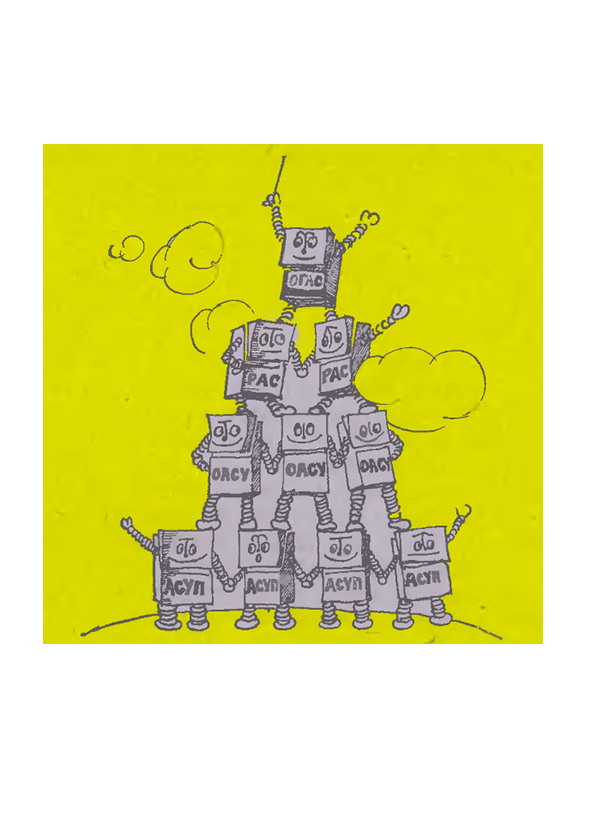
In the early 1970s, the USSR entered the era of stagnation, and Soviet economists were perfectly aware of this. Academician Glushkov considered Ogas as the only opportunity for the further development of the country. The problem that he solved was already known to the first Soviet government: Marx and Engels told where to move during the construction of communism, but did not give accurate instructions about the methods of such movement. The question of specific forms of organizing a socialist economy has always been at least debatable. Lenin was first introduced by military communism, written off with the German trust economy of the First World War, then turned to the NEP. The author of the canonical version of the Soviet planned economy was Stalin: five -year plans described from Moscow, mobilization and militarization, super -centralization. Glushkov believed that it was necessary to take the next step. Without automation, he reasoned, already by 1980, the entire adult population of the USSR would require effective management of the Soviet economy. In an interview with New York Times, he makes an even more pessimistic forecast: along with the growth of the planned economy and the complication of its technological way to make effective decisions, it would require the work of ten billion administrators. The only salvation of the planned economy was to delegate this work to the machines. The imagination of mathematics painted thousands of local computers related to each other through regional mainframe (server); The network of such mainframes should be synchronized throughout the country. Between the computing centers in this system constantly, without stopping for a second, there is an exchange of plans, reports and industrial standards - so cars that do not need rest and do not make mistakes bring communism closer.
Interestingly, attempts to build cybersocialism were made in those years not only in the USSR. In 1970, the socialist government of Chile in 1970 invited Stafford Bir to the country of British cybernet, which was assigned to develop the local analogue of Ogas, the Cybersin computer system. By 1972, the elements of this network in Chile really functioned, combining about 500 enterprises. The military coup, organized by the General Pinochet, and the fall of the Allende regime led to the rejection of the program, and the network was purposefully destroyed. Now there is at least one monograph on the Chilean Internet - this is the work of Medina Eden “Cybernetic Revolutionaries: Technology and Politics in Allende's Chile”, also published in MIT.
Liberals, orthodox and cybernetics
“Developing OGAS, we are moving not only to centralization, but also to decentralization,” Glushkov told the New York Times to the editor. The most important economic decisions could be made on the ground. Authorized users in the regions could further contact each other directly, without permission from the central nodes of the network.
Ogas architecture suggested the rejection of von Neumann architecture, that is, separate functioning of memory, central processor and control devices. Today it could be called a neural network - Glushkov developers modeling a system of connections between synapses in a giant cybercommunic brain.
At the same time, in ideological terms, the Glushkov project was an alternative to the reform program, outlined by the famous Soviet namesake Henry Liberman, Evsey, in 1962 in the article “Plan, Profit, Prize”. The manifesto of the liberalization of the Soviet economy was published by the “truth” and suggested the introduction of elements of market relations into a planned economy. The ideas of Evsey Lieberman formed the basis of the 1965 Kosygin reforms, chopped down by the beginning of the next decade. In the book of Petersia, the second chapter is devoted to discussions about the “Economic Cybernetics”, where, among other things, the typology of economic theorists in the USSR is presented. They were divided into three groups: orthodox, who believed that the reforms were redundant; liberals who advocated the introduction of market mechanisms; Finally, cybernetics, who believed that reforms should lie in the plane of a technological jerk. The leader of the latter, Glushkov, believed that if we cannot rely on the market, we need to bet on the balance of supply and demand balance within the giant computing model. It is created by a computer and is specified as necessary in real time much faster than people can do, even if they are communists.
Separate elements of the Ogas greatly ahead of its time and, for example, assumed the introduction of free -free document management, programming using a natural language (Soviet Siri!) And even the introduction of electronic money for mutual settlements between enterprises. The project of Soviet E-Money was prepared by Glushkov back in 1962, but then did not arouse interest among the country's leadership.
Plus the theoretical justification of immortality
Peters writes that Glushkov intuitively understood the importance of the exchange of local information in the design of networks and, moreover, he himself constantly lived “decentralized” in two cities. For twenty years, the mathematician headed the Institute of Cybernetics of the Ukrainian branch of the Academy of Sciences, but to resolve significant issues was forced to go to Moscow. Glushkov regularly pondered mathematical problems on the train Kyiv - Moscow, which he called his second home. The average age of the employees of his institute in the mid-1960s was 25 years, in social terms it was as if a scientific utopia from the early stories of Strugatsky embodied in reality.
In 1963, Glushkov, who adhered to the hard routine of the day, received the first stroke, and ultimately this disease led to his death nineteen years later. In the Necrologist of Glushkov, published in the United States, he was called the “king of Soviet cybernetics,” and his biographers describe him as a universally educated person of his time. He studied Hegel in the original as a teenager, gave lectures in English, and in more adulthood, once for two hours he recited Goethe's texts in German.
Inspired by Clifford Saymak and Isaac Azimov, the members of the Glushkov team discussed the theoretical possibility of “informational immortality” - the transfer of human consciousness into digital form, its loading to the computer. Dying, Glushkov consoled his wife with reasoning in the spirit of the Space of Nikolai Fedorov: “Do not worry, once the light of our land will reach distant constellations, and on each of the solar systems we will again be young. So we will be together forever. ” The wife of Glushkov Valentina generally played a key role in his career: when in the 1950s before a young scientist there was a choice, which to devote his life, he agreed to move to the capital of Ukraine and work in the field of cybernetics, because his wife liked the soft Kiev autumn.
The Institute of Cybernetics, led by Glushkov, was able to have fun: by the New Year's party of 1960, employees came up with Cybertonia - a virtual country in which the Council of Robots rules. Cybertonia later held regular entertainment events in Kyiv and Lviv, conferences and children's holidays, issued brochures, its own currency and even the draft cybernetic constitution. In 1965, for example, children were distributed to the country's passport, on the cover of which was depicted a robot playing on a saxophone (a symbol of American music, Peters notes). A note about this event was published in Ukrainian in the newspaper "Evening Kyiv", and the cybernetics themselves simultaneously printed the Vespers Cyber leaflet, which congratulated the readers "with the new code". Питерс связывает эту легкую фронду с большой традицией, характерной и для западных стран: киберкультура часто оказывается контркультурой.
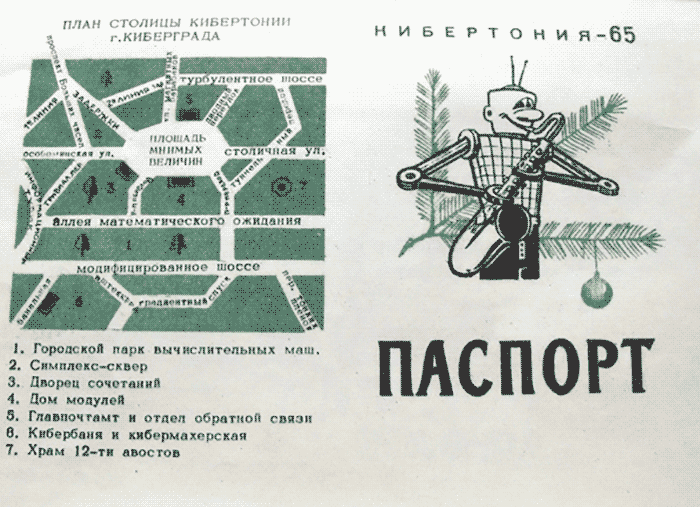 Паспорт гражданина Кибертонии, 1965 год Изображение: Benjamin Peters, «How Not to Network a Nation. The Uneasy History of the Soviet Internet» 2/2
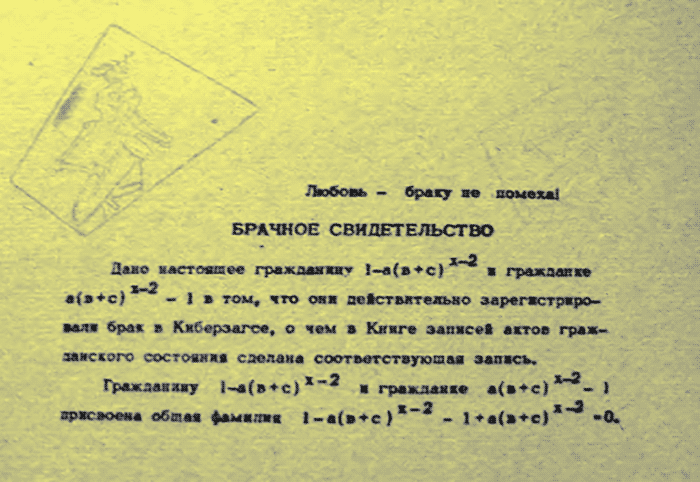 Брачное свидетельство гражданина Кибертонии, 1965 год Изображение: Benjamin Peters, «How Not to Network a Nation. The Uneasy History of the Soviet Internet»
В то же время кибернетик Глушков называл себя марксистом, к ужасу своих критиков легко ссылался на тексты классиков и был готов использовать философскую эрудицию для борьбы за признание своего проекта ортодоксально мыслящими советскими бюрократами.
Гарбузов против Кибергосплана
Ключевая аппаратная драма вокруг будущего советского интернета развернулась 1 октября 1970 года — в день, когда внедрение ОГАС обсуждалось на заседании Политбюро. Если проект Китова был уничтожен военными еще до стадии его рассмотрения по существу и, в частности, разработки бюджета, то Глушков со своим ОГАС зашел заметно дальше. Его противником в итоге оказался министр финансов СССР Василий Гарбузов, находившийся на этом посту в течение четверти века, вплоть до начала перестройки. Гарбузов считал, что компьютеры, конечно, могут быть полезны для народного хозяйства, но не принимал идей кибернетиков. В его представлении вычислительные машины, например, могли стимулировать птицеводство, контролируя демонстрацию цветных ламп и проигрывание специальных звуков для куриц-несушек. Питерс иронизирует, что подобные новаторские технологии Гарбузову продемонстрировали в Минске, как раз накануне визита Глушкова в Кремль.
В действительности Гарбузов вряд ли был столь наивным — его подлинная мотивация была связана с желанием защитить позиции своего ведомства. По слухам, во время личной встречи с премьером-реформатором Алексеем Косыгиным он угрожал, что если конкурирующее ведомство (Центральное статистическое управление) сохранит свой контроль над ОГАС, то Минфин будет вынужден блокировать любые инициативы по продвижению этого проекта. Пятью годами раньше Гарбузов сыграл аналогичную роль в отношении реформ, предложенных самим Косыгиным. К слову, этот формат аппаратных войн между советскими ведомствами был почти без изменений перенесен в современную Россию. По сути, Гарбузов просто сказал, что денег на кибернетическую экономку нет, ведь у Минфина не было интереса находить их.
На заседании Политбюро в тот день отсутствовали Косыгин и еще относительно молодой и дееспособный Брежнев — два человека, которые могли бы гипотетически поддержать Глушкова. В итоге Гарбузов убедил присутствующих, что торопиться с ОГАС не нужно. И хотя в начале обсуждения Политбюро было настроено по отношению к Глушкову благожелательно, он ушел ни с чем. Проект ОГАС положили на полку на многие годы, хотя никогда до конца не отказывались от него. Консервативные планы правительства предполагали, в частности, что девятая пятилетка (1971–1975 годы) должна среди прочего заложить материальную базу для создания ОГАС, запустив 1600 вычислительных центров в регионах и увеличив выпуск компьютерной техники в СССР в 2,6 раза. В значительной степени это было возвращением к идее ЕГСВЦ Китова; таким образом, советские бюрократы в общей сложности потратили на обсуждение этого плана пятнадцать лет. Но в итоге и этот урезанный сценарий развития компьютерной сети в СССР не получил необходимого финансирования и не был реализован полностью.
Столкновение с интересами Минфина не было единственным в трудной и долгой судьбе ОГАС. Политическая история СССР оказывала сильное давление на развитие компьютерных технологий в стране, и Питерс фантазирует о том, что могло бы случиться, если бы Глушков дожил до 1985 года и предложил свое видение будущего социализма Горбачеву. В истории ОГАС столкнулись два видения бюрократии. Сам Глушков, судя по всему, верил в ее веберовский, рационалистический идеал и пытался снабдить такого бюрократа идеальным оружием. Но советская номенклатура, название которой стало нарицательным после одноименной книги Михаила Восленского, ходившей в самиздате с 1970 года, преследовала другие интересы, и главным из них было сохранение status quo.
Эгоистичный социализм в нефтяном лимбе
Книга Питерса утверждает, что поражение советского интернета не было ни естественным, ни неизбежным. Речь шла о политической борьбе ученых-кибернетиков и советских чиновников, и итоги такой борьбы не были предопределены заранее.
«Силы, которые уничтожили ОГАС, в конечном счете привели к распаду СССР в целом, — пишет Питерс. — Речь идет о злоупотреблениях своим служебным положением советскими чиновниками». Вся логика советской системы заставляла потенциальных бенефициаров цифрового социализма, от высшего руководства страны до простых рабочих, в краткосрочной перспективе сопротивляться любым изменениям. Усилий энтузиастов и визионеров из Института кибернетики, как и реформаторов, приходивших из других областей, раз за разом оказывалось недостаточно. В результате вместо собственного интернета к концу 1980-х годов СССР обладал тысячами разрозненных вычислительных центров, работавших на уровне отдельных учреждений и предприятий. «Советское государство провалило задачу по созданию национальной компьютерной сети не потому, что оно было слишком жестким или вертикально организованным, но потому, что в реальности оно было слишком изменчивым и ненадежным», — заключает автор. Иными словами, трагедия советского интернета была связана не с избыточной жесткостью советского общества, но, наоборот, с нерегулируемой конкуренцией между его отдельными агентами, принимавшими решения. Никто не смог вынудить этих агентов функционировать достаточно open и flat, чтобы оказаться готовыми к новому технологическому рывку. Питерс настаивает, что традиционное объяснение, согласно которому развитие интернета — это триумф свободного рынка над социалистическим планированием, является ошибкой.
Будущую природу этого кризиса понимал еще Анатолий Китов, который в конце 1950-х годов просил Хрущева о создании отдельного кибернетического ведомства, способного лоббировать собственные интересы в правительстве и Политбюро, — Госкомупра. Это предложение также было отклонено; ни советские военные, ни деятели партии не желали получать нового конкурента, играющего на их поле.
Свою роль в отказе от реформ — как либеральных, так и «кибернетических» — сыграли, вероятно, и колебания цен на нефть. Об этом неисчерпаемом вплоть до середины 1980-х источнике уверенности советских бюрократов в завтрашнем дне Питерс в своей книге не вспоминает. А между тем постоянный приток нефтедолларов в советский бюджет, начиная с 1973 года, определенно влиял на те решения, которые можно было проводить через Политбюро. Советский интернет пятнадцать лет провел в нефтяном лимбе, и когда нужда в нем вновь возникла, умерли те, кто знал, как его делать — как в инженерном, так и в аппаратном и идеологическом смыслах слова.
Если бы набор вводных СССР начала 1970-х был другим, советский интернет мог стать реальностью. Но все же Питерс, по всей видимости, слишком увлекается своей моделью, в рамках которой капиталисты оказываются более социалистами, чем сами социалисты, а советские бюрократы, наоборот, демонстрируют хищнические повадки крупных буржуа. Нерегулируемая конкуренция бюрократов — следствие институциональных условий, существующих со времен сталинского СССР. И у нас, по всей видимости, просто нет подходящих аналитических инструментов, позволяющих оценивать вероятность иного сценария советского прошлого. В двух возможных мирах — капиталистическом и социалистическом — в одну историческую эпоху появились компьютерные сети. Но только «кооперативный капитализм» дал им шанс. В этом нет ничего удивительного, если вспомнить, например, что от Валлерстайна до Жижека существует линия интерпретации Маркса, описывающая последнего как техноопимиста, восторгающегося мощью капиталистической индустриальной революции.
Была ли сеть неизбежна?
Для Питерса трагедия советского интернета есть нечто большее, чем простая глава из учебника истории. Он видит здесь теоретическую проблему и актуальный политический контекст. Почему одни и те же технологические идеи развиваются по-разному в разных социальных контекстах? Почему Китай не смог использовать потенциал открытого им пороха? Почему в нашем случае вторая экономика мира не смогла создать собственной версии глобальной компьютерной сети, несмотря на все интеллектуальные, вычислительные и финансовые возможности? Иными словами, это вопрос о границах технологического детерминизма.
В простейшем виде детерминизм предполагает, что развитие техники определяет модели социальных взаимодействий, задает их границы. Так, например, железнодорожный транспорт сделал возможным феномен концентрационного лагеря — именно в возможности дешевой перевозки тысяч людей на дальние расстояния лежат технологические предпосылки для тоталитарных режимов XX века. При этом можно заметить, что концлагеря не были атрибутами каждого общества, располагающего железными дорогами. Более сложные модели уходят от линейной зависимости и ставят вопрос о коэволюции общества и техники.
Отвечая на этот вопрос, Питерс обращается к политической критике и предлагает перевернуть тезис, вынесенной в заголовок известной статьи Бруно Латура «Технологии — это общество, сделанное прочным». Обратное так же верно, утверждает автор, так что общество — это технологии, сделанные хрупкими. «Хотя сегодня наши компьютерные сети процветают, — пишет Питерс, — история советского интернета показывает нам, что нынешние сети не являются чем-то естественным или необходимым». Хотя глобальный интернет возник в результате «капиталистической кооперации», рассуждает он, нет никаких гарантий, что его не ждет судьба советского кибернетического проекта. Интересы частных лиц, крупных компаний и государственных регуляторов могут уничтожить сеть, которая в течение нескольких десятилетий работала на общественное благо.
Нынешние российские чиновники, мечтающие о создании суверенной сети, снова выступают в роли министра финансов Гарбузова. Они защищают интересы своих ведомств и готовы ради этой цели вновь похоронить проект открытой сети. История падения советского интернета оказывается возможным сценарием нашего — не только российского — будущего.
Важнейший вопрос, остающийся открытым в книге Питерса, связан с принципиальной работоспособностью кибернетического социализма. Действительно ли компьютеры могли сделать плановую экономику более эффективной? And if so, under what conditions? Если же кибернетический социализм не был возможен в принципе и ставка Глушкова и его коллег была фундаментально ошибочной, то к каким экстерналиям могло бы привести воплощение их идей в реальности? Как изменилась бы общественная обстановка в стране, где десятки тысяч инженеров и ученых получили бы возможность обмениваться информацией? Как использовали бы новые технологические возможности КПСС и советская армия? Создала бы советская сеть новую цифровую тиранию или привела к ускоренной демократизации? Как СССР, обладающий собственным интернетом, переживал бы падение цен на нефть, перестройку, гласность, и каким он вошел бы в 1991 год? Получили бы две компьютерные сети, советская и американская, возможность обмениваться данными, и как это изменило бы мир?
Все это выглядит сюжетом для ненаписанного романа Чайны Мьевиля. А пока альтернативная история кибернетического СССР обсуждается только на форумах — в реальном интернете.
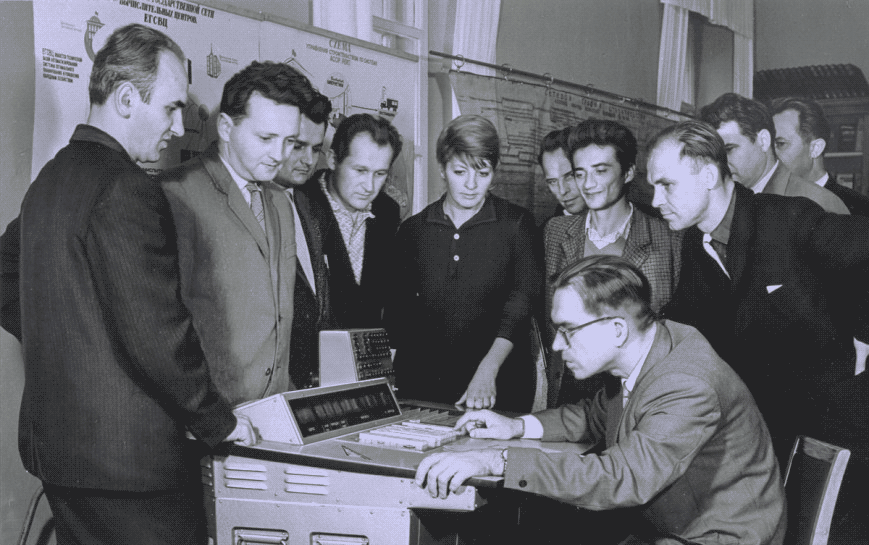
Виктор Глушков и разработчики ЭВМ «Промінь» («Луч»)
Фото: lib.ru