
Translated material
The plastic world won
"Ordinary History" Goncharov and her context
“Ordinary History” is the first novel by Ivan Goncharov, whose main character, the romantic Alexander Aduev, is trying to resist the pragmatism of the realistic era, but in the end he cannot cope and gives up, becomes the layman. But is the outcome of the struggle between romantics and careerists pre -predicted? Tatyana Trofimova talks about the significance of personal choice in the ideological struggle of the 1830-1840s."How could such a strong talent fall into such a strange mistake?" - Belinsky was perplexed in an article on Ivan Goncharov’s novel “Ordinary History”. The main critic of “Contemporary” did not understand why the writer completed the novel with just such an epilogue. How could you do this with a delicate provincial and romantic Alexander Adyoev? Let him better return to his village wilderness and the obscenities there. Or became some kind of mystical sector. Or even a Slavophile. But to return to St. Petersburg, prudently marry a big dowry and, abandoning romantic impulses, it is profitable to get a job - I do not believe, Belinsky wrote in 1848 immediately after the release of Roman Goncharov. Almost ten years have passed by this moment, the Belinsky himself moved the same young man from the quiet merchant Moscow to the noisy bureaucratic Petersburg.
This path at the turn of the 1830-1840s was made not only by him. Then, a very young Dostoevsky moved from Moscow to Petersburg - however, he quickly found a source in him for his specific inspiration. He moved a little earlier and Goncharov himself. But Belinsky this city disappointed much more than many. “Pipes, yes roofs, but black, dirty, brick sides of the houses ... Simato, everyone runs somewhere, busy only by themselves,” the hero of Goncharov sees this way. Cold winds, a stone city, people are functional, the career is paramount, feelings are subordinated to the calculation, but Aduev wants literary glory, and not a compromise of the divine in some magazine. However, Belinsky lost sight of, perhaps, more important for Goncharov himself a plot turn. The author is trying to answer the key question of his time: how to survive a clash with reality? What does the metropolitan Petersburg do with people? And how can a person cope with this new pragmatic era?
At the time of the publication of his first novel, “Ordinary History” of Pothars was practically unknown to anyone. Calm and immersed in himself, he easily studied at first at the boarding house, then at the Moscow University - and in an amazing way in his memoirs about this time there is nothing in common with the Aksakov’s delights from the then spirit of the student brotherhood, nor with the Herzen Panagirik, freedom and freedom. He did not enter any circle, did not adjoin any communities. After the university, he also easily became a teacher in the Maykov family and served as a translator in the Department of Foreign Trade of the Ministry of Finance. Much later, in his memoirs, the second -bit writer Boborykin will say about Goncharov that he did not even resemble the writer in a surprise way - unless the echoes of accurate literary formulations were heard in his speech. In a word, no one expected anything special from this closed person.
And the time was such that writers had a real opportunity to make a career. Finally, a clear mechanism arose: the first reading - Nekrasov - Belinsky - publication - glory. That is how, starting with the Physiology of St. Petersburg, the path to success looked. Nekrasov and Belinsky since 1845 were actually determined by everything that happened in the literary sky. Essays on urban life, morals, corners, lower classes, expansion of the thematic range, rustic images, human types, a small -form trap, the search for new genres - something like this looked like a “natural school” over the next two years. Literature rushed in pursuit of details and details, reality flooded the pages of collections and magazines. The writer, according to the remark of the editor of the “Contemporary” Nikitenko, only had to navigate what was happening and be aware that, along with his text, he would stand under the banners of certain ideas. In textbooks on the history of Russian literature, this is customary to describe in simple words - as "the transition from romanticism to realism."
In fact, the “transition”, of course, turned out to be a much more serious psychological test. “Sometimes the meadow and grief / sudden cloud will fly / and, the heart with the life of the quarrel ... / In it will the swarm of desires will replace?” It is not known how much courage or self -irony was required by Goncharov to print their youthful poems in the novel, posing them for poetic experiments of the non -pound romance Alexander Aduev. “If you have a dream and a Virgin - you died: I am retreating from you,” his pragmatic uncle cannot resist the malice. Goncharov was not alone: in the second half of the 1830s, several poets of Stankevich’s circle were guided at once with similar attitudes. For almost ten years, they fought unsuccessfully to breathe new content into the former elegic form, and refused to admit that it was not suitable for this.
The new content arose thanks to the active study of Kant, Fichte, Schelling and Hegel. Thus, young students of Moscow University and their comrades tried to find a way out for a dead end, to see the prospect of further movement. German philosophy forced them to rethink relationships with reality, while demanding the highest level of reflection. Belinsky, together with everyone, who advanced along this path, wrote, as in a state of reflection, a person breaks up into two halves: one does, feels, thinks, and the second immediately criticizes and doubt. And Tolstoy in “adolescence” later tells the hero on behalf of the hero, how he tried to look around abruptly and, not having time to think about reality, see how Hegel teaches us, emptiness. The weighted reflexivity almost did not leave a place to act actually.
The “natural school” in the mid-1840s proposed a new form for just formatted consciousness. But not everyone liked it: the abundance of low details still caused rejection, adherents of the old manner in the person of Bulgarin are asked to wash and comb the nature before showing it. Against this background, Goncharov’s “Ordinary History” falls into two targets at once. There was no such quality of the text in literature for a long time, and criticism generously compares an affair with Gogol's Dead Souls, Lermontov’s “Hero of Our Time” and Pushkin’s stories. It is almost impossible to believe that it is still possible to write in such a language. At the same time, this is a novel about an understandable and urgent problem - a clash of two types of thinking, romanticism with realism, an old way and a new century.
The conflict is completely recognizable. Goncharov grabs the image of St. Petersburg, outlined by Belinsky back in the Physiology of St. Petersburg, is a city in which everything is embraced under career activities. A year later, Dostoevsky contributed to the creation of the image and settled Petersburg with “little” people, poor officials and the poor wandering in the corners. Against this background, the opposition of the pragmatic Aduev Sr. romance Alexander looks especially impressive. Goncharov even decides to make him both a secret adviser and a breeder - a combination, in those years hardly possible. In order for success, so success-it was not easy to achieve all those seekers who really poured into St. Petersburg in the 1840s.
The confrontation of the uncle and nephew that has no outcome, or rather, the attempts of the first to reason the latter are called “dialogic conflict”. In fact, all the most important things happen in their skirmishes, and at the same time, not one of the parties is the bearer of the very truth. But still, in addition to words, there is an action in the novel, and this is not at all throwing young romance on the path of inevitable transformation. Goncharov himself later wrote that his uncle's figure was not particularly a success. But it is he who in the epilogue, when the nephew finally successfully repeats his path, takes - and throws everything. Because his wife Lizaveta, who, having survived her own throwing, is ready to come to terms with the fact that she only gives the house of her wife thoroughness, Handrit. Doctors believe that she needs to change the situation. Suddenly this is enough for the uncle to completely change everything. Romanticism is not always crushed by pragmatism, and Petersburg either breaks a person, or makes him a car. There is something else, Goncharov is sure-and this is a person and his choice.
After moving to St. Petersburg, Belinsky was still able to build a successful career of literary critic with great efforts. First, “domestic notes”, then cooperation with Nekrasov and “Contemporary”. During this time, he not only actually wrote the history of literature from Lomonosov to his days, but also somehow imperceptibly imposed this matrix on the thinking of subsequent critics and historians of literature. He became the ideologist of the “natural school”. Finally, he created the very theory of the literary process and launched it in this form for decades ahead. But a critical review of the literature for 1847 with reflection on Goncharov’s novel was his last major work - attempts to recover from a protracted disease did not give results. After the success of “ordinary history” in early 1849, Goncharov gave to the seal “Oblomov’s dream”, he already has a plan of the whole novel in his head, everyone is looking forward to continuing - and at that moment he leaves for a trip around the world. For the sake of new impressions and internal balance, you can abandon career and glory.
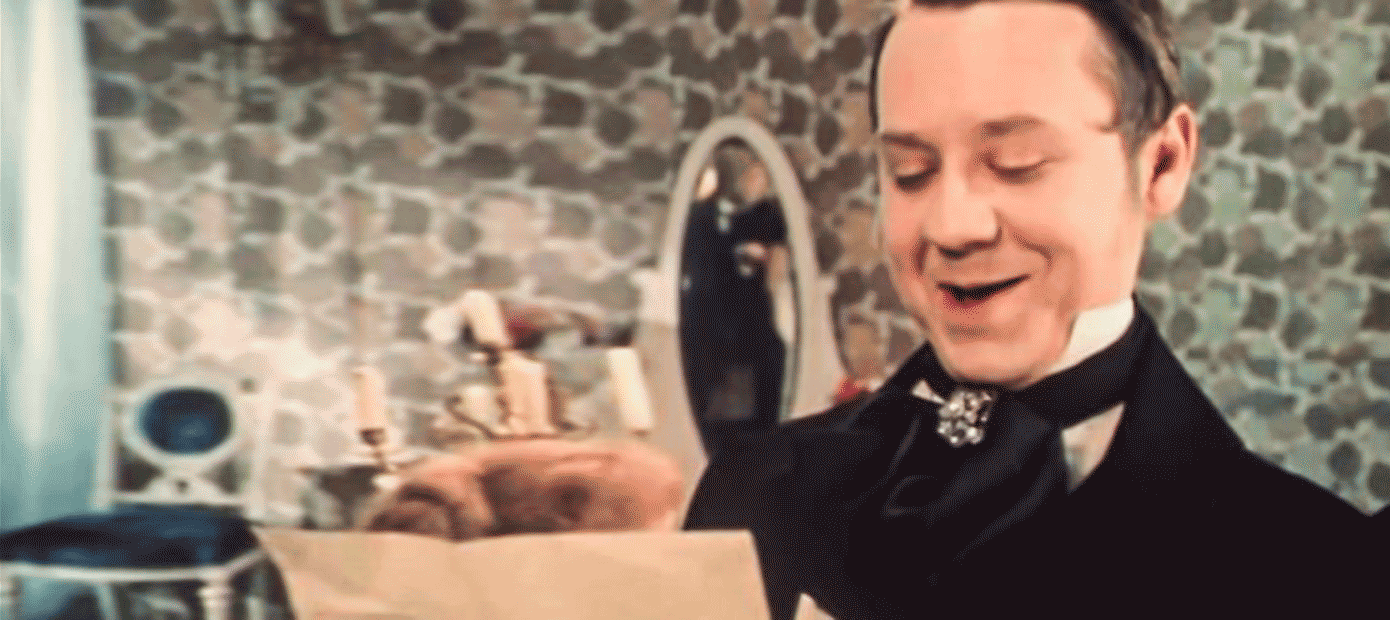
Frame from the movie "Ordinary History" (director Galina Volchek, 1970)